 Way back when, I threw together an app called Green Solvents, which got started anachronistically from a tweet by Sean Ekins (which I misinterpreted, but it got the conversation started, so all is well). Since mid-2011, the app hasn’t had much attention, but that has now changed: it has been rewritten and given a much more modern look. The overhauled version is live on the iTunes AppStore, and is free to anyone with an iThing. Continue reading
iOS
Fullscreen mode in the Green Lab Notebook app
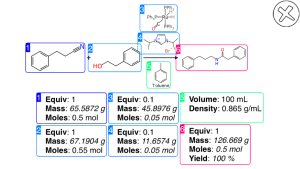 The Green Lab Notebook (GLN) app has a little feature coming up in the next release: a mode for full screen display of an experiment, which consists of the reaction scheme and associated quantities. Continue reading
Visualisation of structure-activity models: fudging it with a widget
 One of the opinions (arguably of the educated variety) that I’ve been pushing for awhile now is the idea that when a model building or visualisation technique requires a user parameter in order to get the correct result, that is essentially an admission of partial failure. If the method really was so great, then it would be able to figure it out, because a parameter is an extra degree of freedom that the method has punted on. Now of course this is not a rule by any stretch of the imagination, and there are numerous exceptions, or grey areas between what’s a parameter and what’s an integral component of the source data. But sometimes a parameter really is just something that a method ought to know, but gives up and passes the burden on to the user – and that’s not necessarily a bad thing, as long as we admit it. Continue reading
Online file sharing with iOS 8: upgrading the Green Lab Notebook app
 Mobile apps for iOS have always been able to share files by a variety of different mechanisms, but many of these were limited in ways that were very detrimental to the user experience. The Green Lab Notebook app is now catching up to the new technology introduced with iOS 8: using the “document picker” interface to import and export files to document providers, which immediately makes it fully interoperable with iCloud, and file sharing services like Dropbox. Continue reading
Structure property calculation in apps: MMDS
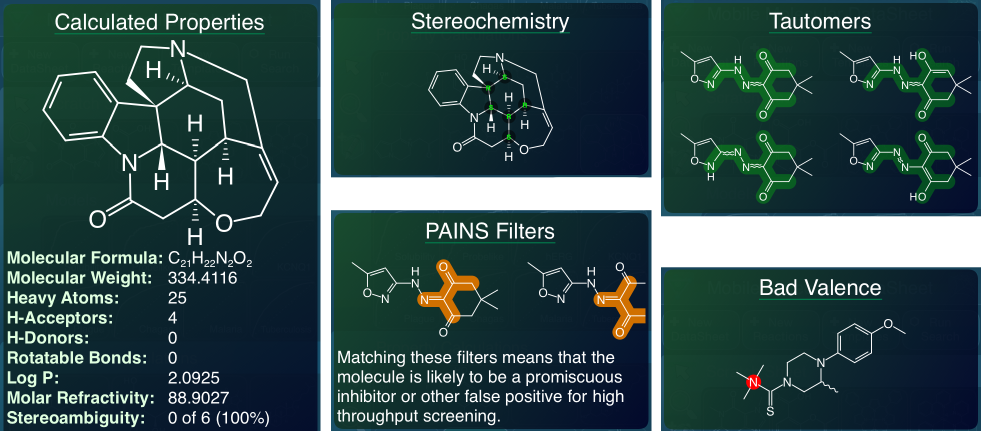 An important milestone in has been reached in the migration of complicated structure-based calculations to pure mobile. The latest version of MMDS (1.5.9) is now available on the AppStore, and allows visualisation of calculated properties for individual molecules, as well as calculating new columns for entire datasheets. Continue reading
Incorporating Bayesian models into the Approved Drugs app
 Some interesting experimental features are on their way to the Approved Drugs app, which has been in the crosshairs for expanded functionality recently. The latest round of improvements involves the ability to collect custom-drawn structures, and apply Bayesian models for predicting the presence of “bad drug” properties, both for molecules overall, and for individual atoms. Continue reading
Mobile sketcher overhaul in progress
 The molecular drawing capabilities introduced with the Mobile Molecular DataSheet (MMDS) app are still unique in the mobile chemistry space insofar as the user interface allows for precise drawing of manuscript-quality diagrams (i.e. perfect bond lengths and angles), on an incredibly tiny screen (the original iPhone form factor), and also very quickly. This sounds like a violation of basic engineering principles (i.e. fast, cheap, good: pick two), but there is of course a down side: the interface is different from the conventional industry standard paradigm, and takes some getting used to. While the capabilities have been regularly improved over more than 4 years since it was first released, a significant overhaul of the “onboarding” experience is long overdue, starting with more targeted adaptation to multiple screen sizes. Continue reading
Impressions of Apple’s Swift, after a bit of practice
Lately I’ve been getting my feet wet learning the latest new programming language from Apple that everyone is talking about: Swift. The short conclusion is that it’s pretty good, but unsurprisingly has quite a collection of glitches: some of them are fixable, some of them are annoying arbitrary choices that I’ll get used to, and others are probably more like design flaws that are unlikely to ever go away. I’m cautiously optimistic that the latter category is fairly short, though still too early to call it. And because Swift is such a new language – hot out of the oven, as it were – I was not inclined to rush in and start coding up anything that’s directly important to my company’s cheminformatics software stack, so instead decided to take a little detour and make a new app from scratch: something fun, that I’ve been meaning to do for ages, called the Beer Lab Notebook, written entirely in Swift, with no non-Apple dependencies. But more about that particular project in a later post. Continue reading
Green Lab Notebook app now available on iTunes
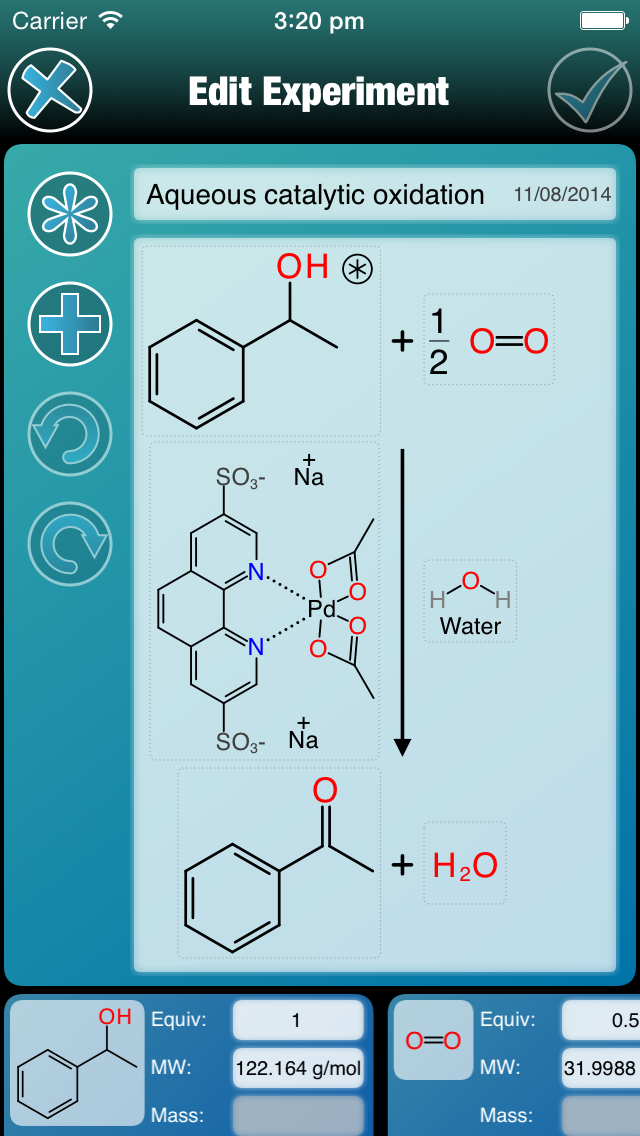 After somewhat more delay than I would have liked, the Green Lab Notebook (GLN) app is now live and available on the iTunes AppStore. The feature set that made its way into version 1.0 was crafted to ensure that editing of multistep reaction experiments and automatic calculation of green chemistry metrics are fully functional, and that importing and exporting features are complete enough to be effective. Continue reading
Presentation about the Green Lab Notebook at ICCE2014 Toronto
 Slides for a talk about the upcoming Green Lab Notebook (GLN) app, which was presented this morning at the International Conference on Chemistry Education (ICCE2014) in Toronto. The short presentation describes how the field of green chemistry can be brought closer to both students and professional chemists with the assistance of an accessible and easy to use mobile app. The presentation was given by Holly Hampson, since I’m currently situated much further away from the event.
 Cheminformatics 2.0