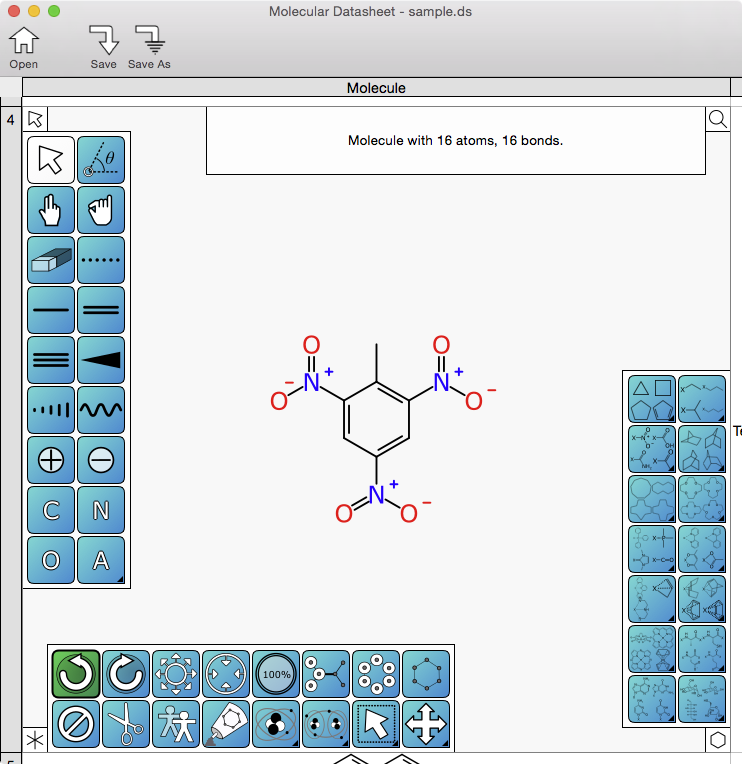
 Since the last sneak preview, the skunkworks project “XMDS” – the Mac OS X desktop version of the Mobile Molecular DataSheet app – has gained enough functionality to make another screenshot, this time showing what the actual molecular drawing interface might look like once it’s done. Continue reading
MMDS
Mobile Bayesian modelling: importing
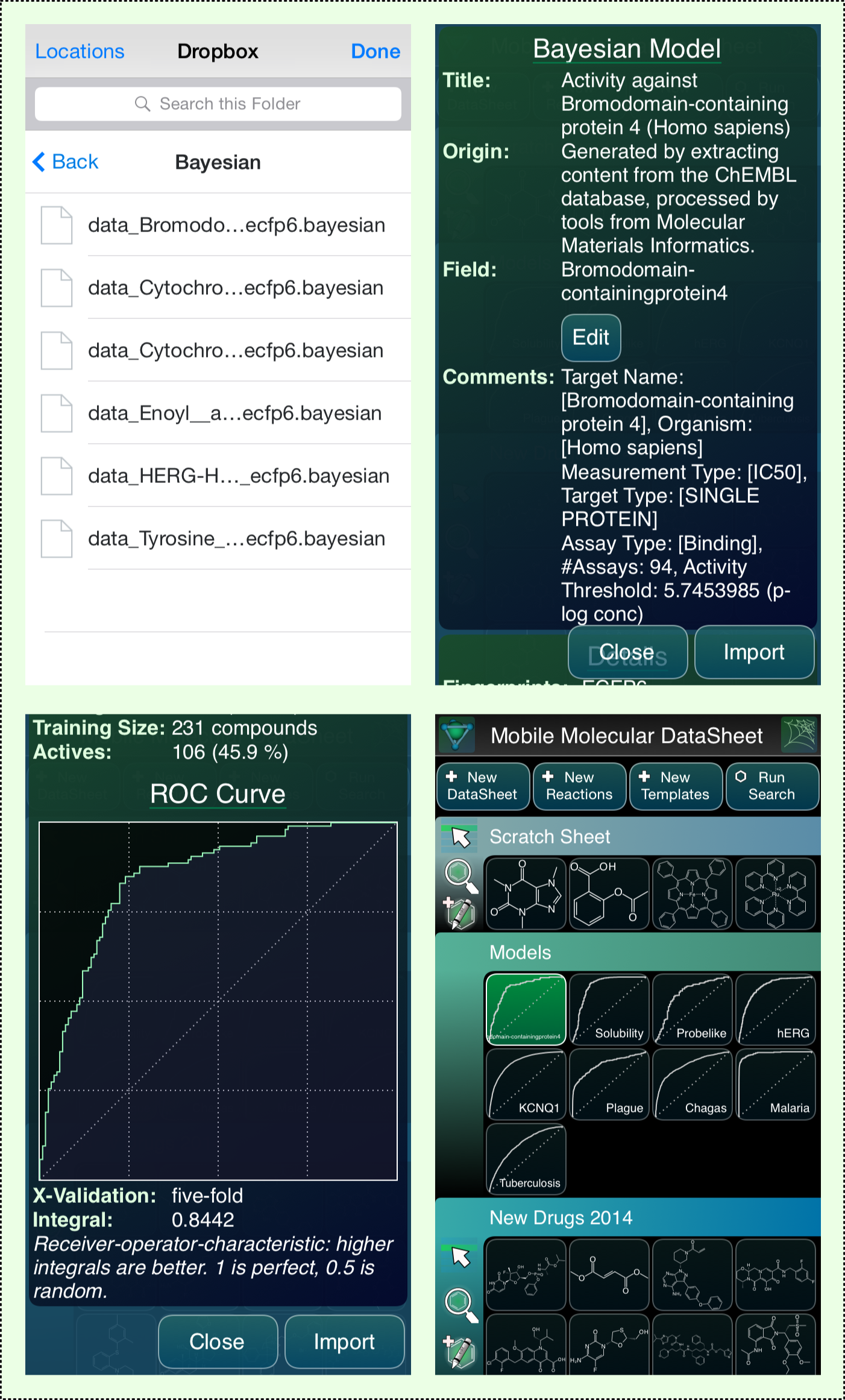 One more key piece is in place for Bayesian modelling with apps: MMDS 1.6.1 just got approved on the AppStore, and brings with it the ability to recognise files with the .bayesian extension (or MIME type chemical/x-bayesian), and import them into the collection of available models that can be used to calculate properties. At the present time the only official way to create such models is to use the bleeding edge build of the Chemical Development Kit and roll your own wrapper code, but we’re working on that!
Recent developments with Bayesian models and app data sharing
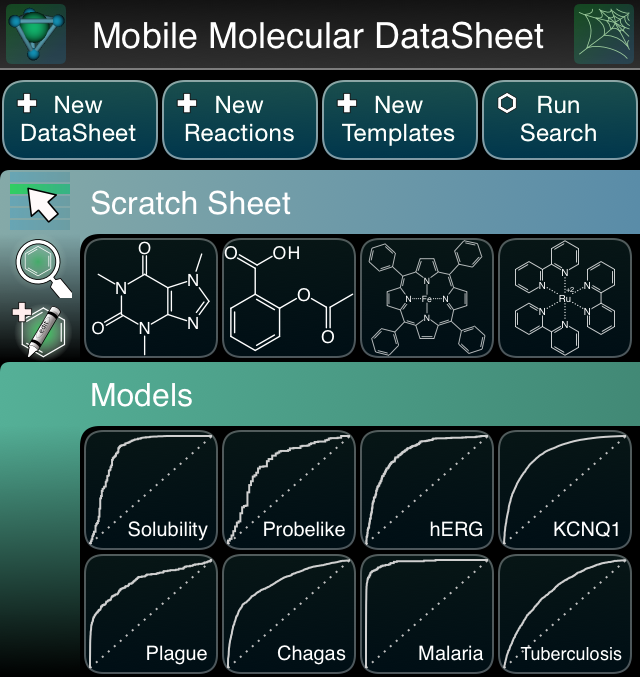 Several of the flagship apps from Molecular Materials Informatics have had major updates recently: the Mobile Molecular DataSheet, SAR Table, MolPrime+, Green Lab Notebook and Approved Drugs. Two separate groups of features have motivated these updates: (1) the inclusion of in-app calculation of nontrivial properties, lately supplemented by the inclusion of Bayesian models, and (2) leveraging the new iOS 8 API feature for importing & exporting data to any compatible service, which includes iCloud by default, but also Dropbox if it is installed. Continue reading
Dabbling with the desktop: molecular datasheet app on the mac
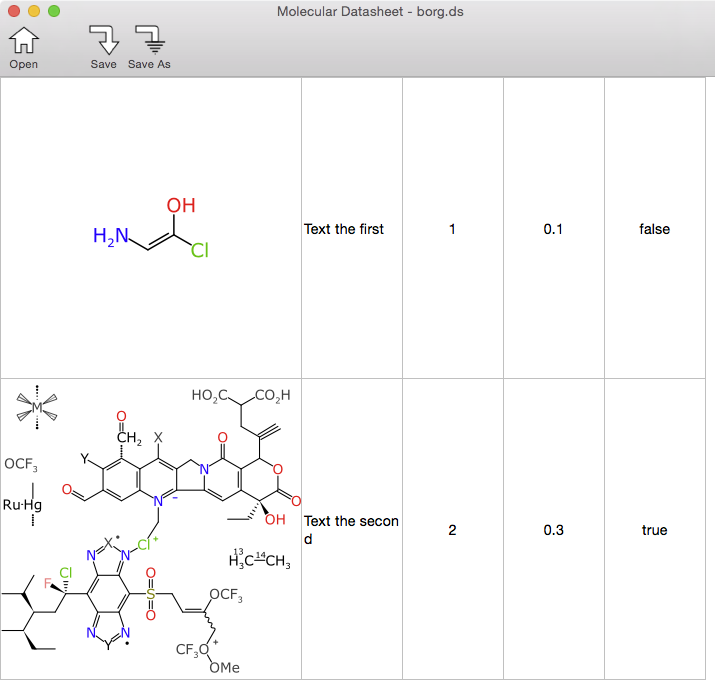 This is a way-too-soon sneak preview of what might someday end up as a commercial product. Currently residing under the project acronym XMDS, it is related to the MMDS app, for Mac OS X (i.e. X-Molecular DataSheet). The minimum viable feature set is intended to be approximately equivalent to the datasheet & molecule editor that is implemented by the open source SketchEl project. Continue reading
Structure property calculation in apps: MMDS
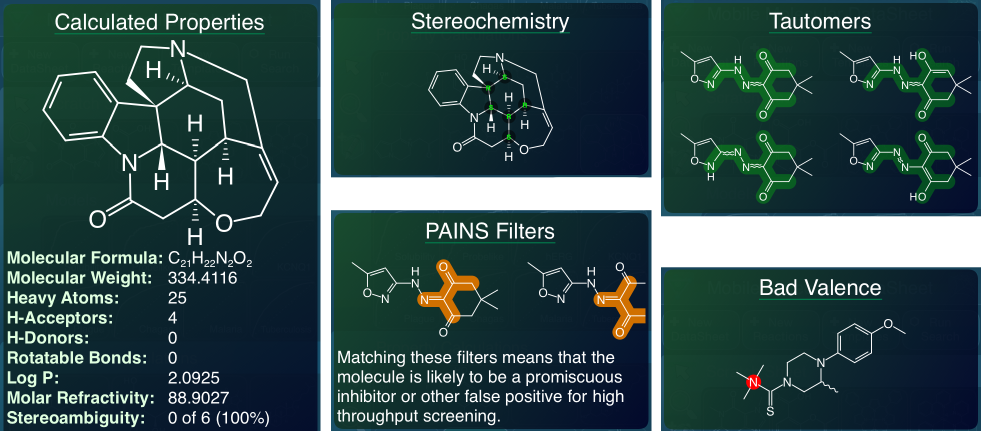 An important milestone in has been reached in the migration of complicated structure-based calculations to pure mobile. The latest version of MMDS (1.5.9) is now available on the AppStore, and allows visualisation of calculated properties for individual molecules, as well as calculating new columns for entire datasheets. Continue reading
Mobile sketcher overhaul in progress
 The molecular drawing capabilities introduced with the Mobile Molecular DataSheet (MMDS) app are still unique in the mobile chemistry space insofar as the user interface allows for precise drawing of manuscript-quality diagrams (i.e. perfect bond lengths and angles), on an incredibly tiny screen (the original iPhone form factor), and also very quickly. This sounds like a violation of basic engineering principles (i.e. fast, cheap, good: pick two), but there is of course a down side: the interface is different from the conventional industry standard paradigm, and takes some getting used to. While the capabilities have been regularly improved over more than 4 years since it was first released, a significant overhaul of the “onboarding” experience is long overdue, starting with more targeted adaptation to multiple screen sizes. Continue reading
Microsoft Word app and vector-drawn molecular graphics
 Like a few hundred million other people, I was curious to see what the newly released Microsoft Word for iPad app was capable of. One feature in particular is of great interest to me: the rendering of DrawingML graphics. It does not go without saying by any means that the app will abide to its own (very complex) format specification, but I am pleased to report that it does.
MetaSearch options: and stealth OpenPHACTS prefilter
 The 1.5 release of the Mobile Molecular DataSheet (MMDS) introduced a couple of major features, including a minimum viable feature deployment of OpenPHACTS assay integration. That is being quite liberal with the meaning of viable: building this into a practical scientific workflow is more of an ongoing campaign than a specific new piece of functionality, and so other features are being improved in lock step. The next one to get an upgrade is the searching capability, which has an additional preflight configuration block (shown to the right). Continue reading
Sneak preview: MMDS lookup of assays via OpenPHACTS
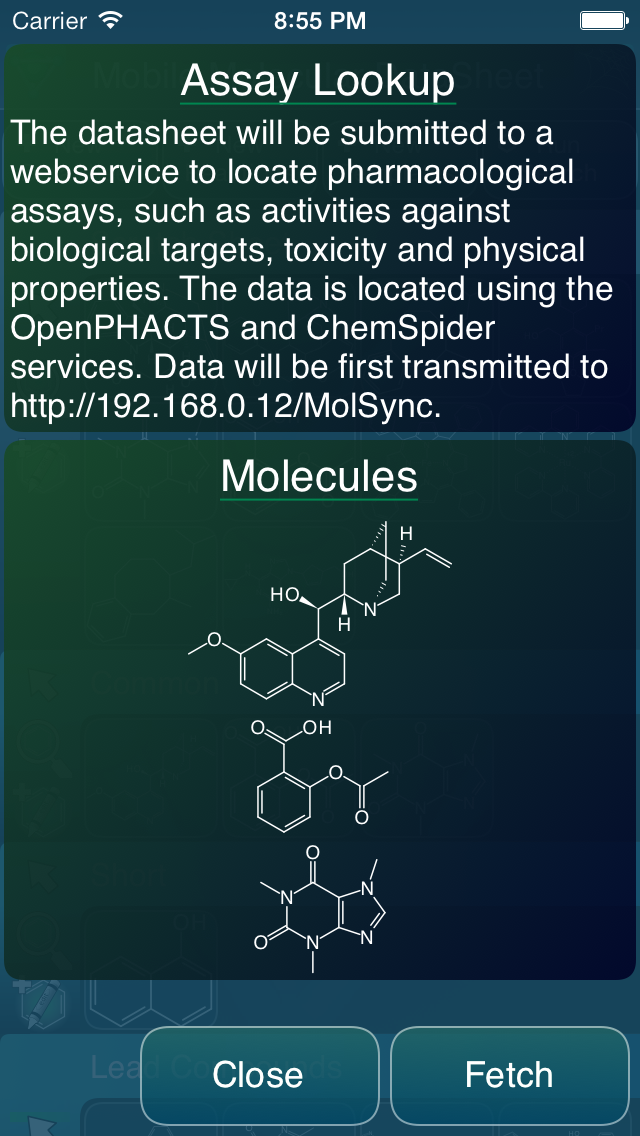 One of the features that’s slated for the next major version of the Mobile Molecular DataSheet (MMDS) is integration with OpenPHACTS pharmacological assay data. The feature is not quite ready yet, but the user interface is taking form, and is almost functional. The basic idea is that you start with a datasheet, with some number of molecules. Then, select the assay lookup feature, and a webservice intermediary cross references each of the molecular structures to the OpenPHACTS service, to pull out every available pharmacology datum, in a form that’s ready to insert into your data sheet as a new column. Looking up the data is quite easy, since OpenPHACTS is preassembled and has a very no-nonsense API, but reconciling a large number of datapoints into one or several columns of numbers is an interesting user interface workflow challenge. Continue reading
Mobile Molecular DataSheet landscape mode on iPhone
 The next major release of the Mobile Molecular DataSheet for iOS will be version 1.5, and it will include quite a few new bits, including the basic linear pipelining feature, as well as a major new service that I’ll describe later. The change that affects all of features is the migration to iOS 7, but perhaps more noticeably, when the app is used on the iPhone (or iPod) form factor, it now allows landscape mode, if you tilt your phone sideways. Continue reading
 Cheminformatics 2.0