Open Drug Discovery Teams & Google Alerts

The Open Drug Discovery Teams project started out as a minimum viable product that obtained all of its data from Twitter, using a server application that periodically polls for relevant hashtags. The development version has now been extended so that topics can also be associated with RSS feeds, and each of the topics has been paired with a feed created via Google Alerts. These source documents are spliced in with the Twitter feed, e.g. the Malaria topic now contains factoids that are obtained by looking for #malaria and a timely feed of articles that Google thinks are relevant to the “Malaria” keyword.

All of the crowdsourcing is still done via Twitter, regardless of where the content came from, i.e. you emit a tweet to endorse or disapprove. And using Twitter is still the appropriate way to inject content into ODDT, because you can just tweet it out and wait for it to be collected.

Addition of the Google-curated content provides a nice supplement the content stream. It will be going live soon, following a bit more testing on the development server.

New ODDT topic: Drug Repurposing

Today we added another topic to the Open Drug Discovery Teams project, called Drug Repurposing. The source material currently corresponds to the Twitter hashtag #drugrepurposing, which means that any time anyone tweets a link with that tag, it will find its way into the incoming content section for the topic.

To get the new topic off to a running start, the source material for version 1.0 of the Approved Drugs app has been divided up into page-sized chunks and tweeted-into the topic – which is the purpose of the series of tweeted datasheets. These provide name, structure and ChemSpider ID for about 1300 drugs approved by the FDA, which is the same data used by the app. The plan is to resubmit the series with each major revision of the source data, so the content will be available to anyone who wants it, not just anyone who has the app.

The Drug Repurposing page within the ODDT app currently looks like this:

The first column of factoids each corresponds to one of the tweeted datasheets, containing approved drugs organised into groups by alphabet. The preview thumbnail in each case shows several of the drug stuctures, and a concise summary of the column named.

Tapping on one of the thumbnails brings up the datasheet viewer:

Note that both the thumbnail, and this scrollable detail-view, are rendered by the app itself. The server recognised the original content as chemical data, and passed this knowledge over to the app. The app parses the datasheet, and its constituent molecules, in order to display it in the appropriate context. The buttons on the top left of this page offer to make this data available to any other apps installed on your device.

Creating a new topic in ODDT and frontloading it with chemical data foreshadows one of the major design objectives of the project: the chemical structures will eventually be searchable, and features are on the drawing board for extracting all kinds of structure:property data from the underlying documents.

ODDT goes crowdfunding

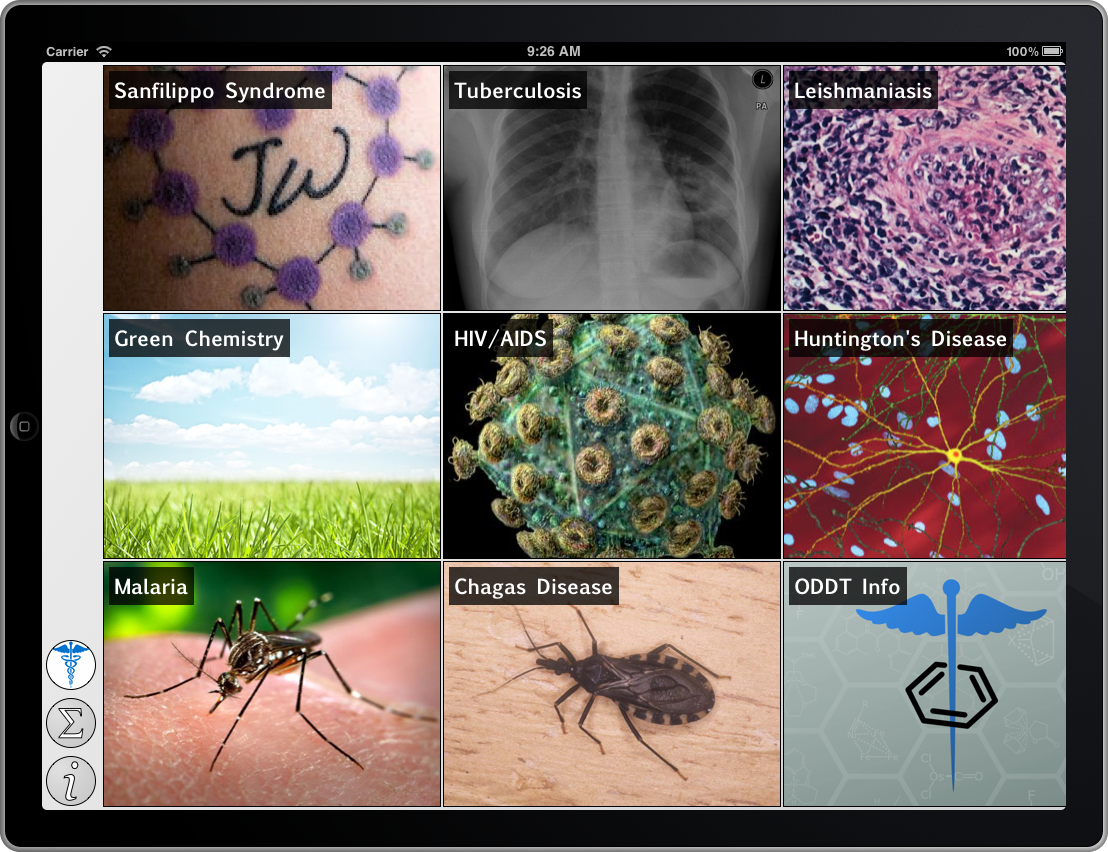
The Open Drug Discovery Teams (ODDT) app was dreamed up earlier this year by Sean Ekins, and by March 2012, it was a minimum viable product with an app on the iTunes AppStore and a server doing its thing on the cloud. The purpose of the project is to aggregate chemistry data from public sources, and put it together under a set of topics. These topics are mainly related to efforts to find cures for rare and neglected diseases, and also for industry relevant precompetitive topics like green chemistry. The ODDT project is heavily focused on open data, and is an attempt to introduce crowd curation of data to open science.

While we are retaining ownership of the tools, which are based on proprietary chemistry app libraries and back-end cheminformatics tools from Molecular Materials Informatics, the front-end app is free to install and free to use. And we would like to keep it that way. Unfortunately cloud hosted servers are not free, and so far we have been paying the hosting cost out of pocket, as well as designing and building the software in our spare time. So now its time to ask people to pitch in, via the crowd-funding project on IndieGoGo. If you think propagating open science for good causes is an idea that ought to be encouraged, and approve of broadening the communities of people who are knowledgeable and potentially able to contribute to these kinds of topics, then please get involved. If you can donate to this project, that would be great. If you can tell people about it, that would also be great. If you’ve read this blog post, then surely you can tweet a link to it, or post it on your social network of choice! We would really appreciate it.

Using ODDT to view Olympicene

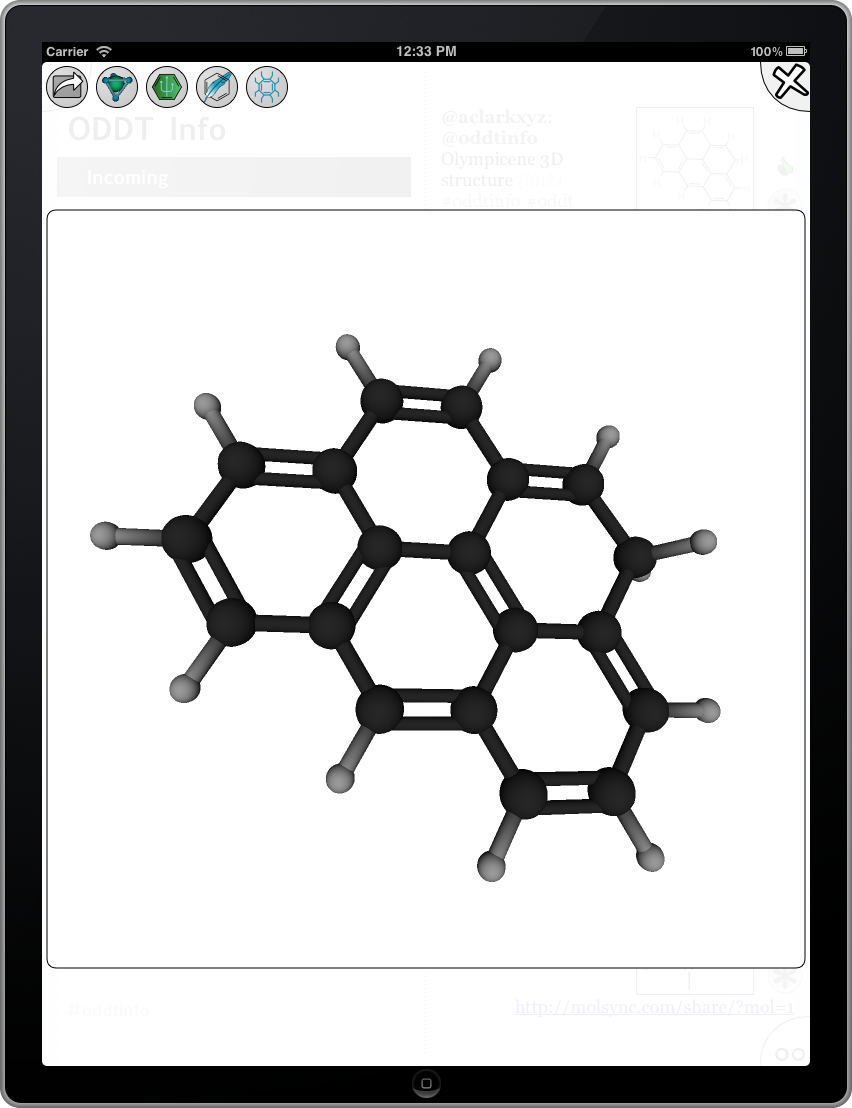
Given all the recent publicity about the timely novelty molecule olympicene, here’s another layer of gimmickry: using the latest version of the Open Drug Discovery Teams (ODDT) app for iOS (free download: iTunes AppStore), it is possible to view the 3D structure of the molecule on your iPhone/iPod/iPad. While most of the chemical structure content that can be browsed using this app is in the form of 2D diagrams, the latest version (0.9.3) added the ability to view 3D structures as well, making use of OpenGL ES. Continue reading

Sneak preview: 3D molecule viewing in Open Drug Discovery Teams app

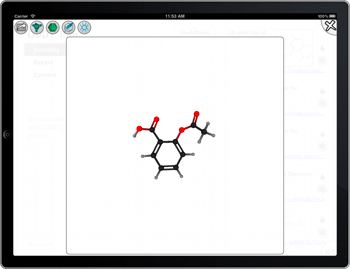
The Open Drug Discovery Teams app will soon acquire a new feature: viewing of 3D molecules from within the app. It will be the first app from Molecular Materials Informatics to make use of recently developed OpenGL code for molecule rendering and visualisation in 3D. Click on the thumbnail on the right for a very short demo, which shows ODDT in action, opening up a factoid-tweet that provides as its payload a 3D conformation of aspirin.

Continue reading

Tweeting chemistry from mobile apps: one less step

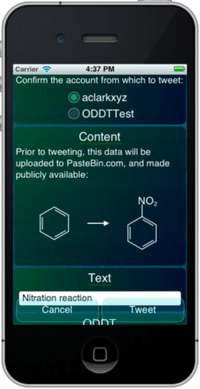
A new feature will be making its way to the Mobile Molecular DataSheet, and other apps, soon: tweeting out chemical data (molecules, reactions, datasheets) without having to login to a repository for storing the source data. All that’s required is authorisation of your Twitter account, as configured within iOS.

To see a preview of how it works, click on the image to the right, to watch a short screencast.

Continue reading

Super Friday app update, and a positive Apple experience

Most of the apps from Molecular Materials Informatics have been updated recently, due to the iPad3: the retina-class screen has half again as many pixels as a 1080p monitor (i.e. a lot), and the performance profiles of some graphics operations have changed. A few things that were fast became slow, and so a few tweaks were necessary. A whole lot of apps got reviewed and passed in quick succession: MolPrime+, MMDS, MolSync, ODDT and ChemSpider Mobile. Others will follow soon.

Continue reading

Open Drug Discovery Teams now live on AppStore

The Open Drug Discovery Teams (ODDT) app has now officially entered the public beta phase: it can be freely downloaded from the iTunes AppStore. The app should still be considered to be a minimum viable product, and by designating it as a beta release, we reserve the right to do regular upgrades/maintenance on the back end server. It is, however, highly functional, and definitely ready to take a look. Continue reading

ODDT entering beta phase

The Open Drug Discovery Teams app (ODDT) has now been promoted to “beta” status (version 0.9.0) and submitted to the iTunes AppStore. If all goes well, within a fortnight anyone with an iPhone, iPod or iPad will be able to download the app for free, and try it out.

Even though the app is now in the process of being made available to the public, it is still a very early product, and the list of features to be added is long. We fully expect community feedback to have a considerable impact on how the project evolves.