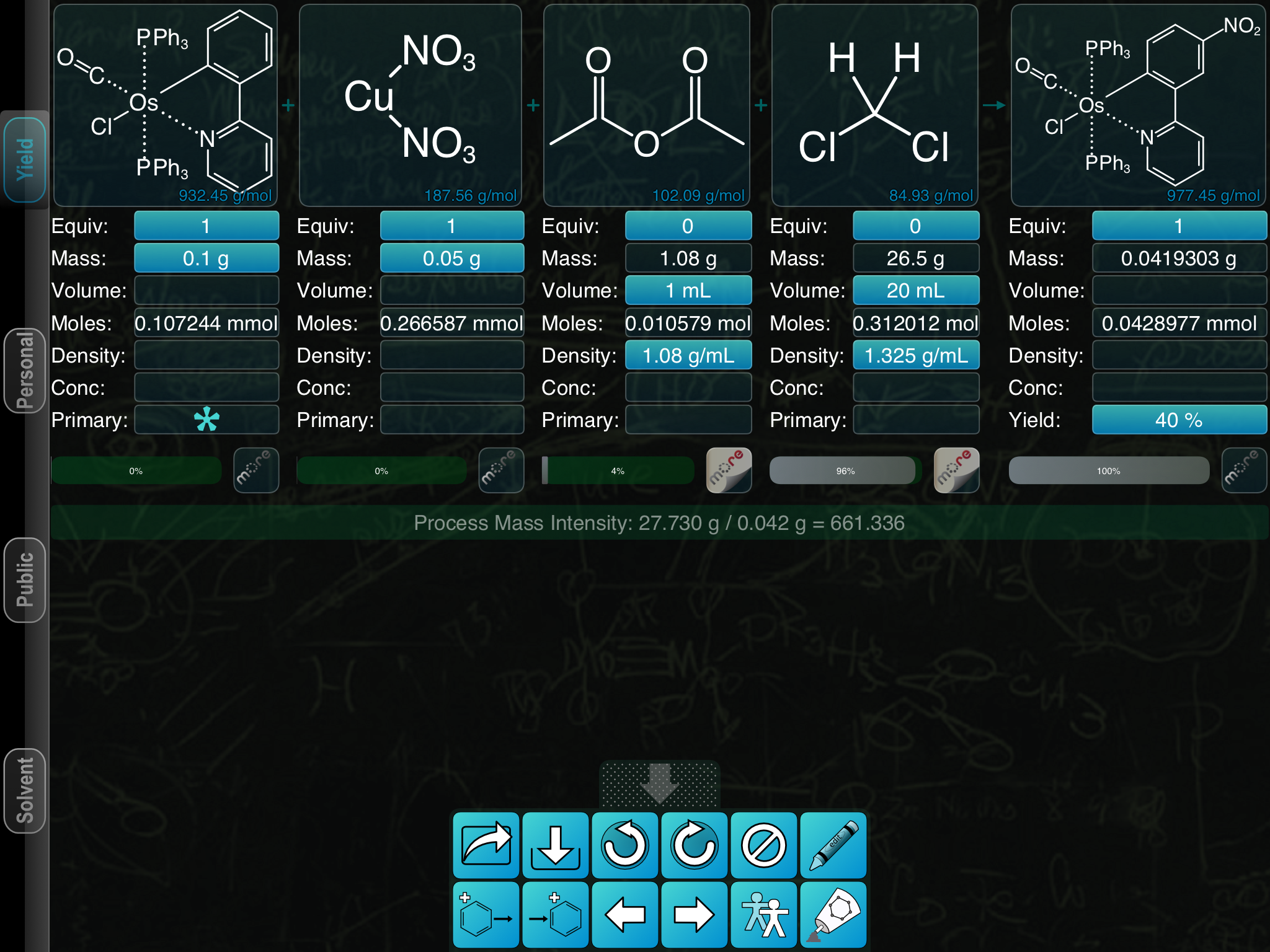
 It’s been awhile, but we’ve finally pushed out new versions of Reaction101 and Yield101, both now upgraded to version 1.1. Apart from a general update with all the improvements/bug fixes in the underlying libraries, the major additions are the ability to share reaction schemes on the web, and the choice of sketchers to use. Continue reading
reaction101
ACS Talk: Building a mobile app ecosystem for chemistry collaboration
The slides for my recent presentation at the American Chemical Society meeting in San Diego (Spring 2012):
The slides cover a whirlwind tour through some of the apps produced by Molecular Materials Informatics, showing how they can be used together in a realistic chemical information workflow.
Reaction101 and Yield101 update
 Late last year my company, Molecular Materials Informatics, in conjunction with Eidogen-Sertanty, released a white paper [PDF] that describes the Reaction101 and Yield101 apps, with a particular emphasis on their use in a classroom environment. The document has been added to Slideshare as well, to encourage sharing.
2011 redux
2011 has been a busy year for Molecular Materials Informatics, with new products, new features and new developments coming on hard and fast. 2012 begins tomorrow, and promises to keep up the same breakneck pace. This post is an executive summary of some of the news that was released over the year. Leaving out of course some of the projects that have yet to be unveiled.
At the beginning of 2011, there were just two products, with the same name: the Mobile Molecular DataSheet, or MMDS for short. Due to the rapidly shifting fortunes of mobile device platform makers, the iOS version for iPhone, iPod and iPad took centre stage in 2011, leaving the BlackBerry version behind. The iOS version was mostly feature complete by the beginning of 2011, having already added webservices access and reaction editing. Throughout 2011 the product has steadily matured, with a regimen of software updates adding minor and not-so-minor features, enhancements, bug fixes and ergonomic improvements.
Mobile chemistry: coming of age
A review has recently been published in Drug Discovery Today, for which I have the honour of being one of the co-authors. The primary instigators are Antony Williams and Sean Ekins. The review is a 12 page tour through some of the highlights of mobile chemistry software. The subject is evolving very rapidly, though – in the months since the manuscript was originally submitted, there have been a number of new developments, e.g. MolSync, ChemSpider Mobile, Reagents… it’s almost time for another review!
Mobile chemistry app ecosystem to date
The current collection of apps for iOS (iPhone/iPod/iPad) which are based on, or make use of, core technology from the Mobile Molecular DataSheet:
 |
The Mobile Molecular DataSheet (MMDS) is the progenitor app, which provides features for drawing molecular structures and reactions, organising datasheets, sharing data, access to web services, and many more. See product page and AppStore. |
 |
MolSync provides chemically aware access to cloud-hosted file repositories, which currently means Dropbox. Files can be browsed, viewed, converted and made into graphics. The app works particularly well in combination with MMDS: the two apps integrate together as a synchronisation/versioning tool/collaboration utility. See product page and AppStore. |
 |
Reaction101 focuses on editing one reaction at a time. Its simplicity, combined with reaction balancing capabilities, make it particularly useful for chemistry students. The app also provides integration with the Mobile Reagents database, common reactions for use as templates, and cloud-based storage of data. See product page and AppStore. |
 |
Yield101 focuses on the quantities involved in a reaction, and automatically calculates related amounts, using molecular weight from structure to interconvert mass, moles, volume, density, concentration, and ultimately yield. This app is useful to students practicing quantity interconversions, as well as any chemist who wants to spend less time using a calculator. See product page and AppStore. |
 |
MolPrime is a free app which allows a structure to be drawn, then used in several ways: reviewed for basic properties, launched with other apps, searched with Mobile Reagents or ChemSpider, copied to the clipboard or sent by email. It also lets you play Conway’s Life, using the chemical structure to seed the first generation. See product page and AppStore. |
 |
Green Solvents is a free app which presents a list of solvents, categorised by functional group. Each of the solvents comes with information about its properties with regard to environmental hazards and disposal. They can easily be looked up in ChemSpider and Mobile Reagents, and there is also a slider-tile minigame, to help out with lab down-time. See product page and AppStore. |
 |
ChemSpider Mobile provides the most effective way to search ChemSpider for chemical structures from a mobile device. The app was commissioned by the Royal Society of Chemistry, and is free to use. See product page and AppStore. |
Furthermore, there are two products from Eidogen-Sertanty that make use of MMDSLib to provide structure drawing capabilities: Mobile Reagents and iProtein. And there are more apps in development, so expect this list to grow!
The current menagerie: MMDS, Reaction101, Yield101
 As of the time of writing, the number of iOS apps published by Molecular Materials Informatics is about to grow to three, with the addition of Yield101, which is in the final stages of testing prior to submitting to the app store. All of these products are built around the same technology core, which includes, most importantly, a chemical structure diagram editor that is optimised for smartphone/tablet-sized devices. They also share a common visual theme and user interface style elements.
The apps, in chronological order of release are… Continue reading
 Cheminformatics 2.0