 The SPRESImobile app provides access to InfoChem‘s SPRESI database. It runs on Apple iOS devices (iPhones, iPods and iPads) and is free on the iTunes AppStore. The latest version extends the search capabilities to include searching by reaction: various types of exact, substructure and similarity searches can be performed. Furthermore, it is now possible for existing customers of SPRESI to provide their user credentials within the app, which unlocks the entirety of the database content, rather than the default curated ChemReact subset that is made available to all.
cheminformatics
Molecular drawing tutorial for Android MolPrime
 As of soon, the MolPrime app for Android will come with a built-in beginner tutorial, which basically forces you to draw caffeine from scratch. You can watch a playthrough on YouTube, and if you have an Android device, you should be able to check it out for yourself soon. Continue reading
Multistep reaction rendering
 The Mobile Molecular DataSheet (MMDS) app has provided the ability to draw chemical reactions for some time now. Soon it will be possible to output them as multistep sequences, rather than discrete units. Continue reading
Keep an eye on the Pistoia Alliance
Anyone who works with software for life sciences R&D has probably heard of the Pistoia Alliance, which counts among its members most of the large pharmaceutical companies. The organisation has lately been working on an app strategy, to help both vendors and customers design and build mobile apps and accompanying cloud-based services to make them more useful and more accessible to their customer base. And conversely making it easier for customers to help guide the way these products are built, in order to solve real problems. The strategy includes the creation of an enterprise app store, which provides an alternative way to deliver apps. Continue reading
MolPrime for Android now on Google Play
 As of now, version 1.0 of MolPrime for Android is available on Google Play. It’s a free app, so if you have an Android device running on operating system 2.3 or later, you can check it out at your leisure. Continue reading
Presentations from ACS Philadelphia
The 2012 Autumn American Chemical Society meeting is now wrapped up, and I’m back in the office sorting through a prioritised to-do list. I presented two talks, both of which are now available on slideshare. Continue reading
A new publication and two ACS talks
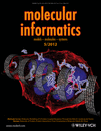 A paper has recently emerged in Molecular Informatics, which Sean Ekins, Antony Williams and myself put together earlier this year, entitled Redefining Cheminformatics with Intuitive Collaborative Mobile Apps. It is currently available as an early access preview, and also happens to be open access, so if you have any interest in how mobile apps can and do fit together in a cheminformatics workflow, go download it now.
The abstract:
The proliferation of mobile devices such as smartphones and tablet computers has recently been extended to include a growing ecosystem of increasingly sophisticated chemistry software packages, commonly known as apps. The capabilities that these apps can offer to the practicing chemist are approaching those of conventional desktop-based software, but apps tend to be focused on a relatively small range of tasks. To overcome this, chemistry apps must be able to seamlessly transfer data to other apps, and through the network to other devices, as well as to other platforms, such as desktops and servers, using documented file formats and protocols whenever possible. This article describes the development and state of the art with regard to chemistry-aware apps that make use of facile data interchange, and some of the scenarios in which these apps can be inserted into a chemical information workflow to increase productivity. A selection of contemporary apps is used to demonstrate their relevance to pharmaceutical research. Mobile apps represent a novel approach for delivery of cheminformatics tools to chemists and other scientists, and indications suggest that mobile devices represent a disruptive technology for drug discovery, as they have been to many other industries.
If you are attending the American Chemical Society meeting in Philadelphia next month, or know somebody who is, you might be interested in either or both of my talks. The first one is on the Sunday, in the Chemical Education division; the second one is on Monday, in Chemical Information: Continue reading
MolPrime for Android getting closer
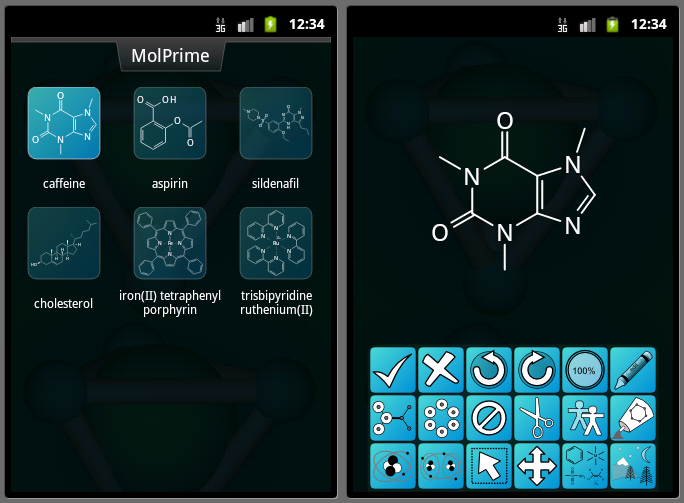 The Android port of MolPrime is getting closer to being a functional app. As you can see in the two-part snapshot to the right, the both the main screen and the diagram sketcher have enough capabilities to present the initial facade. The sketcher currently only displays the structure and some buttons, but that’s still solid progress.
Say hello to Android!
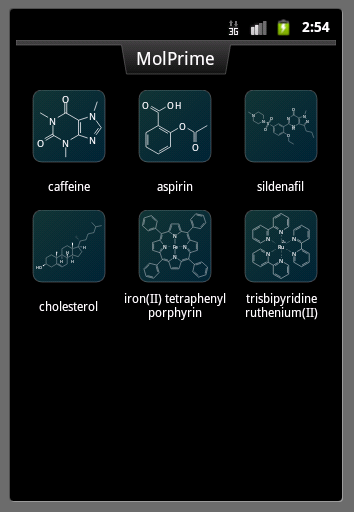
As the screen capture to the right suggests, Molecular Materials Informatics has gotten out the sonic screwdriver and started porting mobile chemistry tools to the Android platform. Work has begun on porting MolPrime – currently only available for iOS – to Android. Before any Android users get too excited, though, this is just an early preview – it doesn’t do much, and there is no estimated completion time as yet. But if you keep reading this blog, you will get regular progress updates. Continue reading
Approved Drugs gets more fields: targets and synonyms
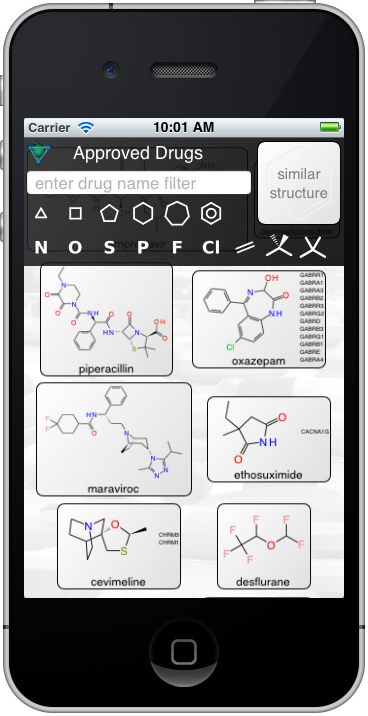 The Approved Drugs app has a new version awaiting review on the AppStore which adds drug targets and synonyms. The target codes have been integrated from the supplementary information of a recent Nature paper describing the prediction of side-effect targets (Lounkine, Keiser, et al), and provide data for 500 or so of the entries. Synonyms have been obtained by using the ChemSpider API, combined with some automated filters and manual verification to restrict the list to common trade names. Continue reading
 Cheminformatics 2.0