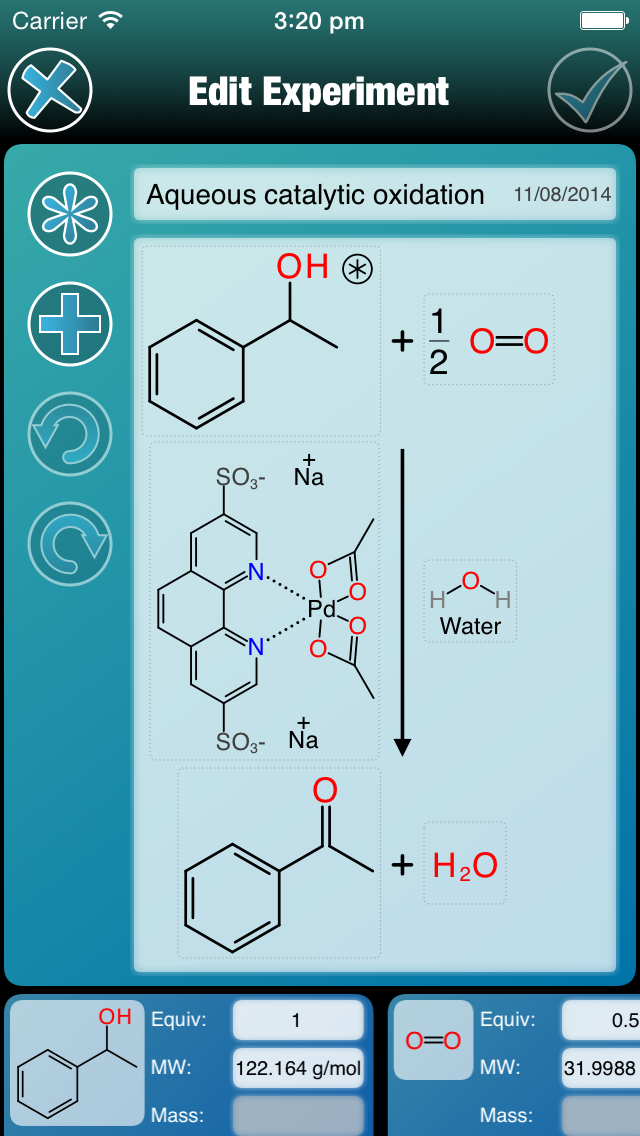
 After somewhat more delay than I would have liked, the Green Lab Notebook (GLN) app is now live and available on the iTunes AppStore. The feature set that made its way into version 1.0 was crafted to ensure that editing of multistep reaction experiments and automatic calculation of green chemistry metrics are fully functional, and that importing and exporting features are complete enough to be effective. Continue reading
cheminformatics
Presentation about the Green Lab Notebook at ICCE2014 Toronto
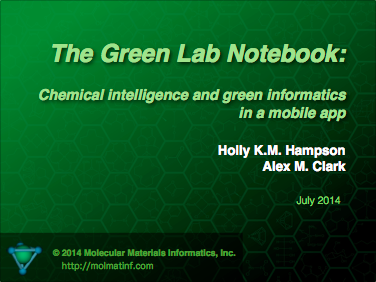 Slides for a talk about the upcoming Green Lab Notebook (GLN) app, which was presented this morning at the International Conference on Chemistry Education (ICCE2014) in Toronto. The short presentation describes how the field of green chemistry can be brought closer to both students and professional chemists with the assistance of an accessible and easy to use mobile app. The presentation was given by Holly Hampson, since I’m currently situated much further away from the event.
On the myth of chemical structure format conversion
There has been a lot of work, many products, and plenty said on the topic of converting chemical structures from one format to another, and a number of well used and highly regarded packages (e.g. OpenBabel) that specialise in providing this capability. Less well discussed, it would seem, is that when it comes to connection-table formats used to encode chemists’ sketches of molecules, there are no software packages and no two formats for which a round trip conversion can be reliably carried out without losing information, even if the chemical entities being expressed fall within the applicable domain of both formats. Continue reading
The Green Lab Notebook project: where it’s at
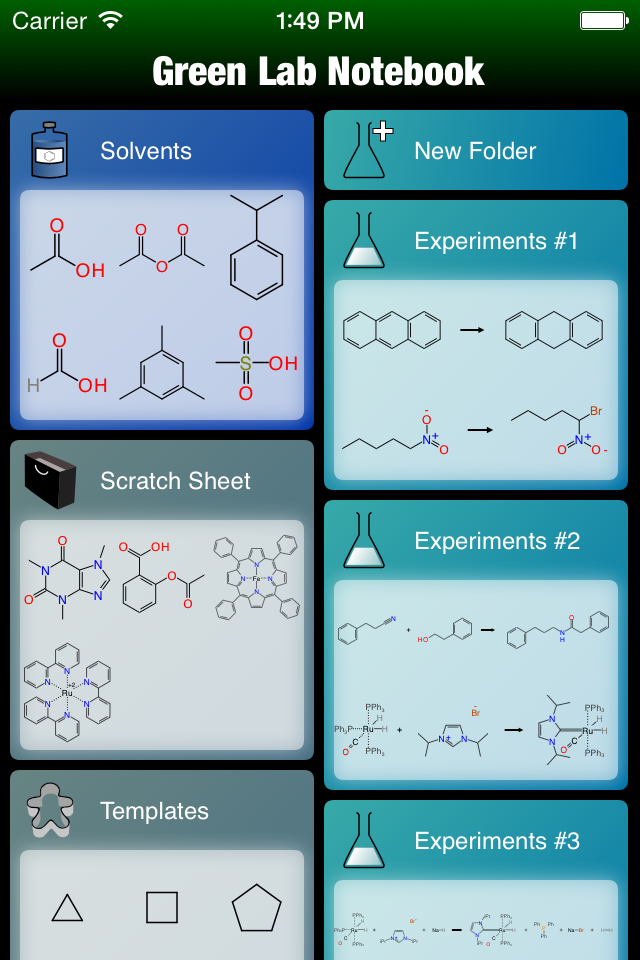 Last week I was at the American Chemical Society meeting in Dallas, which was incidently a particularly enjoyable gathering. I presented two talks, one of which described some of the latest developments of the Green Lab Notebook project (for slides, see slideshare and figshare). After having given a couple of talks about this as yet unfinished app, it’s time to start the run-down checklist for what goes into a minimum viable product.
What to expect from me at the Dallas ACS 2014
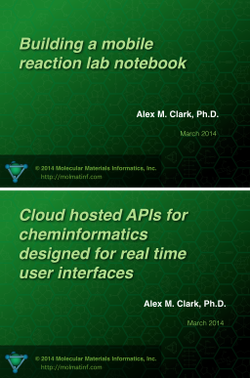 Like many (or most) chemists in North America, the twice annual American Chemical Society (ACS) mega-meeting is an important calendar event in spring & autumn. Its primary value proposition is networking, but it also provides an important source of stretch goals. I’ll be presenting two talks, one on Monday about electronic lab notebooks, and the other on Tuesday, about cloud computing. Continue reading
Green Lab Notebook: more on balancing & green metrics
 Recent blog posts (here & here) have chronicled the experiment editor for the Green Lab Notebook (GLN) app-in-progress. The green chemistry metrics and some interesting stoichiometry/equivalents/balancing issues for multistep reactions have been grappled with. Continue reading
Open source ECFP/FCFP circular fingerprints in CDK
 As of now, the latest version of the popular open source Chemical Development Kit (CDK) has its own implementation of the highly regarded ECFP and FCFP classes of chemical structure fingerprints (sometimes referred to as circular or Morgan fingerprints). While the general recipe for this kind of fingerprint has been available for awhile, and there are a number of implementations in various different toolkits, this one distinguishes itself in several ways: it has been implemented as closely as possible to the description of the original definition (without having access to the trade secrets that were left out of the paper); it includes resolution of chiral centres; it is freely available as open source Java code; and, last but not least, the algorithm is designed to be as portable as possible, with no major dependencies on specific programming languages or cheminformatics toolkits. Continue reading
Major new version of TB Mobile app
 The TB Mobile app for iOS has just received a major new update on the iTunes AppStore. Version 2 of the app brings some fairly powerful cheminformatics functionality to this free mobile app for tuberculosis research. Produced by Collaborative Drug Discovery, built by Molecular Materials Informatics, and organised by Sean Ekins, this app is pushing the boundaries of real science on mobile devices in several important ways. Continue reading
MetaSearch options: and stealth OpenPHACTS prefilter
 The 1.5 release of the Mobile Molecular DataSheet (MMDS) introduced a couple of major features, including a minimum viable feature deployment of OpenPHACTS assay integration. That is being quite liberal with the meaning of viable: building this into a practical scientific workflow is more of an ongoing campaign than a specific new piece of functionality, and so other features are being improved in lock step. The next one to get an upgrade is the searching capability, which has an additional preflight configuration block (shown to the right). Continue reading
Which platform to build software for?
For most of the desktop computing era (ca. 1980-2010) software creators have had to grapple with decisions of which operating systems to build their software for. This century, any desktop application with a user interface has been a choice of Windows/Linux/MacOSX, with relative importance being dependent on the industry. Since mobile devices turned into real computers, and HTML5 found its way onto mobile browsers, the decision has moved up a level: software creators now have to start by deciding which meta-platform, i.e. desktop, mobile or web. And it’s not always an easy choice. Continue reading
 Cheminformatics 2.0