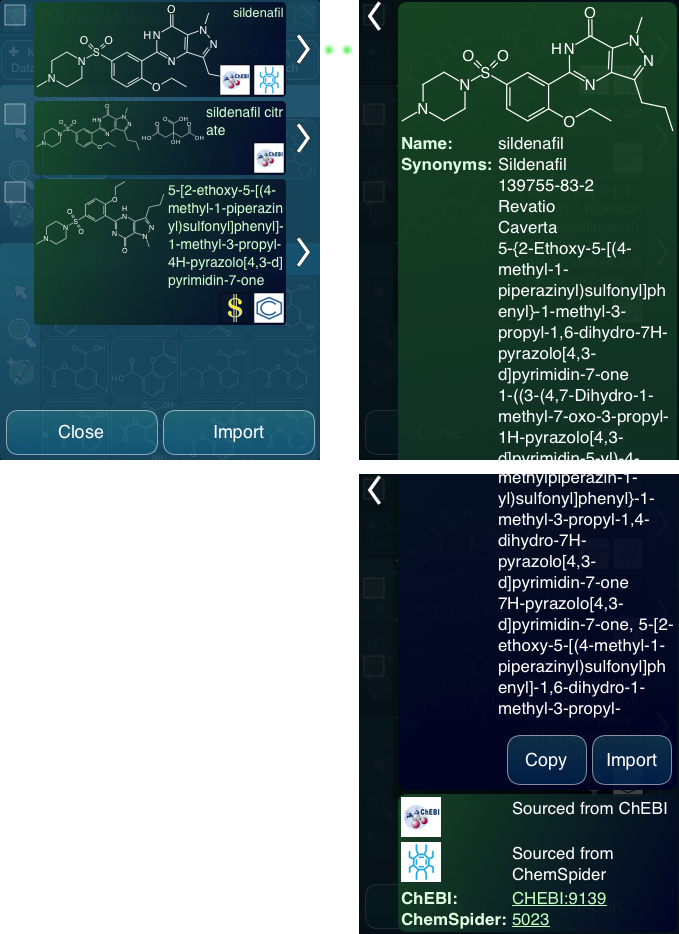
 As of now, searches initiated from the Mobile Molecular DataSheet (MMDS), MolPrime+ or SAR Table include results obtained by searching the ChemSpider database, as well as ChEBI and PubChem. The results from these three public chemical database search engines are combined together into a composite result, which is ready for consumption by the mobile app. Continue reading
cheminformatics
ACS Chemical Information Division (CINF) and the ODDT app
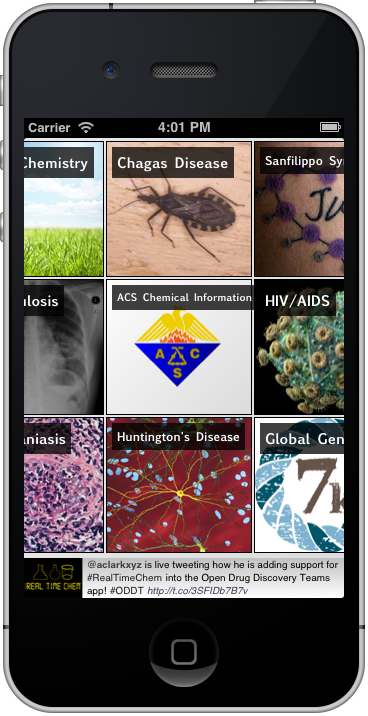 One of the outcomes of the recent American Chemical Society meeting in New Orleans is that my usual haunt – the Division of Chemical Information (CINF) – needs to do a bit more work to publicise itself, and boost the membership count, so it can continue to be an important and relevant fixture in the cheminformatics space. To this end a brainstorming session was held the night before the talks began, and each of us scribbled out as many ideas as we could think of on Post-It notes. One of the ideas that Tony Williams (aka ChemConnector) came up with is to encourage members to tweet out their division-related activities, and use the hashtag #ACSCINF. Then, in the tradition of #RealTimeChem, add a new topic to the Open Drug Discovery Teams app.
First of all, if you have an iPhone, iPod or iPad, and you don’t already have the Open Drug Discovery Teams (ODDT) app installed on it, you need to remedy that by making a quick trip to the iTunes AppStore:
http://itunes.apple.com/app/oddt/id517000016
The app is free. Its purpose is to serve as an aggregator of open content documents for specific science-related topics, which mainly consist of rare & neglected diseases, but also include some precompetitive topics like green chemistry, and some more experimental efforts to involve cheminformaticians in social networking, namely #RealTimeChem and ACS CINF.
The ODDT app contacts a server for its content, which in turn routinely scrapes Twitter and specific RSS feeds. The Twitter-obtained content is an effort to make use of the fact that despite that network being a torrential flood of inanity, there are quite a few sources who post valuable and interesting links, and make the effort to classify their contributions with specific hashtags. ODDT is configured to look for these, and compile them into relevant topics, which means that if you find a relevant document (typically a web page), you can “tweet it into ODDT” by emitting the link and the appropriate hashtag, e.g. #Malaria for articles relating to malaria research. The app provides this information via a browsing interface that was inspired by the very popular Flipboard app.
The second important aspect of its functionality is crowd curation. Documents that are scraped from social networks and added to the system start with an endorsement ranking of 0, which means that they will be kept in the “inbox” for a week, but after that they get flushed. Unless, that is, a user of the ODDT app endorses it. Documents can be voted down as well as up, so as long as its rating stays greater than zero, it will be retained indefinitely. In this way, anything that wasn’t important enough for somebody to endorse gets digested and excreted, leaving behind only the content that people consider valuable.
So if you have any interest in the ACS Division of Chemical Information, you should:
- Download the ODDT app, if you have an iThing
- Tweet out links to relevant content, and add the #ACSCINF hash tag
Try it out. And let us know what you think!
Finding vendors using mobile apps: compliments of PubChem
 Users of the PubChem service may have noticed that the hit records include a list of vendors and links to the compound records for their site (e.g. see here). The Mobile Molecular DataSheet (MMDS) app, among others, can tap into PubChem to search by name or structure. The next version makes use of the vendor information, and provides this to the user as part of the search results. Continue reading
Adding statistics to ODDT topics
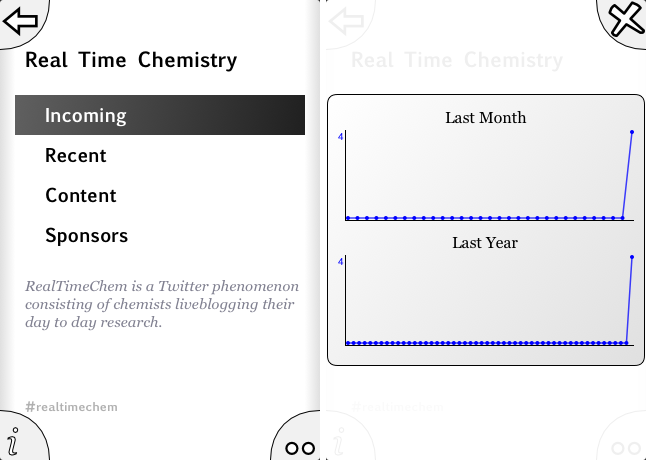 The Open Drug Discovery Teams (ODDT) app is undergoing surgery to add in longer term statistics logging for individual topics. Continue reading
Searching public databases from mobile apps: better feedback
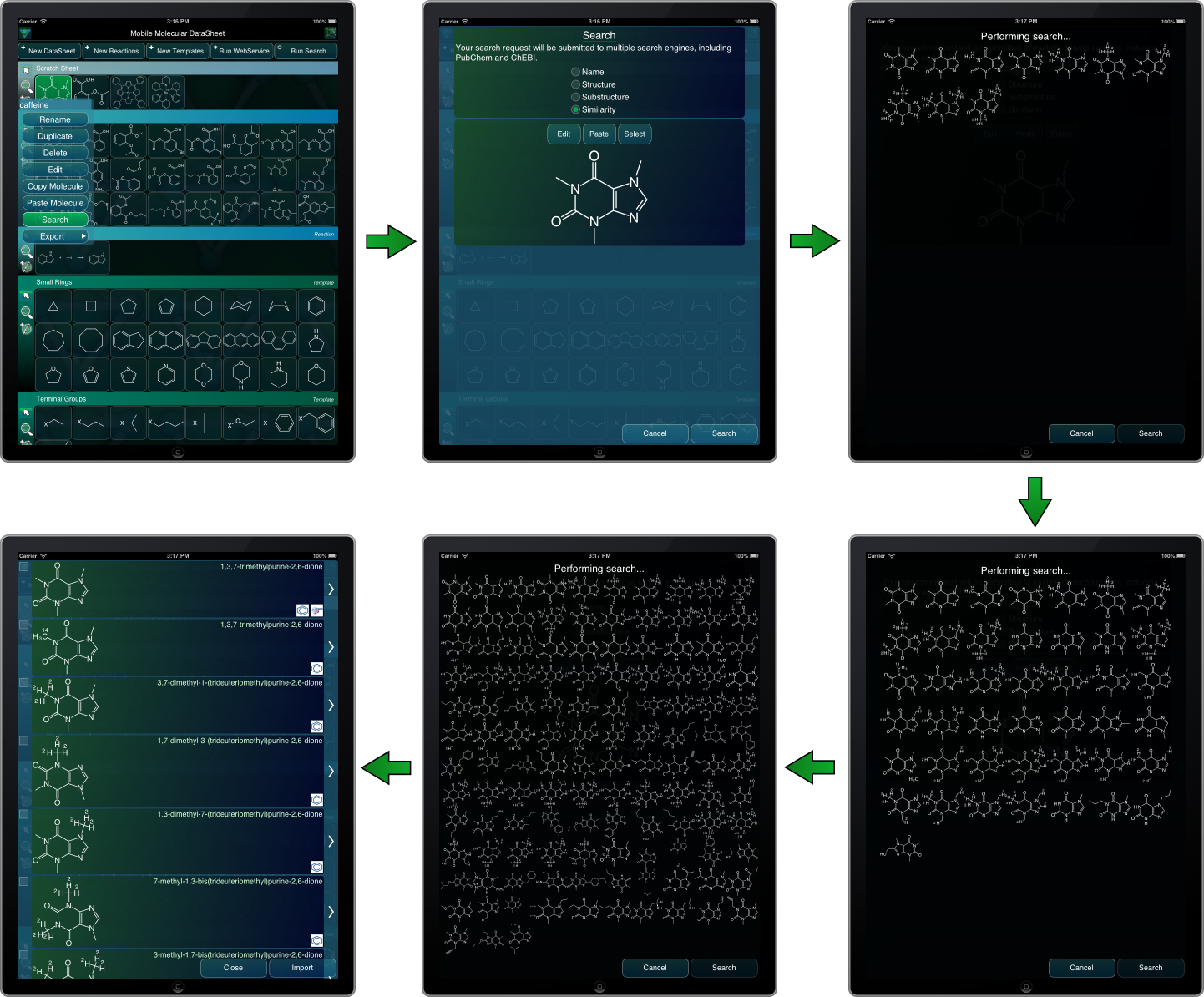 A few iterations ago, some of the flagship mobile apps from Molecular Materials Informatics (namely the Mobile Molecular DataSheet, SAR Table and MolPrime+) added an integrated feature for searching public databases by name and structure. The feature works through a webservice meta-layer that currently wraps PubChem and ChEBI.
The use case is very convenient, but one of the downsides for the presently available features is that the webservice connection is carried out as a single operation, with no feedback until the search is complete. From a user experience point of view, an operation with no progress indicator gives the impression of taking about 10x as long as one that provides useful feedback. Continue reading
ACS redux
The American Chemical Society meeting in New Orleans (April 2013) is now all wrapped up – at least for me anyway, there may be some last vestiges of action still going on. It was a fun meeting, and even though I spent the entire time either talking shop or sleeping, the choice of city didn’t hurt. I managed to experience a number of the highlights while prowling around with gangs on fellow chemists.
My two presentations are now available online:
- COMP division: Mobile + Cloud: A replacement for desktop cheminformatics? (slideshare, figshare)
- CINF division: Pistoia Alliance AppStore: Apps for life sciences R&D (slideshare, figshare)
Also, I was thrilled to see the C&E Picks video feed include a large segment of the footage that I provided, which shows the SAR Table app in action, and the SPRESImobile app is in there too. Mobile apps for chemistry are making their way further up the food-chain!
Improved copying of molecule images to clipboard
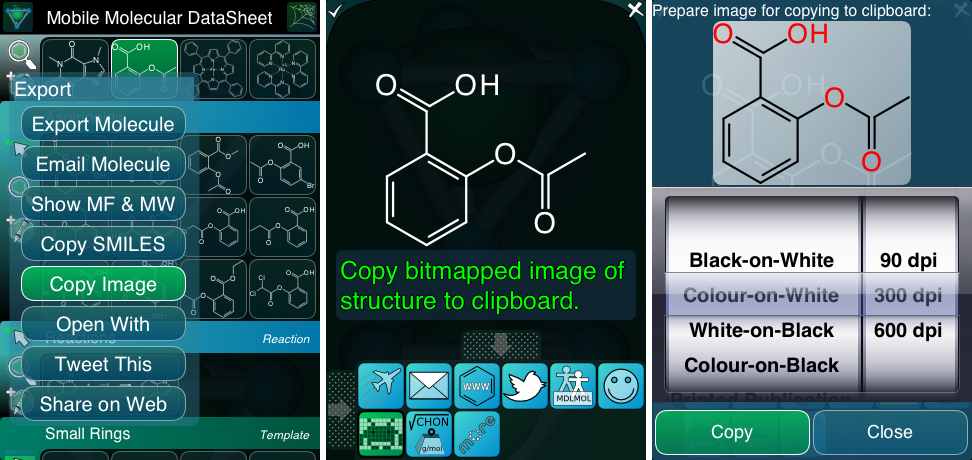 This one has been on the to-do list for a long time, but for some reason never quite bubbled up to the top. Various apps, including the Mobile Molecular DataSheet, allow images of structures (or reactions) to be transferred onto the iOS clipboard, and from there pasted into other apps, like Keynote or Pages. Continue reading
RealTimeChem and molecules: share ’em if you got ’em
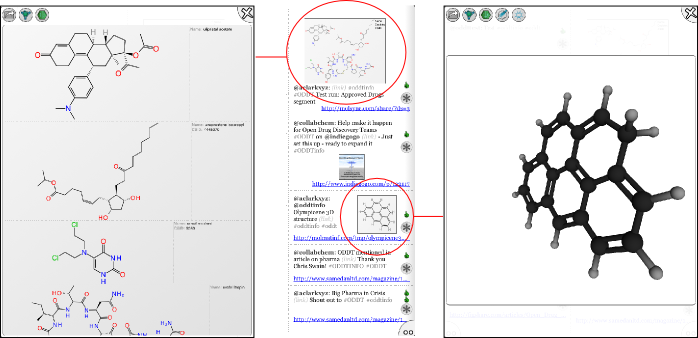 The Open Drug Discovery Teams app (ODDT for short, or “Oddity” if you prefer) now includes the #RealTimeChem hash tag as its own separate topic. Recently written up C&E News, the chemistry-centric tweetup is going to convene RealTimeChem week, starting 22 April 2013. Continue reading
Matching multiple scaffolds at once with the SAR Table app
 The SAR Table app has had the ability to match scaffolds to molecules for awhile now, but as of the latest release (1.3.4) just submitted to the AppStore, it will be able to match more than one scaffold at once. Continue reading
Publication-quality molecular rendering: behind the scenes
 My most recent publication is now available as early access, and is entitled Rendering Molecular Sketches for Publication Quality Output (Molecular Informatics, 2013). As the title suggests, the paper describes the process of turning a data representation of a molecular structure into a graphical figure that is suitable for the most aesthetically demanding circumstances (e.g. manuscripts, posters, etc.). If one were to start with a connection-table representation of a molecule, with well selected coordinates (e.g. a typical MDL Molfile, among others), the process of creating a perfect diagram seems pretty simple compared to everything that goes on up to that point, but actually it’s not. There is a great deal of information that has to be inferred before a great picture can be produced. The paper goes into a lot of detail, and describes all of the important algorithms necessary to bridge the gap. Continue reading
 Cheminformatics 2.0