2011 redux

2011 has been a busy year for Molecular Materials Informatics, with new products, new features and new developments coming on hard and fast. 2012 begins tomorrow, and promises to keep up the same breakneck pace. This post is an executive summary of some of the news that was released over the year. Leaving out of course some of the projects that have yet to be unveiled.

At the beginning of 2011, there were just two products, with the same name: the Mobile Molecular DataSheet, or MMDS for short. Due to the rapidly shifting fortunes of mobile device platform makers, the iOS version for iPhone, iPod and iPad took centre stage in 2011, leaving the BlackBerry version behind. The iOS version was mostly feature complete by the beginning of 2011, having already added webservices access and reaction editing. Throughout 2011 the product has steadily matured, with a regimen of software updates adding minor and not-so-minor features, enhancements, bug fixes and ergonomic improvements.

Continue reading

Mobile chemistry app ecosystem to date

The current collection of apps for iOS (iPhone/iPod/iPad) which are based on, or make use of, core technology from the Mobile Molecular DataSheet:

The Mobile Molecular DataSheet (MMDS) is the progenitor app, which provides features for drawing molecular structures and reactions, organising datasheets, sharing data, access to web services, and many more. See product page and AppStore.
MolSync provides chemically aware access to cloud-hosted file repositories, which currently means Dropbox. Files can be browsed, viewed, converted and made into graphics. The app works particularly well in combination with MMDS: the two apps integrate together as a synchronisation/versioning tool/collaboration utility. See product page and AppStore.
Reaction101 focuses on editing one reaction at a time. Its simplicity, combined with reaction balancing capabilities, make it particularly useful for chemistry students. The app also provides integration with the Mobile Reagents database, common reactions for use as templates, and cloud-based storage of data. See product page and AppStore.
Yield101 focuses on the quantities involved in a reaction, and automatically calculates related amounts, using molecular weight from structure to interconvert mass, moles, volume, density, concentration, and ultimately yield. This app is useful to students practicing quantity interconversions, as well as any chemist who wants to spend less time using a calculator. See product page and AppStore.
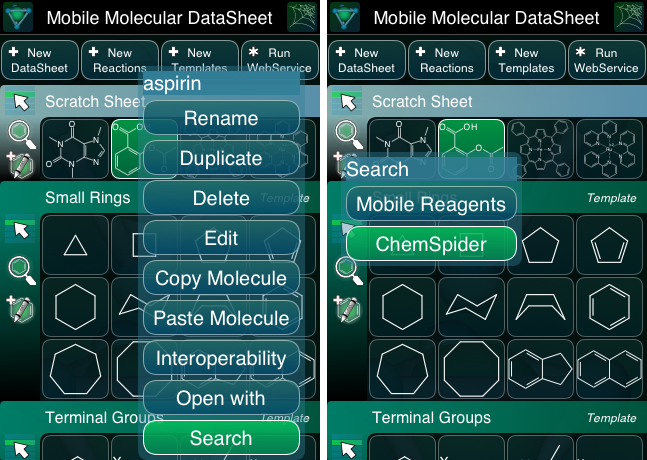
MolPrime is a free app which allows a structure to be drawn, then used in several ways: reviewed for basic properties, launched with other apps, searched with Mobile Reagents or ChemSpider, copied to the clipboard or sent by email. It also lets you play Conway’s Life, using the chemical structure to seed the first generation. See product page and AppStore.
Green Solvents is a free app which presents a list of solvents, categorised by functional group. Each of the solvents comes with information about its properties with regard to environmental hazards and disposal. They can easily be looked up in ChemSpider and Mobile Reagents, and there is also a slider-tile minigame, to help out with lab down-time. See product page and AppStore.
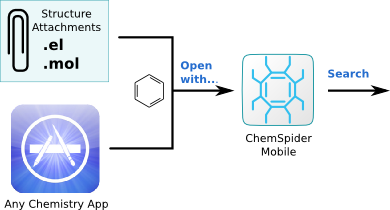
ChemSpider Mobile provides the most effective way to search ChemSpider for chemical structures from a mobile device. The app was commissioned by the Royal Society of Chemistry, and is free to use. See product page and AppStore.

Furthermore, there are two products from Eidogen-Sertanty that make use of MMDSLib to provide structure drawing capabilities: Mobile Reagents and iProtein. And there are more apps in development, so expect this list to grow!


Opening ChemSpider Synthetic Pages with MMDS

A few months ago, the Mobile Molecular DataSheet (MMDS) accumulated a new feature: the ability to parse ChemDraw files. This feature is not just limited to pulling out structures of individual molecules – it can also extract reaction schemes, and reassemble them into the more highly structured form that MMDS uses, i.e. segregated into individual components, where each distinct part of the reaction is characterised as a reactant, reagent or product, and is described by name/structure/both, and stoichiometry.

Continue reading

Latest app: ChemSpider Mobile

This blog has been a bit quiet recently, as might be expected for the sweltering summer months of the northern hemisphere, but rest assured that the secret laboratory of Molecular Materials Informatics has been running at full capacity, with a number of new projects on the way.

Working closely with the ChemSpider team (in particular, Antony Williams and Valery Tkachenko), we are proud to announce that ChemSpider now has a custom-built mobile app, which runs on all the iOS touchscreen devices (iPhone, iPod, iPad). ChemSpider Mobile has been submitted to the Apple iTunes AppStore, which means that it is not actually available yet, but with any luck it will pass through the review process within a week or so. With a lot of luck, it might even be ready in time for the ACS meeting in Denver (August 2011).

There is a precursory overview of the app on the SciMobileApps wiki site. The app is free, just like the ChemSpider website. The design of the app is very simple and easy to navigate. It allows the ChemSpider database to be searched by structure or by name. It’s not a power-user tool like MMDS, rather it’s designed to get users up and running as quickly as possible. Continue reading