CINF webinar: sneak preview

Next week I will be presenting a webinar, organised by ACS CINF (American Chemical Society, Chemical Information division). The title is Practical cheminformatics workflows with mobile apps, so if you have any interest in finding out where the state of the art is at, put aside thirty minutes and tune in.

The graphic shown on the right is a snippet from the upcoming presentation. It’s taken from the latest version of the SAR Table app, which introduces the ability to interface with a webservice that builds a structure-activity model based on available activity data, and predicts the missing values, which are shown as colour-coded half-squares. It’s still experimental, but it will be making an appearance in the workflow example next week.

OSDD Malaria now aggregated by Open Drug Discovery Teams

There’s more than one place to go for information about rare and neglected diseases, which is one of the main reasons we started building the Open Drug Discovery Teams project. An additional source has been added to the Malaria topic: @OSDDMalaria.

This is a Twitter feed compiled by Open Source Drug Discovery, which emits links to current and useful information about efforts to combat malaria. The kinds of information made available from this stream are ideally suited to what we’re trying to collect, and so the links are now polled and assimilated into our aggregated content.

Keep an eye on the Pistoia Alliance

Anyone who works with software for life sciences R&D has probably heard of the Pistoia Alliance, which counts among its members most of the large pharmaceutical companies. The organisation has lately been working on an app strategy, to help both vendors and customers design and build mobile apps and accompanying cloud-based services to make them more useful and more accessible to their customer base. And conversely making it easier for customers to help guide the way these products are built, in order to solve real problems. The strategy includes the creation of an enterprise app store, which provides an alternative way to deliver apps. Continue reading

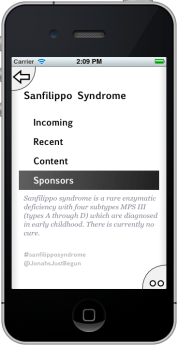
ODDT app adding a Sponsors tab

Version 0.9.7 of the Open Drug Discovery Teams app has been uploaded to the iTunes AppStore, and is awaiting review. The most noticeable difference in this version is that there is now a 4th tab, called Sponsors. This is a feature that is due to the completion of our IndieGoGo campaign, to which a handful of generous supporters expressed their encouragement. As of this version, we can associate sponsors with a topic simply by sending out a specially formatted tweet – a sponsorship acknowledgement is now a special kind of factoid.

Continue reading

Open Drug Discovery Teams & Google Alerts

The Open Drug Discovery Teams project started out as a minimum viable product that obtained all of its data from Twitter, using a server application that periodically polls for relevant hashtags. The development version has now been extended so that topics can also be associated with RSS feeds, and each of the topics has been paired with a feed created via Google Alerts. These source documents are spliced in with the Twitter feed, e.g. the Malaria topic now contains factoids that are obtained by looking for #malaria and a timely feed of articles that Google thinks are relevant to the “Malaria” keyword.

All of the crowdsourcing is still done via Twitter, regardless of where the content came from, i.e. you emit a tweet to endorse or disapprove. And using Twitter is still the appropriate way to inject content into ODDT, because you can just tweet it out and wait for it to be collected.

Addition of the Google-curated content provides a nice supplement the content stream. It will be going live soon, following a bit more testing on the development server.

New ODDT topic: Drug Repurposing

Today we added another topic to the Open Drug Discovery Teams project, called Drug Repurposing. The source material currently corresponds to the Twitter hashtag #drugrepurposing, which means that any time anyone tweets a link with that tag, it will find its way into the incoming content section for the topic.

To get the new topic off to a running start, the source material for version 1.0 of the Approved Drugs app has been divided up into page-sized chunks and tweeted-into the topic – which is the purpose of the series of tweeted datasheets. These provide name, structure and ChemSpider ID for about 1300 drugs approved by the FDA, which is the same data used by the app. The plan is to resubmit the series with each major revision of the source data, so the content will be available to anyone who wants it, not just anyone who has the app.

The Drug Repurposing page within the ODDT app currently looks like this:
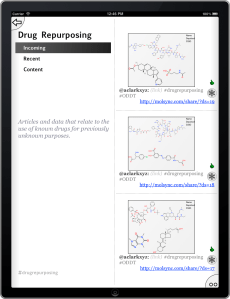
The first column of factoids each corresponds to one of the tweeted datasheets, containing approved drugs organised into groups by alphabet. The preview thumbnail in each case shows several of the drug stuctures, and a concise summary of the column named.

Tapping on one of the thumbnails brings up the datasheet viewer:
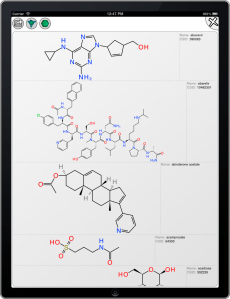
Note that both the thumbnail, and this scrollable detail-view, are rendered by the app itself. The server recognised the original content as chemical data, and passed this knowledge over to the app. The app parses the datasheet, and its constituent molecules, in order to display it in the appropriate context. The buttons on the top left of this page offer to make this data available to any other apps installed on your device.

Creating a new topic in ODDT and frontloading it with chemical data foreshadows one of the major design objectives of the project: the chemical structures will eventually be searchable, and features are on the drawing board for extracting all kinds of structure:property data from the underlying documents.

ODDT goes crowdfunding

The Open Drug Discovery Teams (ODDT) app was dreamed up earlier this year by Sean Ekins, and by March 2012, it was a minimum viable product with an app on the iTunes AppStore and a server doing its thing on the cloud. The purpose of the project is to aggregate chemistry data from public sources, and put it together under a set of topics. These topics are mainly related to efforts to find cures for rare and neglected diseases, and also for industry relevant precompetitive topics like green chemistry. The ODDT project is heavily focused on open data, and is an attempt to introduce crowd curation of data to open science.

While we are retaining ownership of the tools, which are based on proprietary chemistry app libraries and back-end cheminformatics tools from Molecular Materials Informatics, the front-end app is free to install and free to use. And we would like to keep it that way. Unfortunately cloud hosted servers are not free, and so far we have been paying the hosting cost out of pocket, as well as designing and building the software in our spare time. So now its time to ask people to pitch in, via the crowd-funding project on IndieGoGo. If you think propagating open science for good causes is an idea that ought to be encouraged, and approve of broadening the communities of people who are knowledgeable and potentially able to contribute to these kinds of topics, then please get involved. If you can donate to this project, that would be great. If you can tell people about it, that would also be great. If you’ve read this blog post, then surely you can tweet a link to it, or post it on your social network of choice! We would really appreciate it.

Chemical data hosting on molsync.com

As a follow on from a recent post, the idea of sharing chemical data by anonymously uploading it to a server, then making it available in value-added ways using a wrapper service, has been embellished. For the last year or so, the molsync.com server, with its all-original cheminformatics software stack, has provided services for various apps from Molecular Materials Informatics, such as rendering content as Microsoft Office formats, parsing ChemDraw CDX files, matching scaffold-substructures to SAR Tables, calculation of physical properties and tautomers, and enabling sharing of data from the Dropbox public folder using the MolSync app.

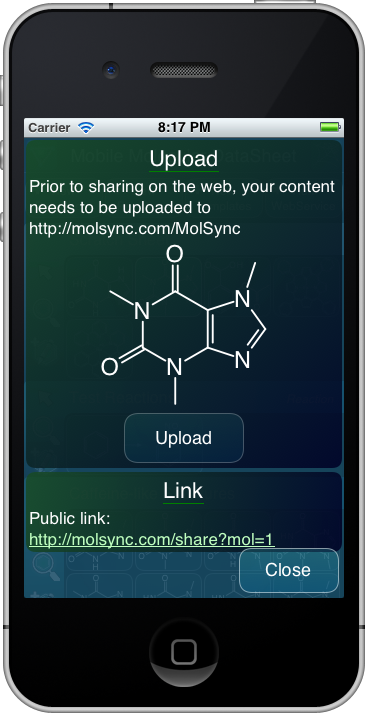
Now it goes one step further: it is possible for the apps to upload chemical documents (molecules, reactions or datasheets) directly to the molsync.com server. The uploads are anonymous and public, and are stored in a database on the server. On successful upload, they can be accessed via the returned ID number. For example, check out:

http://molsync.com/share?mol=1

http://molsync.com/share?ds=1

Continue reading