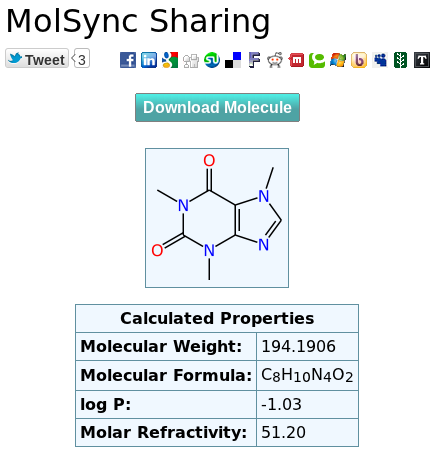
New functionality is being rolled out to the molsync.com server: a new implementation of log P and molar refractivity calculations, two important ADME properties. The functionality is currently available on the web-based interface:
cloud-servers
SAR Table app: now with scaffold substructure searching
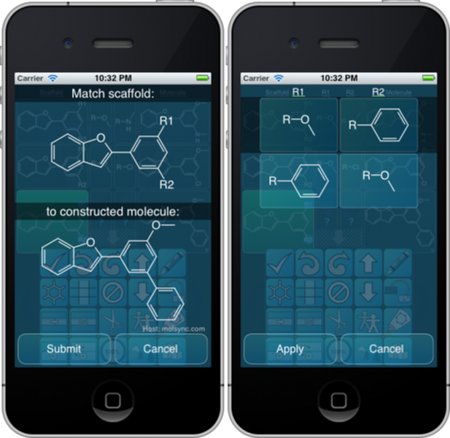
Version 1.1 of the SAR Table app just passed review and is available on the iTunes AppStore. This release is an important one, because it adds a major new feature: scaffold matching. For a row which has a whole molecule defined, and a scaffold core, the scaffold matching algorithm can be invoked to figure out the substituents:
2011 redux
2011 has been a busy year for Molecular Materials Informatics, with new products, new features and new developments coming on hard and fast. 2012 begins tomorrow, and promises to keep up the same breakneck pace. This post is an executive summary of some of the news that was released over the year. Leaving out of course some of the projects that have yet to be unveiled.
At the beginning of 2011, there were just two products, with the same name: the Mobile Molecular DataSheet, or MMDS for short. Due to the rapidly shifting fortunes of mobile device platform makers, the iOS version for iPhone, iPod and iPad took centre stage in 2011, leaving the BlackBerry version behind. The iOS version was mostly feature complete by the beginning of 2011, having already added webservices access and reaction editing. Throughout 2011 the product has steadily matured, with a regimen of software updates adding minor and not-so-minor features, enhancements, bug fixes and ergonomic improvements.
Recent MMDS improvements: drawing and rendering
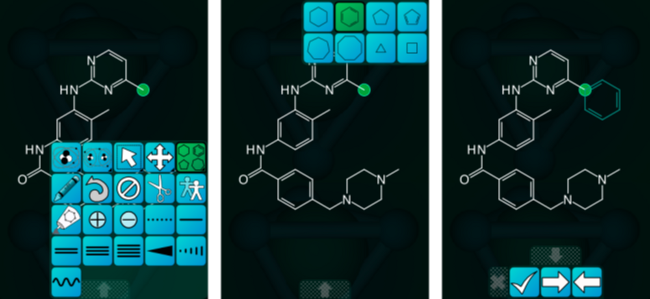
The Mobile Molecular DataSheet (MMDS) v1.3.7 has had a bit of attention to its sketching interface, and now makes available the most commonly used small ring templates from the context menu:
SAR Table app: significant roster of new features
Version 1.0.2 of the SAR Table app has just come out on the iOS AppStore. This is a significant upgrade, since it introduces a number of features that have been planned all along, but were left out of the 1.0 release, in order to get a minimum viable product in place.
One of the most noticeable differences is an expanded command bank for editing SAR tables:
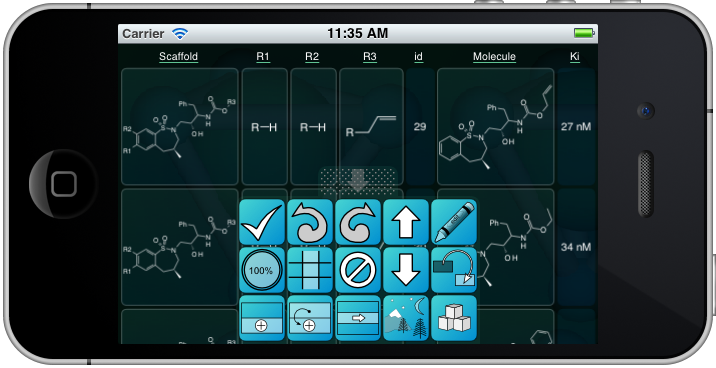
Most of the new features are described in the introductory tutorial, which has been updated for the new version. Continue reading
Sharing public data with MolSync
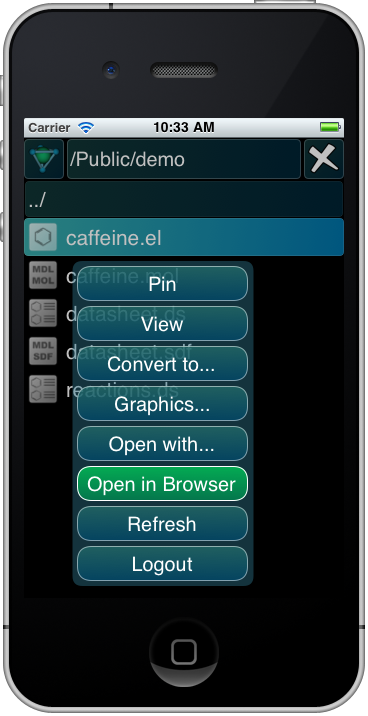
MolSync and MMDS integration
New versions of the Mobile Molecular DataSheet (MMDS) (v1.3) and MolSync (v1.1) are now available on the iTunes AppStore. This is a tandem-release, because the two apps have been enhanced so that they work together explicitly.
Energy-efficient cheminformatics
Mobile devices are energy efficient by design, while traditional PC architectures are not. This may seem like a trivial and obvious point, but it may still be worth making. Technology has a way of being influenced by its origins such that obsolete constraints and objectives live on throughout the decades. It may well be that the most practical way to reduce the energy bill for our information technology is to accelerate the transition to mobile platforms, even when we don’t necessarily need the mobility. Continue reading
 Cheminformatics 2.0