 Like a few hundred million other people, I was curious to see what the newly released Microsoft Word for iPad app was capable of. One feature in particular is of great interest to me: the rendering of DrawingML graphics. It does not go without saying by any means that the app will abide to its own (very complex) format specification, but I am pleased to report that it does.
iOS
The Green Lab Notebook project: where it’s at
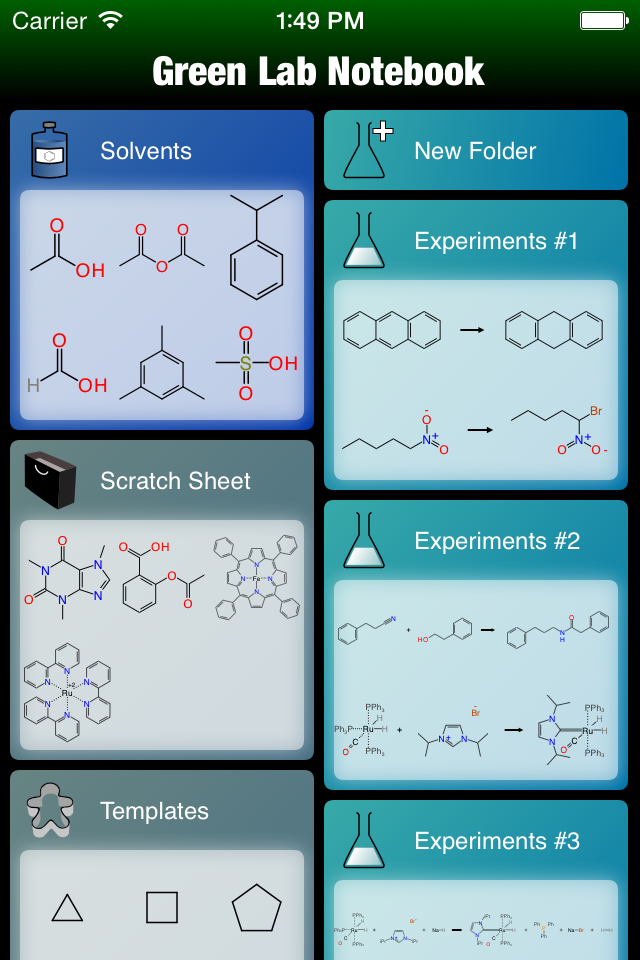 Last week I was at the American Chemical Society meeting in Dallas, which was incidently a particularly enjoyable gathering. I presented two talks, one of which described some of the latest developments of the Green Lab Notebook project (for slides, see slideshare and figshare). After having given a couple of talks about this as yet unfinished app, it’s time to start the run-down checklist for what goes into a minimum viable product.
Major new version of TB Mobile app
 The TB Mobile app for iOS has just received a major new update on the iTunes AppStore. Version 2 of the app brings some fairly powerful cheminformatics functionality to this free mobile app for tuberculosis research. Produced by Collaborative Drug Discovery, built by Molecular Materials Informatics, and organised by Sean Ekins, this app is pushing the boundaries of real science on mobile devices in several important ways. Continue reading
MetaSearch options: and stealth OpenPHACTS prefilter
 The 1.5 release of the Mobile Molecular DataSheet (MMDS) introduced a couple of major features, including a minimum viable feature deployment of OpenPHACTS assay integration. That is being quite liberal with the meaning of viable: building this into a practical scientific workflow is more of an ongoing campaign than a specific new piece of functionality, and so other features are being improved in lock step. The next one to get an upgrade is the searching capability, which has an additional preflight configuration block (shown to the right). Continue reading
Which platform to build software for?
For most of the desktop computing era (ca. 1980-2010) software creators have had to grapple with decisions of which operating systems to build their software for. This century, any desktop application with a user interface has been a choice of Windows/Linux/MacOSX, with relative importance being dependent on the industry. Since mobile devices turned into real computers, and HTML5 found its way onto mobile browsers, the decision has moved up a level: software creators now have to start by deciding which meta-platform, i.e. desktop, mobile or web. And it’s not always an easy choice. Continue reading
Mobile Molecular DataSheet landscape mode on iPhone
 The next major release of the Mobile Molecular DataSheet for iOS will be version 1.5, and it will include quite a few new bits, including the basic linear pipelining feature, as well as a major new service that I’ll describe later. The change that affects all of features is the migration to iOS 7, but perhaps more noticeably, when the app is used on the iPhone (or iPod) form factor, it now allows landscape mode, if you tilt your phone sideways. Continue reading
Linear pipelining operations with the Mobile Molecular DataSheet app
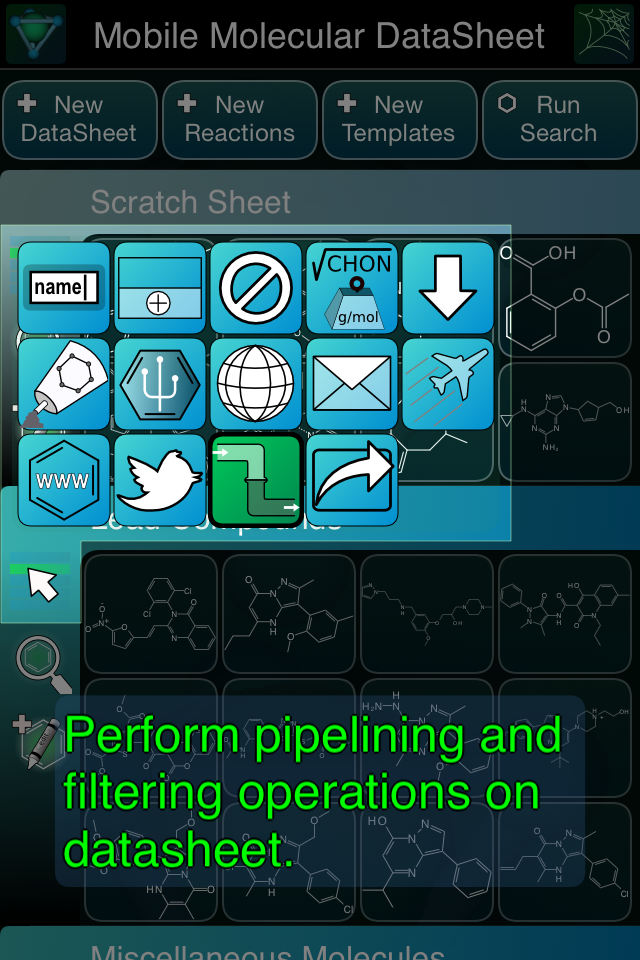 The next release of the Mobile Molecular DataSheet (MMDS) app will have a fairly major new feature: pipelining. First let me point out that it is not the grandiose feature that the name might suggest. Pipelining usually suggests a graphical layout tool allowing arbitrary nodes with multiple branches and huge volumes of data with sophisticated calculations at each step, and the new feature is much more constrained. But it is still useful, and intended to evolve into a midpoint compromise between power and simplicity. The system is engineered to provide linear pipelines (e.g. no branching, no alternative pathways, etc.): any number of datasheets can be jammed into the input funnel, but the outcome is always just a single resulting datasheet. The kinds of operations fit into 3 categories: filters, sorts and web operations. Filters are boolean logic clauses used to reduce the number of rows, sorts are are exactly what they sound like, and web operations are going to be implemented in a later iteration (keep reading for more about that). Continue reading
Mobile Molecular DataSheet refit: icon menus and importing
 The Mobile Molecular DataSheet (MMDS) app has been out there on the appstore for quite a long time (3.5 years), and has picked up quite a few rather advanced features. Along the way it has also accumulated an equally long wishlist of things to do, and things to improve on after the original iterative attempts to get it right. The next version that is waiting for review in the appstore (1.4.9) has two most noticeable changes: icon menus on the front-facing panel, and a redesigned import process. Continue reading
Winter project: Green Lab Notebook
 The Canadian winter has announced itself, coinciding with American thanksgiving. Apart from a lot more time indoors and a significantly increased consumption of heavy stout ales, it signifies time to hunker down and concentrate on product development for awhile. Continue reading
Dynamic similarity clustering in the Approved Drugs app
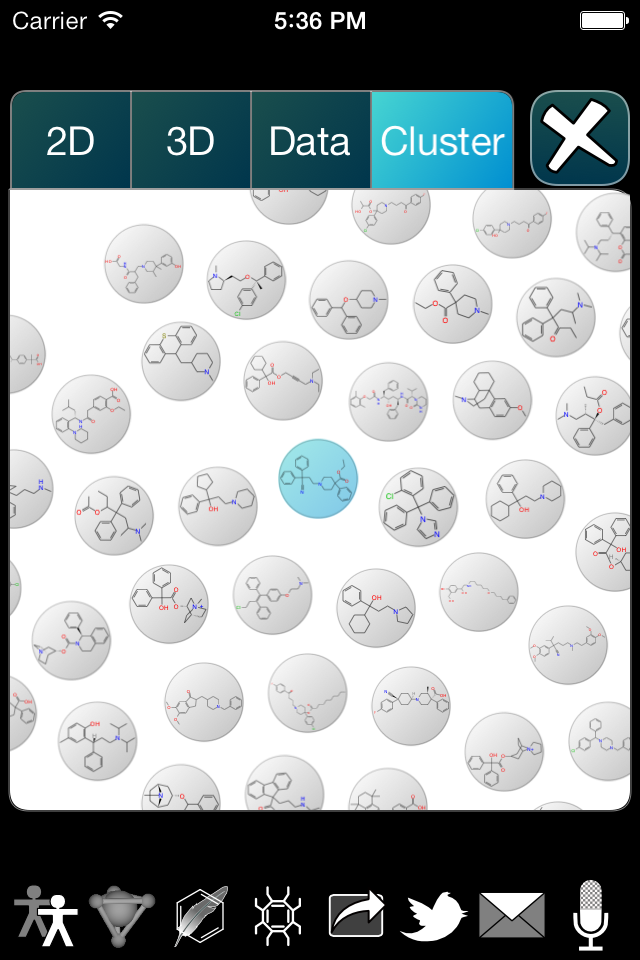 The Approved Drugs app is about to get a new update, which introduces a visual clustering feature. Initially, this is a bit of a novelty, but has a clear pathway toward a more sophisticated, high value offering. Continue reading
 Cheminformatics 2.0