Latest app: ChemSpider Mobile

This blog has been a bit quiet recently, as might be expected for the sweltering summer months of the northern hemisphere, but rest assured that the secret laboratory of Molecular Materials Informatics has been running at full capacity, with a number of new projects on the way.

Working closely with the ChemSpider team (in particular, Antony Williams and Valery Tkachenko), we are proud to announce that ChemSpider now has a custom-built mobile app, which runs on all the iOS touchscreen devices (iPhone, iPod, iPad). ChemSpider Mobile has been submitted to the Apple iTunes AppStore, which means that it is not actually available yet, but with any luck it will pass through the review process within a week or so. With a lot of luck, it might even be ready in time for the ACS meeting in Denver (August 2011).

There is a precursory overview of the app on the SciMobileApps wiki site. The app is free, just like the ChemSpider website. The design of the app is very simple and easy to navigate. It allows the ChemSpider database to be searched by structure or by name. It’s not a power-user tool like MMDS, rather it’s designed to get users up and running as quickly as possible. Continue reading
Hybrid desktop/mobile sketcher (sneak preview)

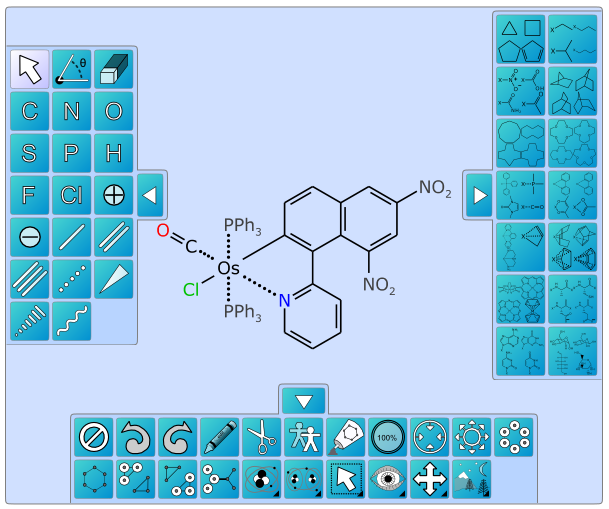
Users of the mobile apps produced by Molecular Materials Informatics will find the following screen capture familiar in two ways:

Hybrid sketcher: conventional toolbar, mobile command actions

The toolbar on the left is a conventional tool palette which is recognisable to any chemist who has used a desktop software package to draw molecular structures. The bottom and right toolbars are suspiciously similar to the main menu and template groups provided by the MMDS structure editor for iOS and BlackBerry mobile platforms. Continue reading

MMDS with remote procedure calls: email SVG

Version 1.2.8 of the Mobile Molecular DataSheet has been submitted to the AppStore: with any luck, the new version will be available within a few days. The release schedule got moved forward a little bit because the previous version inadvertantly blanked out two of the icons on the main menu (oops). The new version introduces a significant new feature that has been in the works for some time: MMDS now makes use of remote procedure calls to provide some of its functionality. The first such feature to be exposed is the ability to generate SVG (scalable vector graphics) of images when sending molecules, reactions or datasheets via email. Continue reading

Melting point prediction for MMDS by way of Open Notebook Science

As described in the UsefulChem blog, the Open Notebook Science WebServices project has been making good use of a collection of high quality, well curated physical property data, in particular: melting points. As many people have independently discovered, melting points have traditionally yielded poor results when subjected to attempts to use chemical descriptors to predict properties, as compared to other related physical properties, such as boiling point. It would seem, from recent results, that the reason for these poor results may well be primarily due to low quality data. As the data is cleaned up, the correlations improve.

These new results, which are based on open data, are made available to the world by way of webservices, and more recently, the functionality has been made available using the MMDS webservices protocol. MMDS (the Mobile Molecular DataSheet) uses an openly defined protocol which allows it to communicate with an arbitrary webservice. The Open Notebook Science physical property prediction service is now included in the default set of webservices offered to users of MMDS.

Continue reading

Upgrading apps to “retina quality”: starting with MolPrime

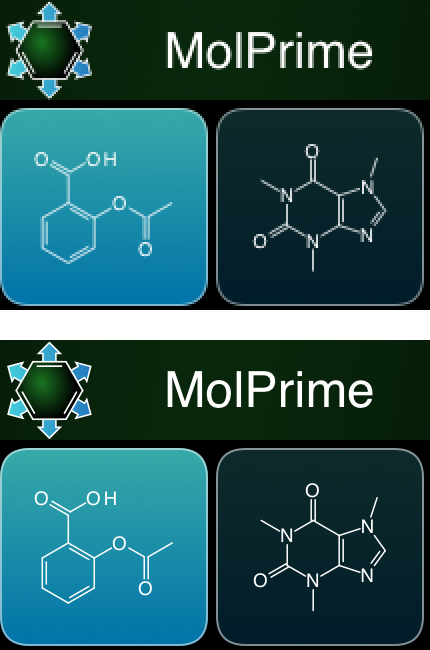
Top: regular display. Bottom: retina display.

Anyone who reads this blog and owns an iPhone 4 (or iPod equivalent) undoubtedly knows that one of the key differences between this device and its predecessor is the jump from 320×480 screen resolution to 640×960, which is double in both directions. Since the screen is the same physical size as the predecessor, this means that the pixel density is 4 times what it was, which essentially means that the resolution is so high that the user experience no longer needs to be reminded that pixels even exist. Hence the use of the term “retina”.

Continue reading

An inline abbreviation mechanism for structure diagrams

One of the habits that most chemists engage in when they sketch out structures with a pen and paper is the use of abbreviations for certain kinds of functional groups. Using abbreviations saves a lot of wasted time and ink, and it is also a useful way to draw attention to the chemistry that is relevant to the subject at hand, and away from the spinach that is coming along for the ride. For example:

In this classical organic chemisty reaction, the phenyl groups of the Wittig reagent are abbreviated as Ph, and the unreactive alkyl chain is abbreviated as a molecular formula, because these groups are inert and not particularly exciting; the part that really matters is the reaction transform.

Continue reading

The current menagerie: MMDS, Reaction101, Yield101

Icons for MMDS, Reaction101, Yield101As of the time of writing, the number of iOS apps published by Molecular Materials Informatics is about to grow to three, with the addition of Yield101, which is in the final stages of testing prior to submitting to the app store. All of these products are built around the same technology core, which includes, most importantly, a chemical structure diagram editor that is optimised for smartphone/tablet-sized devices. They also share a common visual theme and user interface style elements.

The apps, in chronological order of release are… Continue reading