A new publication and two ACS talks

A paper has recently emerged in Molecular Informatics, which Sean Ekins, Antony Williams and myself put together earlier this year, entitled Redefining Cheminformatics with Intuitive Collaborative Mobile Apps. It is currently available as an early access preview, and also happens to be open access, so if you have any interest in how mobile apps can and do fit together in a cheminformatics workflow, go download it now.

The abstract:

The proliferation of mobile devices such as smartphones and tablet computers has recently been extended to include a growing ecosystem of increasingly sophisticated chemistry software packages, commonly known as apps. The capabilities that these apps can offer to the practicing chemist are approaching those of conventional desktop-based software, but apps tend to be focused on a relatively small range of tasks. To overcome this, chemistry apps must be able to seamlessly transfer data to other apps, and through the network to other devices, as well as to other platforms, such as desktops and servers, using documented file formats and protocols whenever possible. This article describes the development and state of the art with regard to chemistry-aware apps that make use of facile data interchange, and some of the scenarios in which these apps can be inserted into a chemical information workflow to increase productivity. A selection of contemporary apps is used to demonstrate their relevance to pharmaceutical research. Mobile apps represent a novel approach for delivery of cheminformatics tools to chemists and other scientists, and indications suggest that mobile devices represent a disruptive technology for drug discovery, as they have been to many other industries.

If you are attending the American Chemical Society meeting in Philadelphia next month, or know somebody who is, you might be interested in either or both of my talks. The first one is on the Sunday, in the Chemical Education division; the second one is on Monday, in Chemical Information: Continue reading
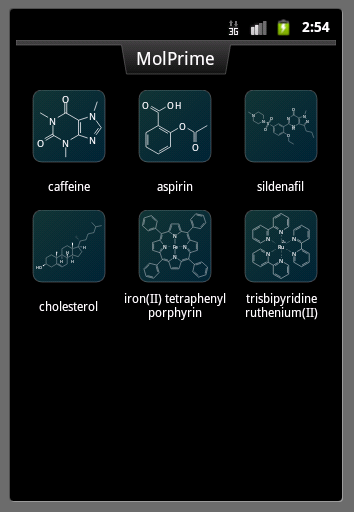
Say hello to Android!

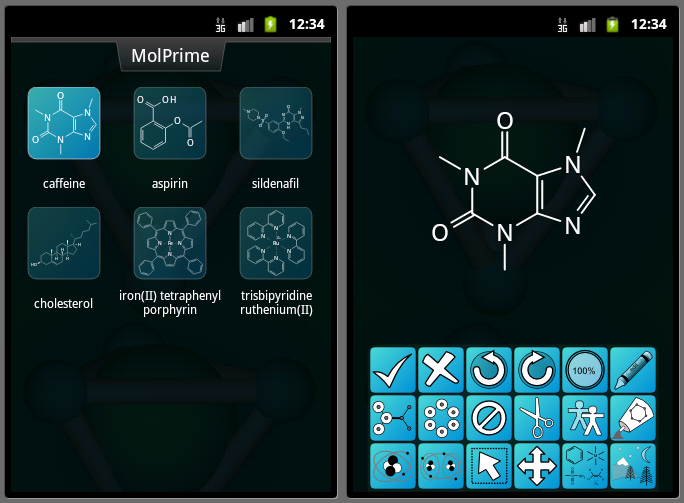
Preview of MolPrime for Android, main screen

As the screen capture to the right suggests, Molecular Materials Informatics has gotten out the sonic screwdriver and started porting mobile chemistry tools to the Android platform. Work has begun on porting MolPrime – currently only available for iOS – to Android. Before any Android users get too excited, though, this is just an early preview – it doesn’t do much, and there is no estimated completion time as yet. But if you keep reading this blog, you will get regular progress updates. Continue reading

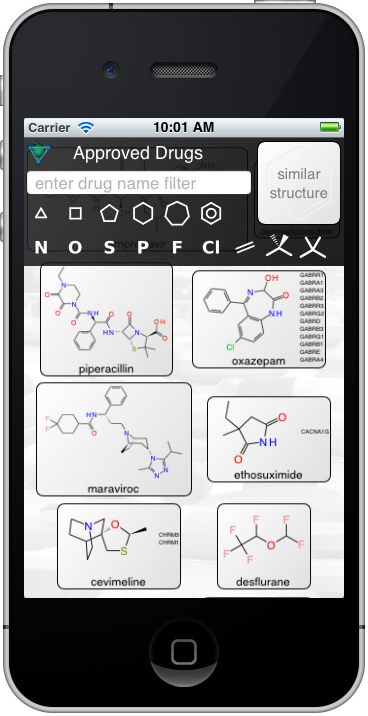
Approved Drugs gets more fields: targets and synonyms

The Approved Drugs app has a new version awaiting review on the AppStore which adds drug targets and synonyms. The target codes have been integrated from the supplementary information of a recent Nature paper describing the prediction of side-effect targets (Lounkine, Keiser, et al), and provide data for 500 or so of the entries. Synonyms have been obtained by using the ChemSpider API, combined with some automated filters and manual verification to restrict the list to common trade names. Continue reading

Open Drug Discovery Teams & Google Alerts

The Open Drug Discovery Teams project started out as a minimum viable product that obtained all of its data from Twitter, using a server application that periodically polls for relevant hashtags. The development version has now been extended so that topics can also be associated with RSS feeds, and each of the topics has been paired with a feed created via Google Alerts. These source documents are spliced in with the Twitter feed, e.g. the Malaria topic now contains factoids that are obtained by looking for #malaria and a timely feed of articles that Google thinks are relevant to the “Malaria” keyword.

All of the crowdsourcing is still done via Twitter, regardless of where the content came from, i.e. you emit a tweet to endorse or disapprove. And using Twitter is still the appropriate way to inject content into ODDT, because you can just tweet it out and wait for it to be collected.

Addition of the Google-curated content provides a nice supplement the content stream. It will be going live soon, following a bit more testing on the development server.

New ODDT topic: Drug Repurposing

Today we added another topic to the Open Drug Discovery Teams project, called Drug Repurposing. The source material currently corresponds to the Twitter hashtag #drugrepurposing, which means that any time anyone tweets a link with that tag, it will find its way into the incoming content section for the topic.

To get the new topic off to a running start, the source material for version 1.0 of the Approved Drugs app has been divided up into page-sized chunks and tweeted-into the topic – which is the purpose of the series of tweeted datasheets. These provide name, structure and ChemSpider ID for about 1300 drugs approved by the FDA, which is the same data used by the app. The plan is to resubmit the series with each major revision of the source data, so the content will be available to anyone who wants it, not just anyone who has the app.

The Drug Repurposing page within the ODDT app currently looks like this:

The first column of factoids each corresponds to one of the tweeted datasheets, containing approved drugs organised into groups by alphabet. The preview thumbnail in each case shows several of the drug stuctures, and a concise summary of the column named.

Tapping on one of the thumbnails brings up the datasheet viewer:

Note that both the thumbnail, and this scrollable detail-view, are rendered by the app itself. The server recognised the original content as chemical data, and passed this knowledge over to the app. The app parses the datasheet, and its constituent molecules, in order to display it in the appropriate context. The buttons on the top left of this page offer to make this data available to any other apps installed on your device.

Creating a new topic in ODDT and frontloading it with chemical data foreshadows one of the major design objectives of the project: the chemical structures will eventually be searchable, and features are on the drawing board for extracting all kinds of structure:property data from the underlying documents.

ODDT goes crowdfunding

The Open Drug Discovery Teams (ODDT) app was dreamed up earlier this year by Sean Ekins, and by March 2012, it was a minimum viable product with an app on the iTunes AppStore and a server doing its thing on the cloud. The purpose of the project is to aggregate chemistry data from public sources, and put it together under a set of topics. These topics are mainly related to efforts to find cures for rare and neglected diseases, and also for industry relevant precompetitive topics like green chemistry. The ODDT project is heavily focused on open data, and is an attempt to introduce crowd curation of data to open science.

While we are retaining ownership of the tools, which are based on proprietary chemistry app libraries and back-end cheminformatics tools from Molecular Materials Informatics, the front-end app is free to install and free to use. And we would like to keep it that way. Unfortunately cloud hosted servers are not free, and so far we have been paying the hosting cost out of pocket, as well as designing and building the software in our spare time. So now its time to ask people to pitch in, via the crowd-funding project on IndieGoGo. If you think propagating open science for good causes is an idea that ought to be encouraged, and approve of broadening the communities of people who are knowledgeable and potentially able to contribute to these kinds of topics, then please get involved. If you can donate to this project, that would be great. If you can tell people about it, that would also be great. If you’ve read this blog post, then surely you can tweet a link to it, or post it on your social network of choice! We would really appreciate it.

Approved Drugs app approved: new ideas already queuing up

If you’ll excuse the tongue-twister in the title, the Approved Drugs app is now available on the iTunes AppStore. There is now an official documentation page for it, which covers all the functionality. With the app being live for barely 24 hours, already ideas for enhancements are starting to manifest themselves.

One of them relates to a paper that appeared in Nature a few days after the app was submitted, entitled Large-scale prediction and testing of drug activity on side-effect targets. This paper describes a similarity-based approach for predicting the likely targets for a potential structure, by comparing it to known activities of existing structures vs. known targets – and hence creating a predictivity model for side effects.

The technology used to accomplish this is quite similar to what the Approved Drugs app already has. And the paper included quite a bit of useful source material in the supplementary information. So future revisions may just pick up the pace quite a bit!

Using ODDT to view Olympicene

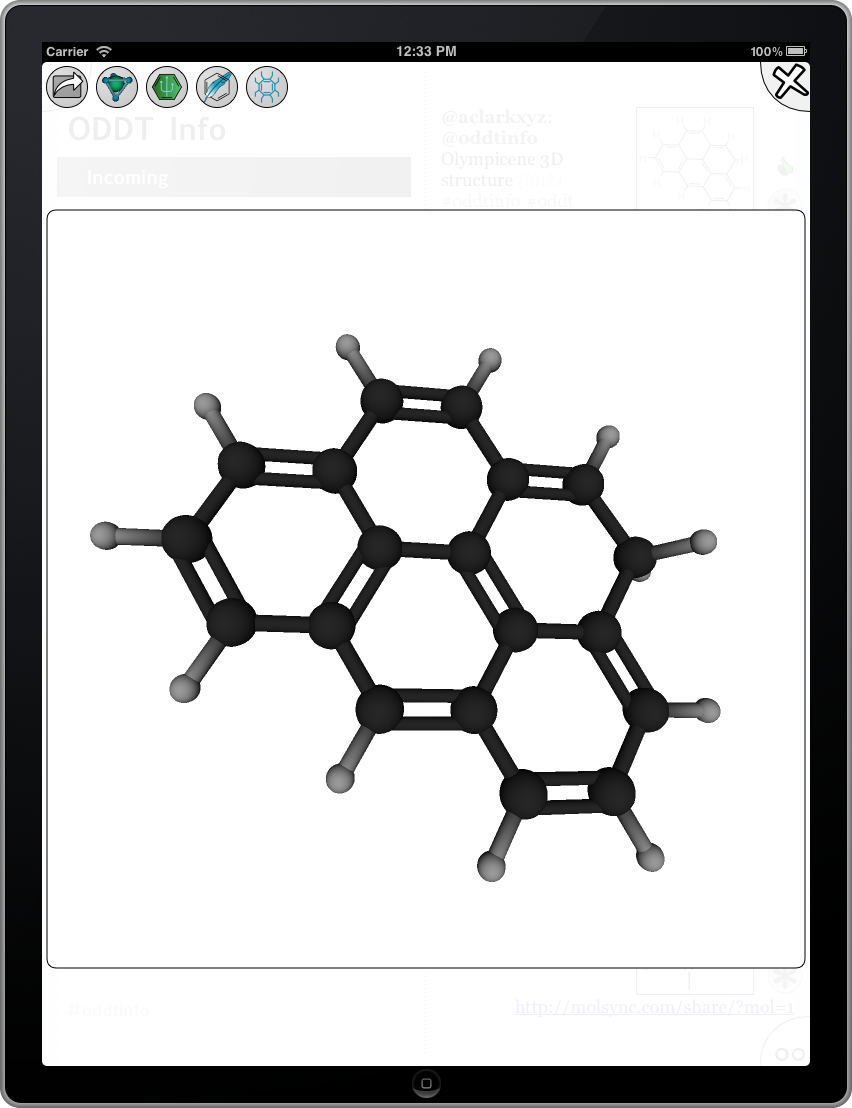
Given all the recent publicity about the timely novelty molecule olympicene, here’s another layer of gimmickry: using the latest version of the Open Drug Discovery Teams (ODDT) app for iOS (free download: iTunes AppStore), it is possible to view the 3D structure of the molecule on your iPhone/iPod/iPad. While most of the chemical structure content that can be browsed using this app is in the form of 2D diagrams, the latest version (0.9.3) added the ability to view 3D structures as well, making use of OpenGL ES. Continue reading