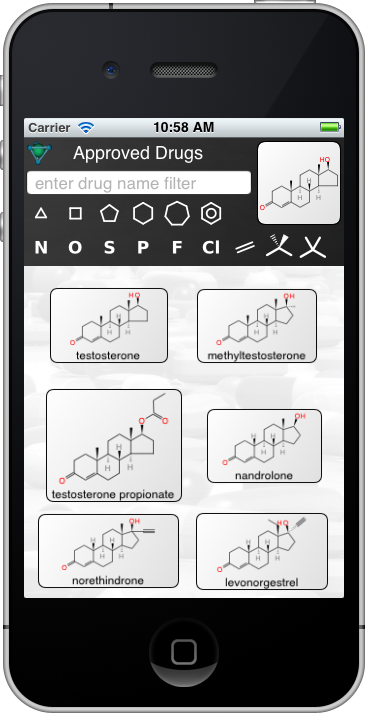
 A new app from Molecular Materials Informatics is now waiting on the iTunes AppStore: the Approved Drugs app, which provides a list of drugs (structure, name) from the set of drugs that have been approved by the FDA.
The basic interface is simple: about 1300 drugs are contained within the app itself, and when the app starts, they are displayed onscreen, in a list that can be scrolled up and down. Each entry in the list is a nicely depicted 2D structure diagram with a name underneath. Continue reading
mobile devices
Chemical data hosting on molsync.com
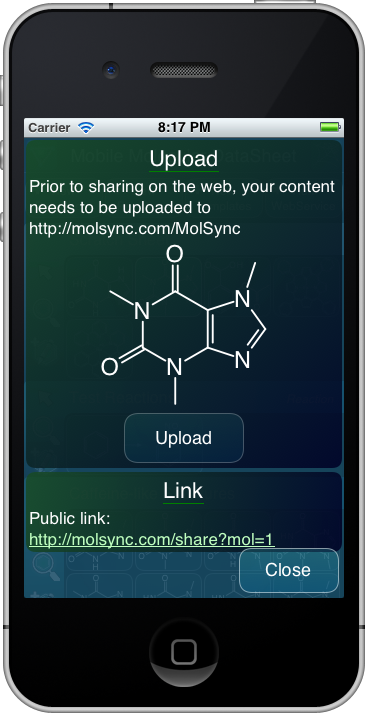 As a follow on from a recent post, the idea of sharing chemical data by anonymously uploading it to a server, then making it available in value-added ways using a wrapper service, has been embellished. For the last year or so, the molsync.com server, with its all-original cheminformatics software stack, has provided services for various apps from Molecular Materials Informatics, such as rendering content as Microsoft Office formats, parsing ChemDraw CDX files, matching scaffold-substructures to SAR Tables, calculation of physical properties and tautomers, and enabling sharing of data from the Dropbox public folder using the MolSync app.
Now it goes one step further: it is possible for the apps to upload chemical documents (molecules, reactions or datasheets) directly to the molsync.com server. The uploads are anonymous and public, and are stored in a database on the server. On successful upload, they can be accessed via the returned ID number. For example, check out:
Sneak preview: 3D molecule viewing in Open Drug Discovery Teams app
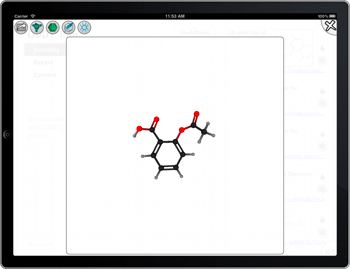 The Open Drug Discovery Teams app will soon acquire a new feature: viewing of 3D molecules from within the app. It will be the first app from Molecular Materials Informatics to make use of recently developed OpenGL code for molecule rendering and visualisation in 3D. Click on the thumbnail on the right for a very short demo, which shows ODDT in action, opening up a factoid-tweet that provides as its payload a 3D conformation of aspirin.
Tweeting chemistry from mobile apps: one less step
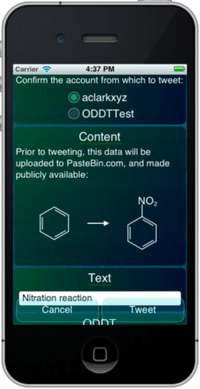
A new feature will be making its way to the Mobile Molecular DataSheet, and other apps, soon: tweeting out chemical data (molecules, reactions, datasheets) without having to login to a repository for storing the source data. All that’s required is authorisation of your Twitter account, as configured within iOS.
To see a preview of how it works, click on the image to the right, to watch a short screencast.
Venturing into the world of 3D
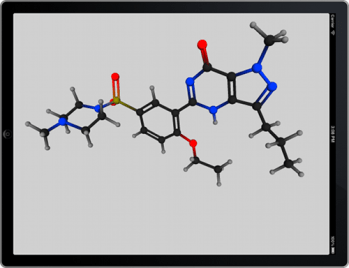 Over the last week or so, I’ve been spinning up some test code and infrastructure for supplementing my mobile apps with 3D viewing capabilities. This involves adventuring into the wild world of OpenGL ES, which is quite a maze of toolkits, meta-toolkits, versions, subsets, deprecated functions and optimisation gotchas. Nonetheless, I now have a widget capable of displaying 3D MOLfiles, and thus far allowing finger-dragging to rotate, as you can see if you click on the image to the right and watch the short screencast.
MolSync v1.2 adds iCloud support
 MolSync v1.2 has just been submitted to the AppStore, and with any luck will pass through the review process in a week or so. The new version adds another repository type: iCloud. In prior versions, the app supported only Dropbox, but has always been intended to support a variety of services. Continue reading
UI tweaks: corner tabs and general configuration settings
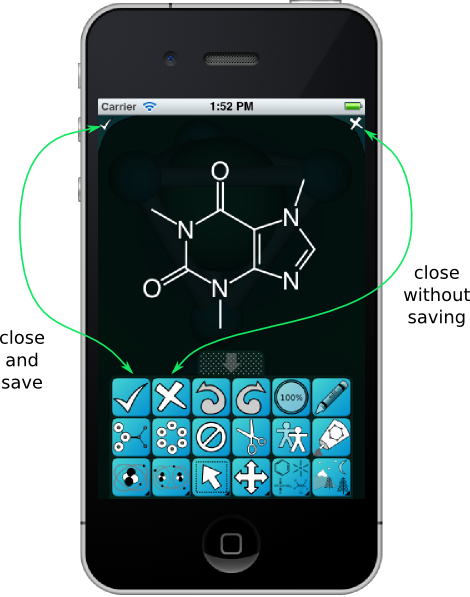 The editor panels for the MMDS app (structures, reactions and datasheets) have been augmented to include new buttons along the top corners, which can be used to close the editor. These are analogous to buttons in the main bank for close and save and close without saving. This addresses a minor but persistent inconvenience: previously, the main command bank had to be open in order to exit from any of the editor panels. Continue reading
Sneak preview: SAR Table matrix view
 The SAR Table app is currently undergoing surgery to add a major new feature: the matrix view, which allows two columns to be plotted against each other, e.g. R1 vs. R2. Cells at the intersection of two values are plotted with a colour/gradient that is indicative of the response, i.e. the activity. The sample snapshot to the right displays several activity values using the “heat map” colour scheme.
The new feature is in its early stages, and the visual feng shui will certainly mutate before the next release, but the core functionality is operational. Stay tuned for the next major version.
Open Drug Discovery Teams presentation at Montreal NewTech
Last night I presented a 5-minute slideshow/5-minute questions for Open Drug Discovery Teams, at the Montreal NewTech event. The slides are up on slideshare, and a video will be forthcoming in the not too distant future.
Encapsulated PostScript (EPS) graphics from mobile or web
The remote procedure calls provided by molsync.com now allow the creation of publication quality graphics in a number of formats. The list has been extended to include Encapsulated PostScript (EPS), which can be generated using the web interface, or from the next version of the Mobile Molecular DataSheet (currently awaiting review).
 Cheminformatics 2.0