A new app is on the way: MolPrime+

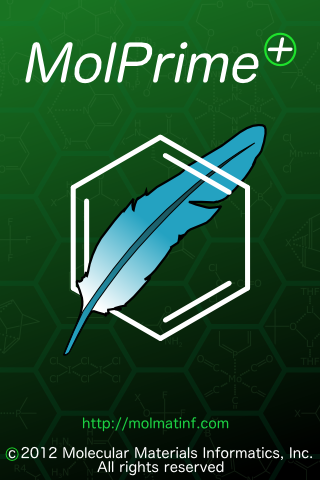
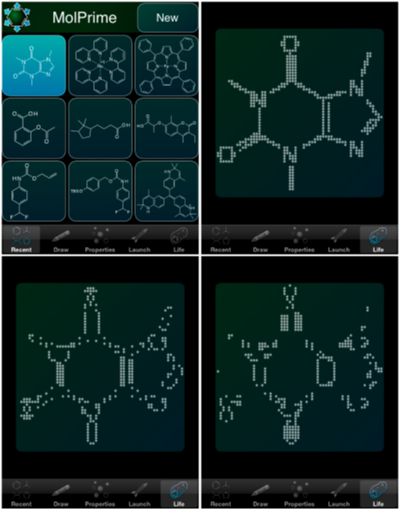
There is now another iOS app waiting for initial approval on the AppStore, by the name of MolPrime+. As the name suggests, this is an enhanced version of the MolPrime app. Once the app gets through the review process, it will be available for the grand price of one dollar, whereas its predecessor was free. In return for this investment, advertisements are gone, some more advanced structure-properties can be calculated, and more graphics exporting options are available, including exporting vector graphics to Microsoft Word’s .docx format. And also the user interface has been overhauled, and if you’re not convinced already, it even has new cover art:

2011 redux

2011 has been a busy year for Molecular Materials Informatics, with new products, new features and new developments coming on hard and fast. 2012 begins tomorrow, and promises to keep up the same breakneck pace. This post is an executive summary of some of the news that was released over the year. Leaving out of course some of the projects that have yet to be unveiled.

At the beginning of 2011, there were just two products, with the same name: the Mobile Molecular DataSheet, or MMDS for short. Due to the rapidly shifting fortunes of mobile device platform makers, the iOS version for iPhone, iPod and iPad took centre stage in 2011, leaving the BlackBerry version behind. The iOS version was mostly feature complete by the beginning of 2011, having already added webservices access and reaction editing. Throughout 2011 the product has steadily matured, with a regimen of software updates adding minor and not-so-minor features, enhancements, bug fixes and ergonomic improvements.

Continue reading

Mobile chemistry: coming of age

A review has recently been published in Drug Discovery Today, for which I have the honour of being one of the co-authors. The primary instigators are Antony Williams and Sean Ekins. The review is a 12 page tour through some of the highlights of mobile chemistry software. The subject is evolving very rapidly, though – in the months since the manuscript was originally submitted, there have been a number of new developments, e.g. MolSync, ChemSpider Mobile, Reagents… it’s almost time for another review!

Mobile chemistry app ecosystem to date

The current collection of apps for iOS (iPhone/iPod/iPad) which are based on, or make use of, core technology from the Mobile Molecular DataSheet:

The Mobile Molecular DataSheet (MMDS) is the progenitor app, which provides features for drawing molecular structures and reactions, organising datasheets, sharing data, access to web services, and many more. See product page and AppStore.
MolSync provides chemically aware access to cloud-hosted file repositories, which currently means Dropbox. Files can be browsed, viewed, converted and made into graphics. The app works particularly well in combination with MMDS: the two apps integrate together as a synchronisation/versioning tool/collaboration utility. See product page and AppStore.
Reaction101 focuses on editing one reaction at a time. Its simplicity, combined with reaction balancing capabilities, make it particularly useful for chemistry students. The app also provides integration with the Mobile Reagents database, common reactions for use as templates, and cloud-based storage of data. See product page and AppStore.
Yield101 focuses on the quantities involved in a reaction, and automatically calculates related amounts, using molecular weight from structure to interconvert mass, moles, volume, density, concentration, and ultimately yield. This app is useful to students practicing quantity interconversions, as well as any chemist who wants to spend less time using a calculator. See product page and AppStore.
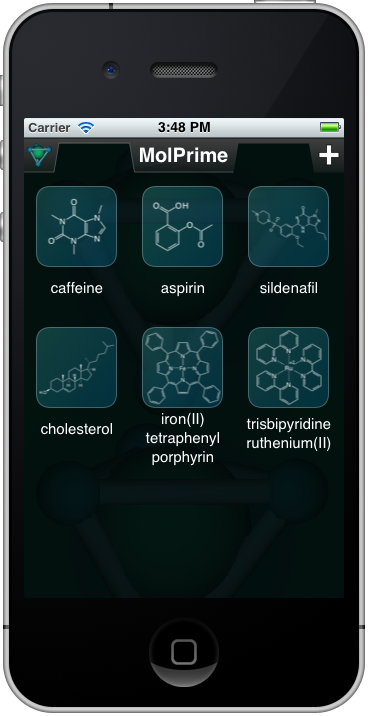
MolPrime is a free app which allows a structure to be drawn, then used in several ways: reviewed for basic properties, launched with other apps, searched with Mobile Reagents or ChemSpider, copied to the clipboard or sent by email. It also lets you play Conway’s Life, using the chemical structure to seed the first generation. See product page and AppStore.
Green Solvents is a free app which presents a list of solvents, categorised by functional group. Each of the solvents comes with information about its properties with regard to environmental hazards and disposal. They can easily be looked up in ChemSpider and Mobile Reagents, and there is also a slider-tile minigame, to help out with lab down-time. See product page and AppStore.
ChemSpider Mobile provides the most effective way to search ChemSpider for chemical structures from a mobile device. The app was commissioned by the Royal Society of Chemistry, and is free to use. See product page and AppStore.

Furthermore, there are two products from Eidogen-Sertanty that make use of MMDSLib to provide structure drawing capabilities: Mobile Reagents and iProtein. And there are more apps in development, so expect this list to grow!


Upgrading apps to “retina quality”: starting with MolPrime

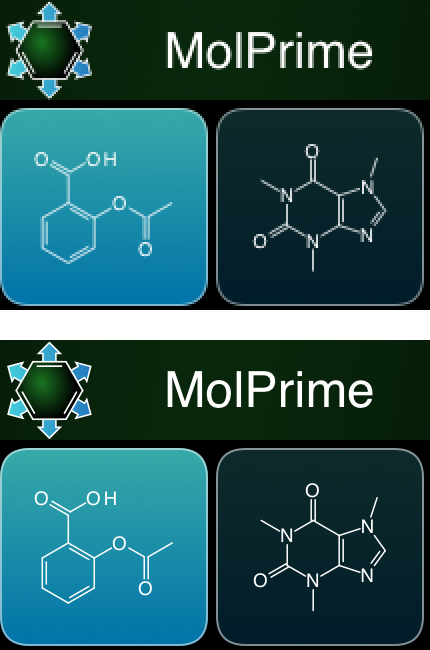
Top: regular display. Bottom: retina display.

Anyone who reads this blog and owns an iPhone 4 (or iPod equivalent) undoubtedly knows that one of the key differences between this device and its predecessor is the jump from 320×480 screen resolution to 640×960, which is double in both directions. Since the screen is the same physical size as the predecessor, this means that the pixel density is 4 times what it was, which essentially means that the resolution is so high that the user experience no longer needs to be reminded that pixels even exist. Hence the use of the term “retina”.

Continue reading