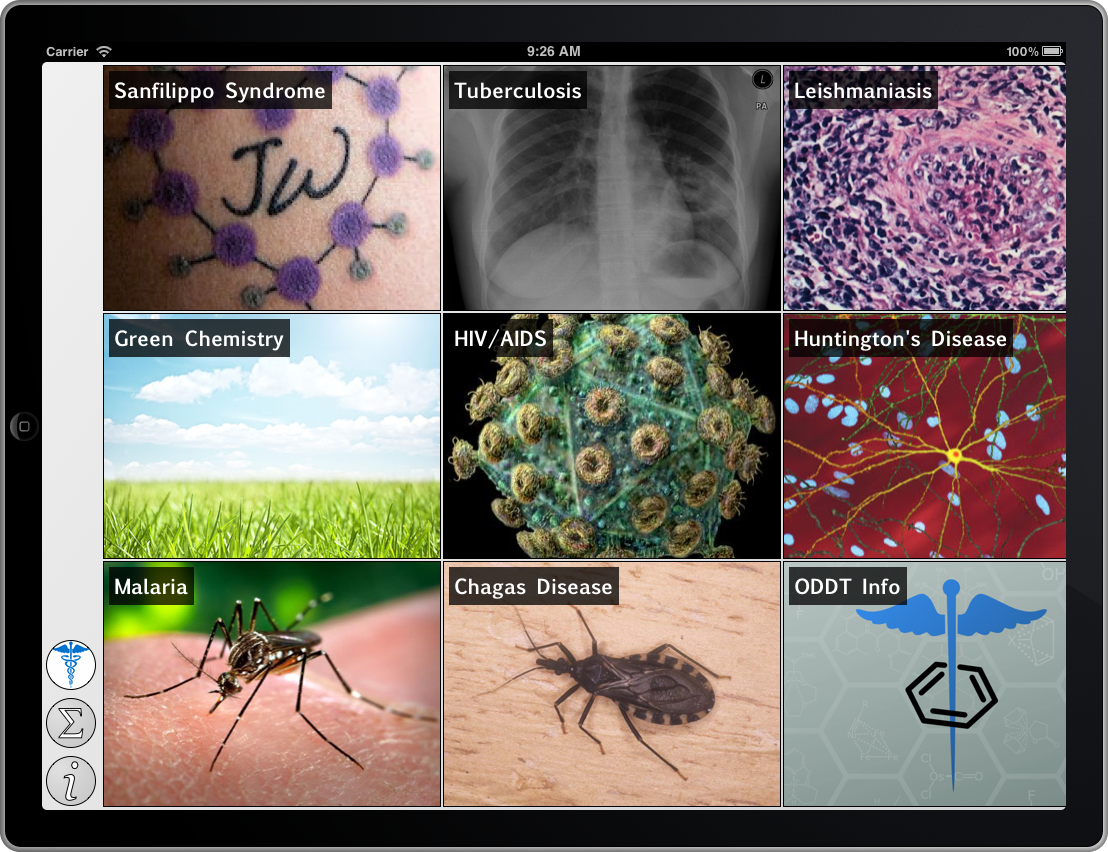
 The Open Drug Discovery Teams (ODDT) app has now officially entered the public beta phase: it can be freely downloaded from the iTunes AppStore. The app should still be considered to be a minimum viable product, and by designating it as a beta release, we reserve the right to do regular upgrades/maintenance on the back end server. It is, however, highly functional, and definitely ready to take a look. Continue reading
ODDT entering beta phase
The Open Drug Discovery Teams app (ODDT) has now been promoted to “beta” status (version 0.9.0) and submitted to the iTunes AppStore. If all goes well, within a fortnight anyone with an iPhone, iPod or iPad will be able to download the app for free, and try it out.
Even though the app is now in the process of being made available to the public, it is still a very early product, and the list of features to be added is long. We fully expect community feedback to have a considerable impact on how the project evolves.
Sketcher improvements: familiar toolbars, and helpful tooltips
The 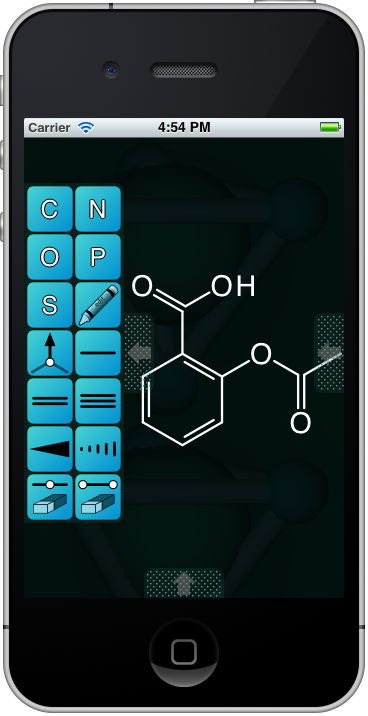 chemical structure diagram editor used by the Mobile Molecular DataSheet, and all other apps created by Molecular Materials Informatics, is currently undergoing a refit in order to make it more accessible to new users. The sketcher, which has been around for nearly 2 years, is based on a drawing paradigm that was designed from the ground up to be suitable for small-sized devices with severe constraints on screen real estate and user interaction methods. It can be used on iPads, iPhones, and even non-touch BlackBerry phones with trackpad+keyboard, to draw publication quality structures, both quickly and perfectly. While the method makes extensive use of gestures, there is still a down side to all of this functionality: it comes with a learning curve. But this about to change, which you can watch via this YouTube clip. Continue reading
Icon makeover for MMDS and other mobile apps
The Mobile Molecular DataSheet,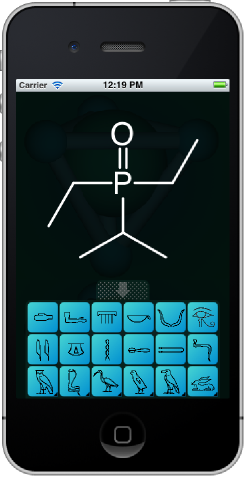 and other mobile apps, will soon have an icon makeover. Implementing a publication-quality molecular drawing user interface for all sizes of mobile device, from the palm-sized iPhone to the page-sized iPad, is no simple task: there are many aspects of functionality, and the screen only has enough room to represent all of the options with iconic glyphs. Because there are so many components to drawing chemical structures, there are correspondingly a lot of icons. Continue reading
ACS Talk: Building a mobile app ecosystem for chemistry collaboration
The slides for my recent presentation at the American Chemical Society meeting in San Diego (Spring 2012):
The slides cover a whirlwind tour through some of the apps produced by Molecular Materials Informatics, showing how they can be used together in a realistic chemical information workflow.
Mobile sketching: convert group to formula
Version 1.3.9 of the Mobile Molecular DataSheet (MMDS) for iOS has just come out, and it brings a nice improvement to molecule sketching: there is now an action button for converting a selected terminal group into an inline abbreviation, which is automatically set to its molecular formula:

The action subsumes the selected atoms into an inline abbreviation, so the original chemical structure is preserved. Representing formulae within a molecular structure is a very common way to condense representations of a structure, and using this method ensures that the structural nuances are not lost, i.e. the abbreviation can be restored by re-expanding it, and the overall molecular formula for the structure is still calculated correctly. Continue reading
ODDT: web page crawling in search of images
The latest alpha testing version of ODDT (Open Drug Discovery Teams) has been enhanced to be considerably more graphical. The back-end server operates by regularly polling for predefined Twitter hashtags, and assimilating new content into its own stream. For several revisions, links that contain chemical data (structures, reactions, datasheets) have been recognised explicitly, and handled by the app, allowing the content to be previewed and used in conjunction with other apps. Now images are handled as well: tweets with links that go directly to images are recognised as such, and links that lead to HTML pages are downloaded and crawled, in search of references to embedded images.
Reaction101 and Yield101 update
 Late last year my company, Molecular Materials Informatics, in conjunction with Eidogen-Sertanty, released a white paper [PDF] that describes the Reaction101 and Yield101 apps, with a particular emphasis on their use in a classroom environment. The document has been added to Slideshare as well, to encourage sharing.
ChemSpider and ODDT: content recognition
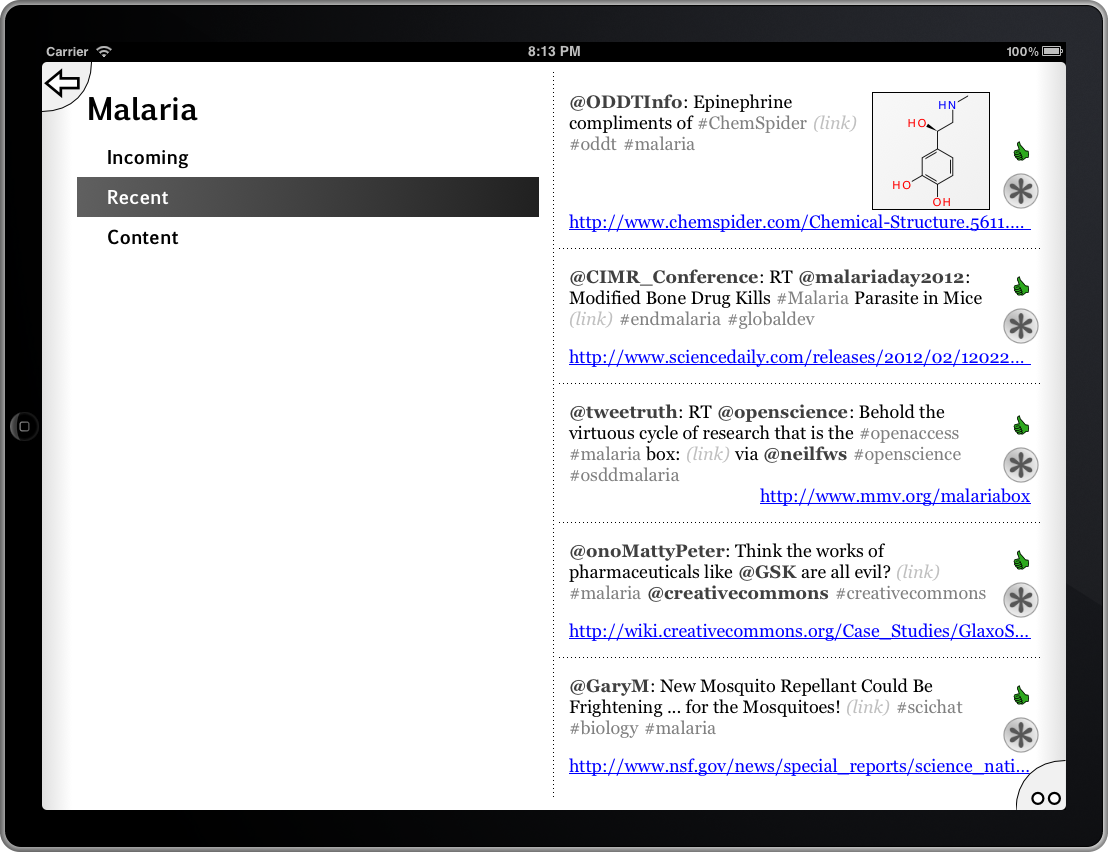 The latest feature to be added into the Open Drug Discovery Teams (ODDT) prototype is integration with tweeted links from ChemSpider. As can be seen on the picture to the right, the top-listed factoid has an inline picture of the molecular structure of epinephrine. The actual link itself goes to the ChemSpider page for that structure.
ODDT snapshot: twitter mugshots
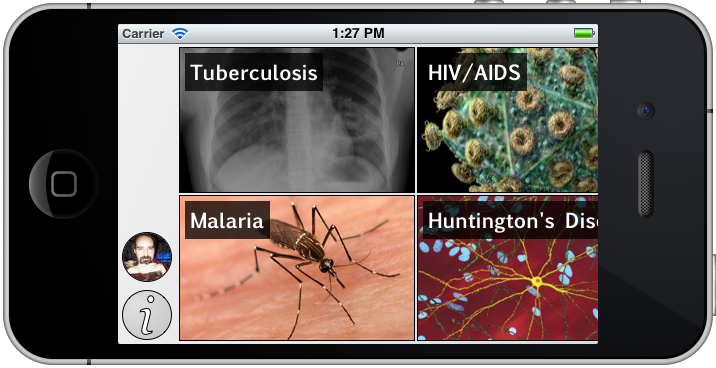 The alpha stage prototype of the Open Drug Discovery Teams (ODDT) app proceeds. Since the last snapshot, a couple of extra buttons have been added to the main page, as can be seen by the graphic on the right (which also demonstrates that this is not just an iPad app, it is designed to work on iPhones/iPods as well). Continue reading
 Cheminformatics 2.0