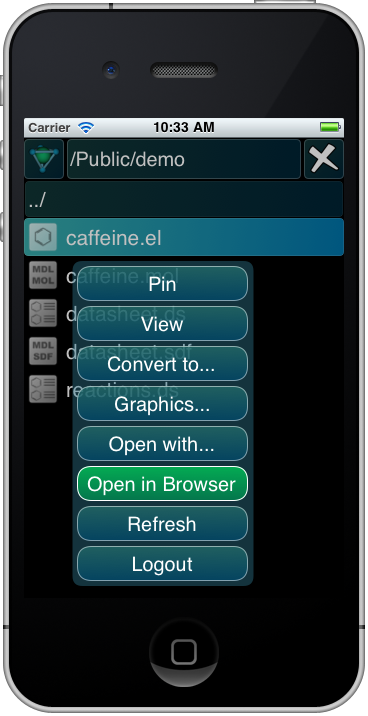
MolSync v1.1.1 is now available on the AppStore, and it comes with a subtle little menu option that is available when browsing your Public folder:
New versions of the Mobile Molecular DataSheet (MMDS) (v1.3) and MolSync (v1.1) are now available on the iTunes AppStore. This is a tandem-release, because the two apps have been enhanced so that they work together explicitly.
The latest version of MolPrime now comes with its own mini-game: Life! Old-school 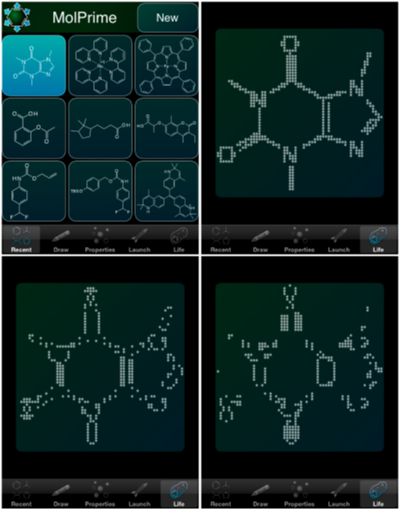 math-science types will be intimately familiar with this game, which was invented in 1970 by John Horton Conway. It simulates the birth and death of cells, which is determined by the number of adjacent cells in the previous generation. Continue reading
Mobile devices are energy efficient by design, while traditional PC architectures are not. This may seem like a trivial and obvious point, but it may still be worth making. Technology has a way of being influenced by its origins such that obsolete constraints and objectives live on throughout the decades. It may well be that the most practical way to reduce the energy bill for our information technology is to accelerate the transition to mobile platforms, even when we don’t necessarily need the mobility. Continue reading
Ever 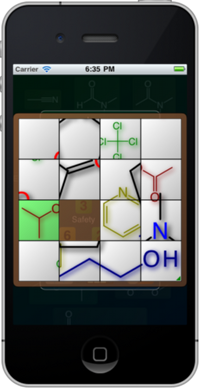 had an idle moment where you just want to entertain yourself with a mindlessly simple game, but still want to stay in the chemistry zone and keep focused on staring at molecules? Well very soon you will be able to: the version of Green Solvents that has just been submitted to the App Store has a built-in mini-game!
Yesterday a new iOS app was added to the stable: MolSync. An overview article can be found on the Molecular Materials Informatics website, and it’s available on the iTunes AppStore.
What the app does, right now, in one sentence, is: allows you to manage chemical data within your Dropbox account, using a mobile device.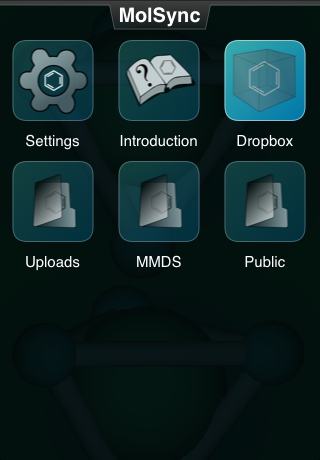
Today I submitted a new app to the iTunes AppStore. As I got to the end of the registration process I realised, to my horror, that final question about “Does your app use encryption?”, which I always click “No” for was in fact “Yes” this time. Continue reading
A few months ago, the Mobile Molecular DataSheet (MMDS) accumulated a new feature: the ability to parse ChemDraw files. This feature is not just limited to pulling out structures of individual molecules – it can also extract reaction schemes, and reassemble them into the more highly structured form that MMDS uses, i.e. segregated into individual components, where each distinct part of the reaction is characterised as a reactant, reagent or product, and is described by name/structure/both, and stoichiometry.
This blog has been a bit quiet recently, as might be expected for the sweltering summer months of the northern hemisphere, but rest assured that the secret laboratory of Molecular Materials Informatics has been running at full capacity, with a number of new projects on the way.
Working closely with the ChemSpider team (in particular, Antony Williams and Valery Tkachenko), we are proud to announce that ChemSpider now has a custom-built mobile app, which runs on all the iOS touchscreen devices (iPhone, iPod, iPad). ChemSpider Mobile has been submitted to the Apple iTunes AppStore, which means that it is not actually available yet, but with any luck it will pass through the review process within a week or so. With a lot of luck, it might even be ready in time for the ACS meeting in Denver (August 2011).
There is a precursory overview of the app on the SciMobileApps wiki site. The app is free, just like the ChemSpider website. The design of the app is very simple and easy to navigate. It allows the ChemSpider database to be searched by structure or by name. It’s not a power-user tool like MMDS, rather it’s designed to get users up and running as quickly as possible. Continue reading
Users of the mobile apps produced by Molecular Materials Informatics will find the following screen capture familiar in two ways:
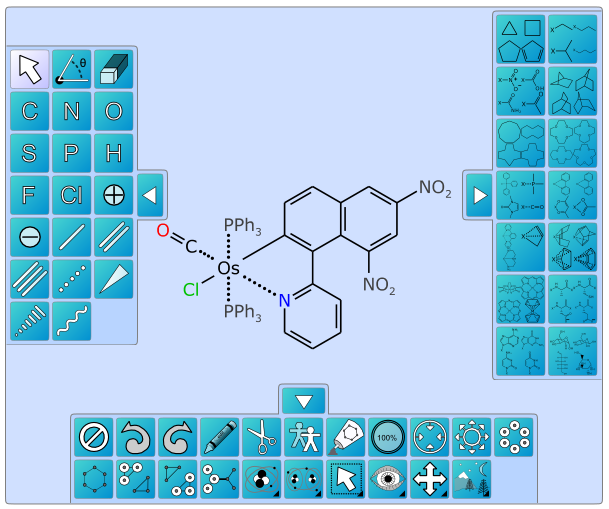
The toolbar on the left is a conventional tool palette which is recognisable to any chemist who has used a desktop software package to draw molecular structures. The bottom and right toolbars are suspiciously similar to the main menu and template groups provided by the MMDS structure editor for iOS and BlackBerry mobile platforms. Continue reading
 Cheminformatics 2.0