 It’s time to start writing about the BioAssay Express project, since it has been technically developed out in the open. This is what has been taking up the majority of my time for the last half year or so, and it has the potential to make an important contribution to the drug discovery process. Continue reading
Author: Dr. Alex M. Clark
An overdue status update

It’s been awhile since I posted, but this welcome gift shown to the right reminded me to do so: one of the outputs from the honeycomb clustering algorithm is featured on the Journal of Chemical Information and Modeling cover page, for an article driven by Sean Ekins. My main contribution was the diagram technique, which hadn’t been described in the literature before, but has been demonstrated within the Approved Drugs and PolyPharma apps.
What I have been actively working on these last couple months has involved another sabbatical at the Collaborative Drug Discovery mothership in the San Francisco Bay Area, helping out with a number of R&D projects, but most significantly the BioAssay Express. This is a project you will be hearing about more in the near future: it has been somewhat on the down-low so far, despite being implemented in the open, with the entire project being deployed to a public internet-facing website with no security of any sort. It’s all about describing bioassay protocols using well structured terminology, rather than the rather retro best practice of writing everything down in scientific English jargon. Stay tuned for more.
Reaction similarity searching with MolSync
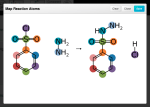 To continue on in the series of reaction-based cheminformatics on the MolSync website, the final missing search piece has now been implemented: reaction similarity. This works in a manner that is analogous to the transform feature, insofar as if you just draw one side of the reaction, or draw both sides but provide no atom-to-atom mapping information, the search behaviour just uses the molecules as-is. If you do provide atom mapping, though, the search gets a whole lot more specific. Continue reading
MolSync reaction searching: atom mapping
 The latest unit of progress for the molsync.com site is the addition of an interface for atom mapping. As mentioned in the previous post, basic reaction searching capabilities are operational, but more sophisticated techniques require a way to specify which atoms map to each other on each side of the reaction scheme, in order to describe a transformation. Continue reading
MolSync reaction searching: basic pieces in place
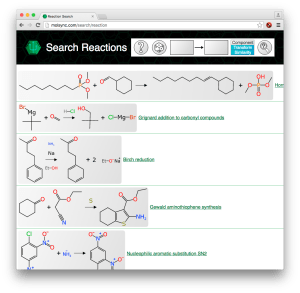 The last update of the MolSync site added a visual overhaul and molecule searching. Today’s update brings along the basic UI for reaction searching, and preliminary functionality for various kinds of reaction searching by structure. Continue reading
MolSync site with visual overhaul
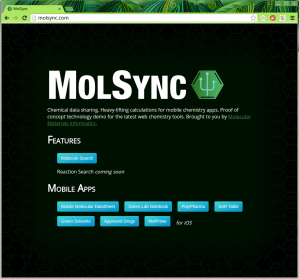 As mentioned in previous posts, the MolSync site has had a major redesign under the hood, and now it has been followed up with an aesthetic re-skinning. The presentable web content was always presented as somewhat of a placeholder, since the main purpose of the site was to expose certain cheminformatics and data hosting capabilities, in particular to boost the functionality of various mobile apps. Now that it is evolving into a site that provides user-facing functionality as well, it is time for a little bit more attention to detail on the design front. Continue reading
MolSync web structure searching
 As mentioned in the previous post, the MolSync (.com) website and the technology behind it have been moving forward rapidly. The public-facing deployment now shows a proof of concept page for performing molecule searches: molsync.com/search/molecule.php. Continue reading
MolSync overhaul: back to the web, now with reactions too
 Things have been a bit quiet in these parts lately, but not due to inactivity: far from it. In between working on some exciting projects with Collaborative Drug Discovery, I have been quietly making rapid progress on several important key technologies. These include the OS X Molecular DataSheet (XMDS), presiding over a growing collection of reaction data, and most recently a complete overhaul of the MolSync website, which provides cheminformatics support services of various kinds. Continue reading
XMDS experiments: quantities, metrics and SVG
 The XMDS molecular datasheet editor is steadily marching forward in terms of functionality: the reaction scheme editor has been complemented by separate display panels showing the quantities of each component in blocks, which can be opened up and edited. The green chemistry metrics (PMI, E-factor, atom economy) are also calculated and shown. In the interests of making the data useful for presentations, bitmapped or vector representations can be dragged directly into a graphics package (e.g. Pages, Word, PowerPoint, Keynote, etc.), and generation of SVG images is now supported, so reactions and molecules can be easily touched-up with a vector graphics editor like Inkscape. The XMDS app (for Mac OS X) is still in long beta, so you are welcome to try it out (just ask nicely). Continue reading
Workflows and pipelining: a visual end-user interface
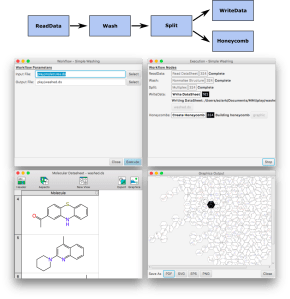 A recent post described preliminary integration of the Molecular Materials Informatics toolkit with KNIME. Further to that objective, some more developments are coming through within the toolkit itself, being used independently of any third party tools: in particular, a way to execute pre-existing workflows with the benefit of a visual interface. Continue reading
 Cheminformatics 2.0