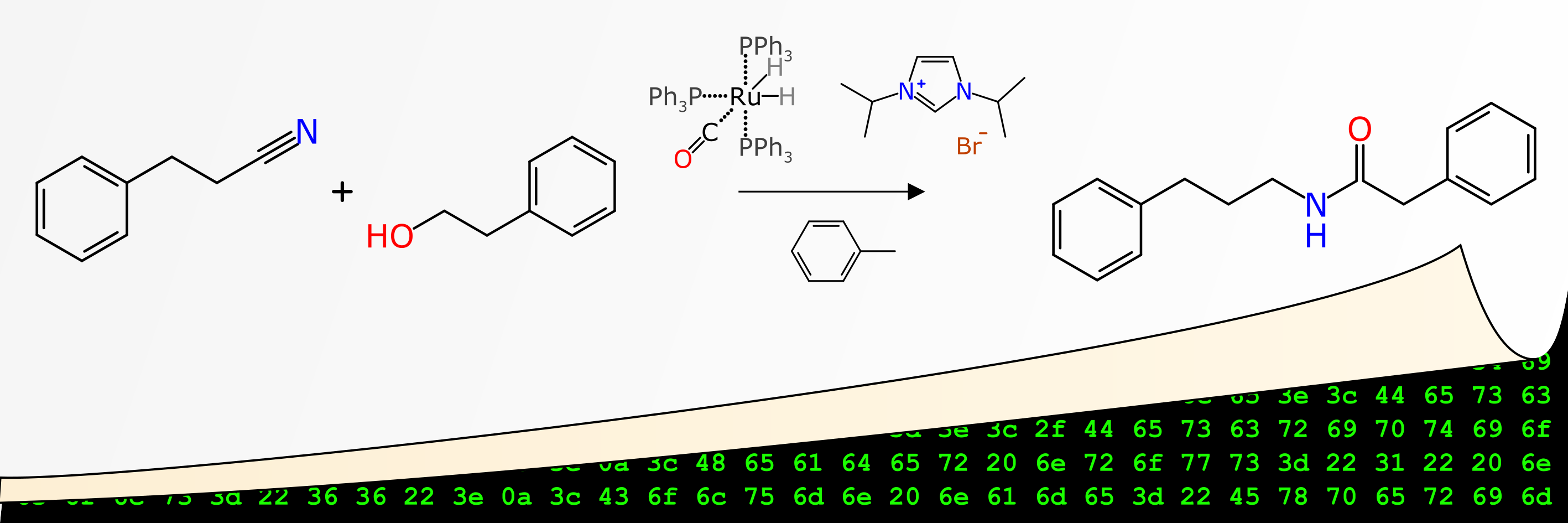
 Recently one of my papers emerged through the publication system of Journal of Cheminformatics, entitled “Machines first, humans second: on the importance of algorithmic interpretation of open chemistry data“, co-authored with Antony Williams and Sean Ekins, and incorporated into the JC Bradley Memorial Issue. Spoiler alert: the paper is about how if you’re publishing open lab notebook data without adhering to rigorously defined standards for machine readability, then you’re mostly wasting your time, and arguably making the open data situation even worse than it already is. The tone of the article is a bit less polite than I normally try to be, so fair warning, but it’s all for a good cause.
sketchel
Dabbling with the desktop: molecular datasheet app on the mac
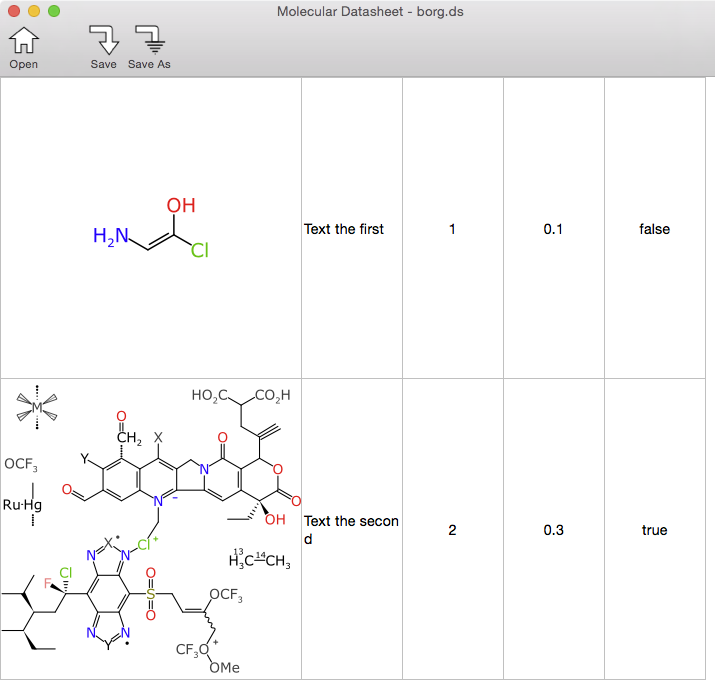 This is a way-too-soon sneak preview of what might someday end up as a commercial product. Currently residing under the project acronym XMDS, it is related to the MMDS app, for Mac OS X (i.e. X-Molecular DataSheet). The minimum viable feature set is intended to be approximately equivalent to the datasheet & molecule editor that is implemented by the open source SketchEl project. Continue reading
On the myth of chemical structure format conversion
There has been a lot of work, many products, and plenty said on the topic of converting chemical structures from one format to another, and a number of well used and highly regarded packages (e.g. OpenBabel) that specialise in providing this capability. Less well discussed, it would seem, is that when it comes to connection-table formats used to encode chemists’ sketches of molecules, there are no software packages and no two formats for which a round trip conversion can be reliably carried out without losing information, even if the chemical entities being expressed fall within the applicable domain of both formats. Continue reading
Sharing structures with SketchEl and molsync.com
 The latest version of SketchEl (1.60) has added a new feature: sharing of content via molsync.com. From either the molecule editor or the datasheet editor, the underlying content can be directly uploaded, making it openly accessible to the greater internet.
While SketchEl is not technically a product of Molecular Materials Informatics, the copyright is held by me, it’s made available via the Gnu Public License, and it gets a bit of maintenance from time to time. It is a conventional and fairly capable 2D structure drawing program that is written in pure Java, and runs on all the major platforms. It can even be used as an applet, though that doesn’t matter as much as it used to. It also allows editing of molecular spreadsheets (“datasheets”) that contain molecules and various scalar data. Over the years (since 2005) it has served as a test bed for a few ideas, like the SketchEl molecule file format, and I still use it regularly for editing structures and collections.
The newly added sharing feature offers to upload the current molecule or datasheet. Once the upload is complete, the result is available in the form of a URL, which can be opened in the browser, e.g. http://molsync.com/share?mol=3161:
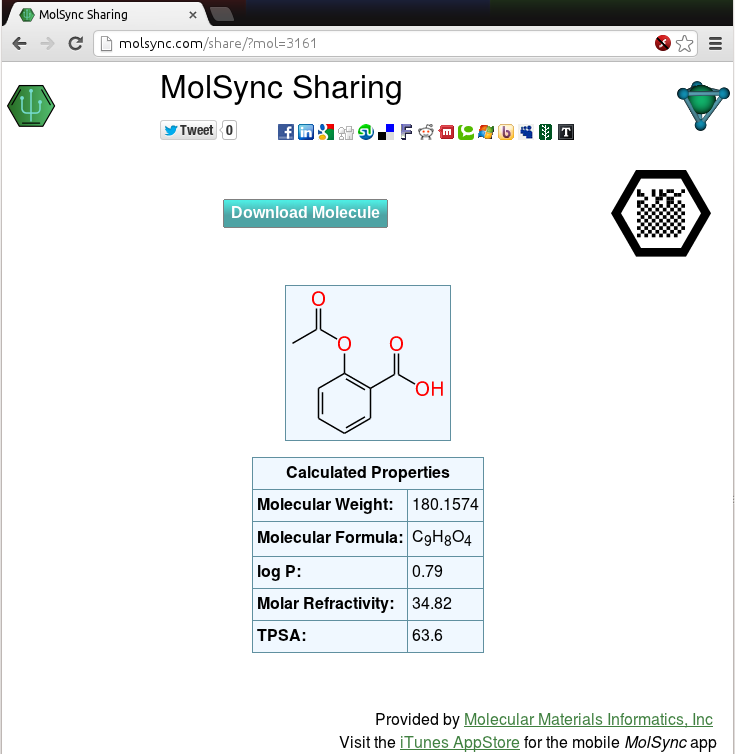
This is the same workflow that is available via several mobile apps, like MMDS and MolPrime+, either for sharing directly as a web page, or as a prelude to tweeting out the data. Once you have the data uploaded to the site, the content is served up in viewable form, and can be downloaded in various cheminformatics and graphics formats. It can be shared by any sort of internet distribution means, and there are lots of clickable icons for bouncing it out via Twitter, Facebook, LinkedIn, Google+, etc.
Notice also that the page includes the molecular recognition glyph – that’s the black hexagon with the square dot pattern in the middle. The timing is no coincidence, because it means that as soon as the Living Molecules app gets through the appstore review process, the following workflow will be possible:
- Draw molecules and/or assemble them into a datasheet with textual content, properties, etc., using any desktop platform (Linux, Windows, Mac, whatever)
- Share the content on molsync.com
- Export the molecular glyph and include the graphic on a poster
- Put up the poster at a conference, and anyone with an iThing can snap the glyph and access the underlying data
Of course, using many of the content creation apps the data can be created on a mobile device as well, but adding the feature to SketchEl now makes that a choice: create content on mobile or desktop, whichever is most convenient at the time. And it’s not just for making posters either, but that is one of the original use case proposals.
SketchEl gets an update: MDL MOL extensions for zero-order bonds
 The open source project SketchEl, hosted by SourceForge, is a cheminformatics-focused structure editor that I wrote back at the dawn of time (also known as the year 2005). The latest version, 1.56, adds in MDL MOL extensions that allow this popular legacy format to be used for reading and writing structures that use zero-order bonds, and non-computable virtual hydrogens, as described in J. Chem. Inf. Model., 51, 3149-3157 (2011). Continue reading
 Cheminformatics 2.0