 A little bit of tinkering with the WordPress plugin mechanisms for the TinyMCE editor has been fruitful: the web-based sketcher from WebMolKit and SketchEl2 is now integrated into the MolPress plugin. Continue reading
Uncategorized
XMDS with MolPress
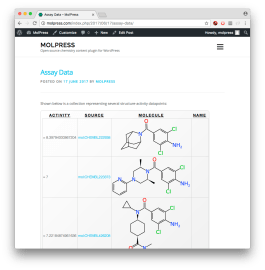 Last week’s post mentioned the MolPress plugin for WordPress running on an actual website (molpress.com). The purpose of the plugin is to add a convenient use case for incorporating chemical data into an article, and having it rendered as a diagram that’s just as good as a dedicated picture. This fusion of machine & human readable content is desperately lacking in the realm of chemical data communication of all kinds, from electronic lab notebooks to the peer-reviewed literature. Continue reading
MolPress: live instance
 This weekend I dusted off the MolPress plugin code (see here, here and here) and deployed it on an internet-accessible server: molpress.com. The site documents itself, so follow the link and check it out. The WordPress plugin is a public GitHub repository, and is based on the WebMolKit library (both open source).
SketchEl 2: now a public repository
 As was mentioned awhile back, the SketchEl 2 project is underway as a desktop app, based on web technology and delivered as an Electron package. The GitHub repository is now public, on account of there being enough functionality to be arguably useful. This is a very early release, so do be ready to give some useful feedback if you feel so inclined to try it out. Continue reading
American Chemical Society meeting: Spring 2017 San Francisco
 I’m much looking forward to the impending meeting, which starts this weekend. For anyone who is going to be attending, I’ll be making an appearance in several preordained locations:
- Sunday (2/Apr) 7-9pm: Poster in Division of Medicinal Chemistry, West Hall – Moscone Center: Bioassay protocols: Semantic annotation to enable informatics (see thumbnail)
- Monday (3/Apr) 8:15am: Presentation in Division of Chemical Information, Metropolitan II – Park Central SF: Expanding the target dimension: How to visualize a lot of SAR
- Friday (7/Apr) 10:15am: CDD special event, American Bookbinders Museum SF: Assay informatics with the BioAssay Express (BAE): when protocols are machine readable, good things happen
And as well, I will be found lurking around the Collaborative Drug Discovery booth (#1620) in the expo haul at key moments, particularly during the lunchtime rush.
2017: more with bioassay protocols, and the ACS meeting
 It’s been awhile since I wrote a post. Most of my work these last few months has been on the BioAssay Express project, which has been advancing forward on every front: technology, data, collaborations, commercialisation, and even a software patent. Continue reading
SketchEl2 as an Electron app (web runtime on the desktop)
 Some recent developments in porting core cheminformatics functionality to the web have been released as an open source project called WebMolKit (see GitHub) which has its own built in sketcher. A logical followup to this is to package up the functionality as a desktop app, using the Electron wrapper. Continue reading
BioAssay Express: crowd curation now technically possible
 Until earlier this week, the public facing instance of the BioAssay Express was basically read only: we carried out our curation exercises by passing files around. As of now, though, it is possible to authenticate yourself using ORCID and submit your annotations. From that point your changes will be stored in a special holding bay until they are approved. This feature is enabled on the beta preview version. Continue reading
Browser cheminformatics: WebMolKit & MolPress now public
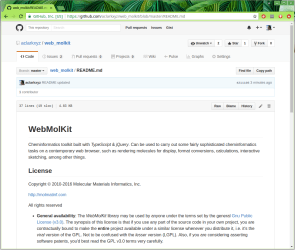 As promised in a string of previous posts, the two projects WebMolKit and MolPress are now public on GitHub. They can both be considered rough around the edges with no kind of onboarding to speak of, but they are no longer hiding behind closed doors.
MolPress: embedding reactions & tabulated quantity data
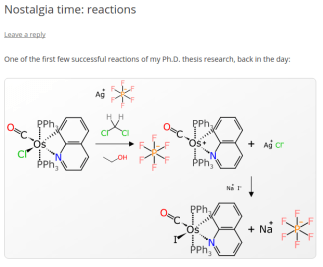 The last two posts introduced molecules and collections being embedded into a WordPress document. Now the range of datatypes has been extended to include reactions, which can be rendered as schemes – or tabular forms indicating all of the components that go into a multistep reaction, with associated stoichiometry and quantity information. Continue reading
 Cheminformatics 2.0