Summer of 2014: roundup

Things have been a little quiet on this blog lately, as well as the Molecular Materials Informatics website, and indeed in the secret laboratory: and there is a perfectly good explanation for that – I’ve been away. For the last few months I’ve been quietly roosting in San Francisco, working on an interesting and exciting project at the bay area HQ of Collaborative Drug Discovery. Not wanting to put out any spoilers, but the beans will be spilled very soon via PeerJ, which should be releasing a paper with my name on it very soon indeed.

I left San Francisco a couple of weeks ago, which unfortunately means I didn’t get to attend the ACS meeting that many of you are heading towards right about now, but there is a perfectly good explanation for that, too: at the end of last month, I turned 40, and decided to celebrate this milestone by returning to my home country of New Zealand, which I have not been back to for a long time. It was a delightful trip, albeit too short: after having been away from my normal home (in Montreal) for more than 4 months, the things-to-do list was piling up quite high, as it tends to do. Continue reading
Presentation about the Green Lab Notebook at ICCE2014 Toronto

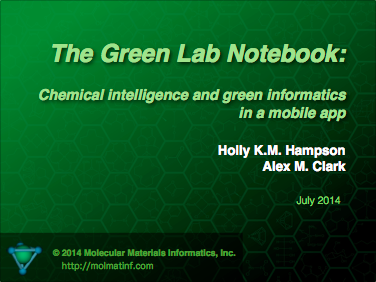
icceglnSlides for a talk about the upcoming Green Lab Notebook (GLN) app, which was presented this morning at the International Conference on Chemistry Education (ICCE2014) in Toronto. The short presentation describes how the field of green chemistry can be brought closer to both students and professional chemists with the assistance of an accessible and easy to use mobile app. The presentation was given by Holly Hampson, since I’m currently situated much further away from the event.

On the myth of chemical structure format conversion

There has been a lot of work, many products, and plenty said on the topic of converting chemical structures from one format to another, and a number of well used and highly regarded packages (e.g. OpenBabel) that specialise in providing this capability. Less well discussed, it would seem, is that when it comes to connection-table formats used to encode chemists’ sketches of molecules, there are no software packages and no two formats for which a round trip conversion can be reliably carried out without losing information, even if the chemical entities being expressed fall within the applicable domain of both formats. Continue reading

The Green Lab Notebook project: where it’s at

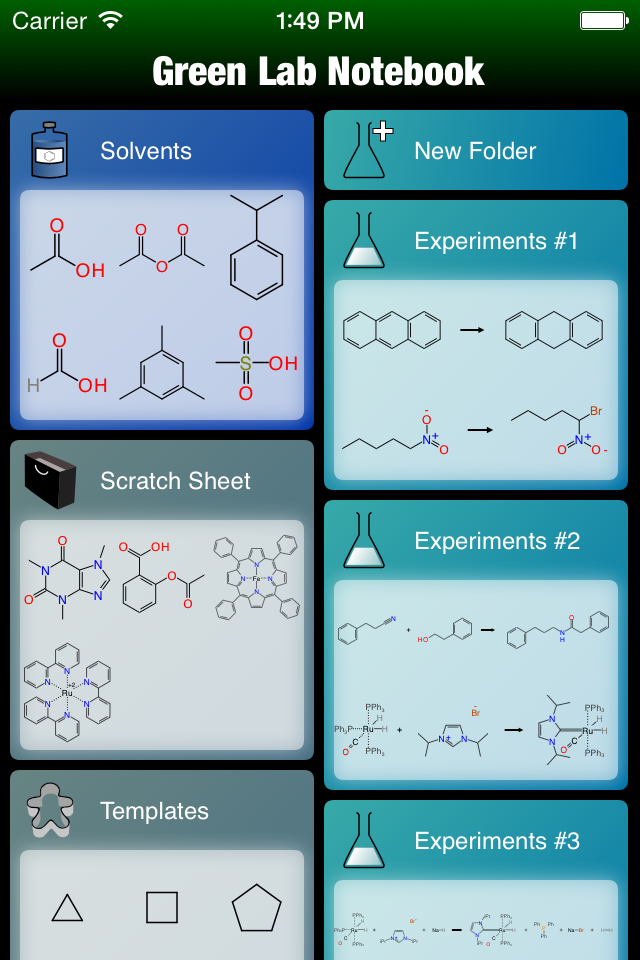
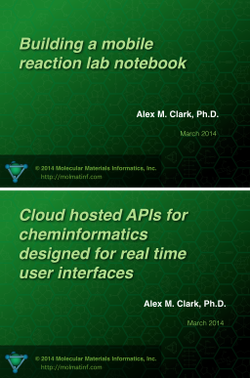
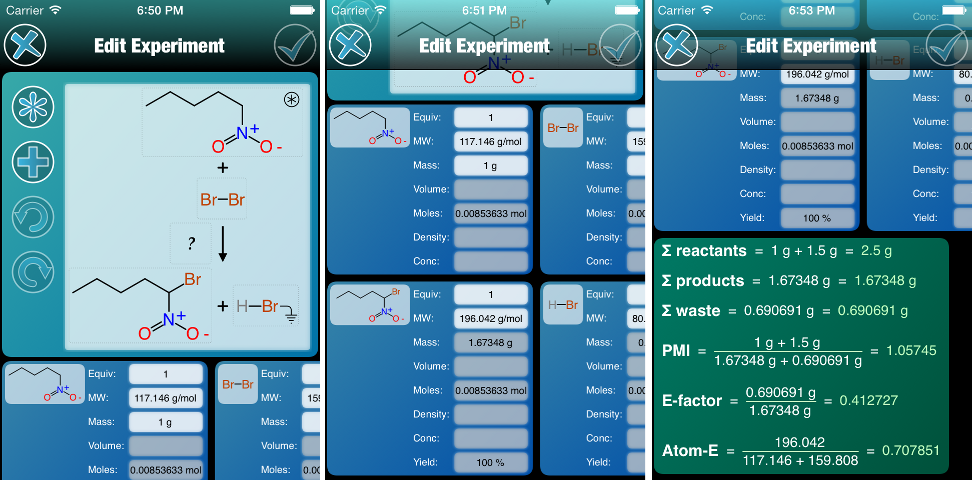
gln_snap20140324Last week I was at the American Chemical Society meeting in Dallas, which was incidently a particularly enjoyable gathering. I presented two talks, one of which described some of the latest developments of the Green Lab Notebook project (for slides, see slideshare and figshare). After having given a couple of talks about this as yet unfinished app, it’s time to start the run-down checklist for what goes into a minimum viable product.

Continue reading

Open source ECFP/FCFP circular fingerprints in CDK

circular_rocAs of now, the latest version of the popular open source Chemical Development Kit (CDK) has its own implementation of the highly regarded ECFP and FCFP classes of chemical structure fingerprints (sometimes referred to as circular or Morgan fingerprints). While the general recipe for this kind of fingerprint has been available for awhile, and there are a number of implementations in various different toolkits, this one distinguishes itself in several ways: it has been implemented as closely as possible to the description of the original definition (without having access to the trade secrets that were left out of the paper); it includes resolution of chiral centres; it is freely available as open source Java code; and, last but not least, the algorithm is designed to be as portable as possible, with no major dependencies on specific programming languages or cheminformatics toolkits. Continue reading

Major new version of TB Mobile app

tbmobile2_intro1The TB Mobile app for iOS has just received a major new update on the iTunes AppStore. Version 2 of the app brings some fairly powerful cheminformatics functionality to this free mobile app for tuberculosis research. Produced by Collaborative Drug Discovery, built by Molecular Materials Informatics, and organised by Sean Ekins, this app is pushing the boundaries of real science on mobile devices in several important ways. Continue reading