Anyone who has used Reaction101 or Yield101 will know that these apps have access to a collection of common reactions that can be used as a helpful reference, or as a starting point for drawing new reaction schemes. The reaction data has received a bit of an overhaul and cleanup, and is now also viewable online. Follow the link to see the reactions organised into categories, which can be browsed, rendered and downloaded in a variety of different cheminformatics and graphics formats.
Yield101 now includes solvent density
The Yield101 app introduced a list of solvents several releases back, which allows browsing of solvents and convenient addition as a reactant, with just a double-tap. Version 1.0.5, which has recently been released on the AppStore, includes density values for each of these solvents.
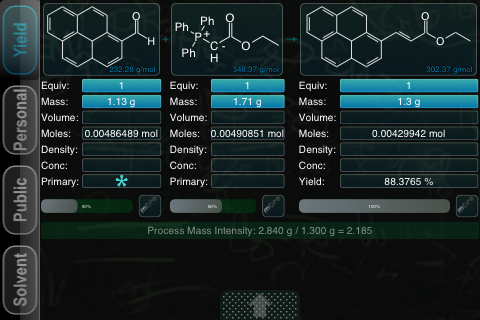
Consider the following Wittig reaction:
Mobile chemistry: coming of age
A review has recently been published in Drug Discovery Today, for which I have the honour of being one of the co-authors. The primary instigators are Antony Williams and Sean Ekins. The review is a 12 page tour through some of the highlights of mobile chemistry software. The subject is evolving very rapidly, though – in the months since the manuscript was originally submitted, there have been a number of new developments, e.g. MolSync, ChemSpider Mobile, Reagents… it’s almost time for another review!
Searching ChemSpider directly from MMDS
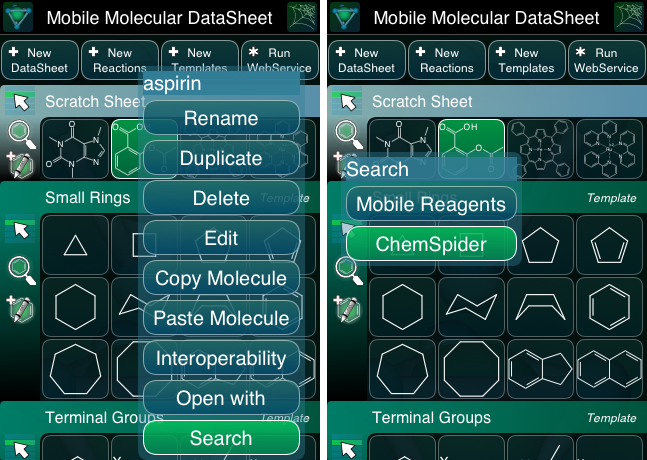
A convenience feature has been added to the latest version of the Mobile Molecular DataSheet (MMDS): the menu list for molecules now includes a Search option, which has a submenu containing both Mobile Reagents and ChemSpider:
Twitter now integrated into MolSync app
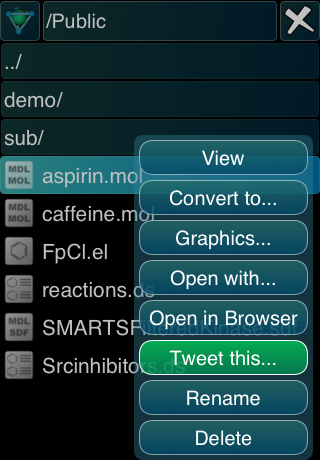
The MolSync app now passes along a new feature provided by iOS 5: sending tweets from inside the app, using the Twitter framework that is now part of the device operating system.
Mobile chemistry, collaboration and the future of pharmaceutical research
I don’t often weigh in on the grandiose topic of the future of the pharmaceutical industry, partly because my closest experience with the subject is based on designing software to help other chemists with drug discovery: this gives me a great detail view of some of the trees, but as far as the forest is concerned, that has to be covered by reading news and discussions with friends and colleagues. But it doesn’t take a seer to figure out that the pharmaceutical industry is trying to reinvent itself, with increasingly radical (or desperate) attempts to find a way to comfortably survive, if not actually return to the boom times of decades past.
A recent blog by Sean Ekins about the virtualisation of R&D mentions some of the trends towards breaking down the monolithic practices that were so successful in the past, and putting them back together out of myriad alliances between contractors, academia, government and of course the pharma companies themselves. My professional interest in this redesign is of course software: in order to permit these disparate research interests to collaborate successfully from all around the globe, we’re all going to need lots of software. And not the old kind that your IT guy installs on the locked down computer at your desk, which you use to show your boss what you’ve been working on when he walks down the corridor to see what you’ve been up to. Continue reading
MMDS now supports Chemical Markup Language (CML)
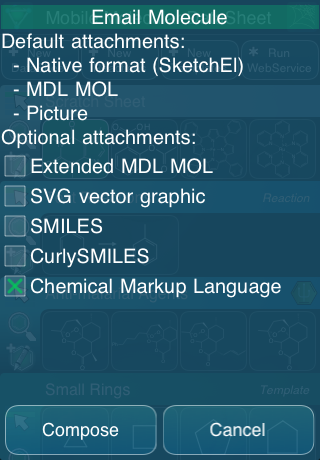
Support for the Chemical Markup Language (CML) has been added to the Mobile Molecular DataSheet (MMDS). CML is an XML dialect for describing chemical entities in general, and structures in particular. This functionality is provided to the mobile app via remote procedure calls to molsync.com, and will most likely first be encountered when sending data via email:
Interacting with the ChemSpider Mobile app
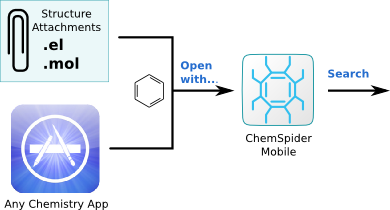
ChemSpider Mobile for iOS version 1.0.1 has been released (see AppStore, MMI, SciMobileWiki). The new version allows the app to be used to open chemical structures from arbitrary sources, which includes email attachments, web downloads, and other apps which implement the “Open with” functionality for chemical structure data:
Using MolSync for chemical collaboration
Two articles have recently been added to the Molecular Materials Informatics site:
As the titles suggest, both articles are about sharing data with MolSync. Used in conjunction with MMDS, the apps can synchronise data on a Dropbox account, in many-to-one or many-to-many relationships.
Mobile chemistry app ecosystem to date
The current collection of apps for iOS (iPhone/iPod/iPad) which are based on, or make use of, core technology from the Mobile Molecular DataSheet:
 |
The Mobile Molecular DataSheet (MMDS) is the progenitor app, which provides features for drawing molecular structures and reactions, organising datasheets, sharing data, access to web services, and many more. See product page and AppStore. |
 |
MolSync provides chemically aware access to cloud-hosted file repositories, which currently means Dropbox. Files can be browsed, viewed, converted and made into graphics. The app works particularly well in combination with MMDS: the two apps integrate together as a synchronisation/versioning tool/collaboration utility. See product page and AppStore. |
 |
Reaction101 focuses on editing one reaction at a time. Its simplicity, combined with reaction balancing capabilities, make it particularly useful for chemistry students. The app also provides integration with the Mobile Reagents database, common reactions for use as templates, and cloud-based storage of data. See product page and AppStore. |
 |
Yield101 focuses on the quantities involved in a reaction, and automatically calculates related amounts, using molecular weight from structure to interconvert mass, moles, volume, density, concentration, and ultimately yield. This app is useful to students practicing quantity interconversions, as well as any chemist who wants to spend less time using a calculator. See product page and AppStore. |
 |
MolPrime is a free app which allows a structure to be drawn, then used in several ways: reviewed for basic properties, launched with other apps, searched with Mobile Reagents or ChemSpider, copied to the clipboard or sent by email. It also lets you play Conway’s Life, using the chemical structure to seed the first generation. See product page and AppStore. |
 |
Green Solvents is a free app which presents a list of solvents, categorised by functional group. Each of the solvents comes with information about its properties with regard to environmental hazards and disposal. They can easily be looked up in ChemSpider and Mobile Reagents, and there is also a slider-tile minigame, to help out with lab down-time. See product page and AppStore. |
 |
ChemSpider Mobile provides the most effective way to search ChemSpider for chemical structures from a mobile device. The app was commissioned by the Royal Society of Chemistry, and is free to use. See product page and AppStore. |
Furthermore, there are two products from Eidogen-Sertanty that make use of MMDSLib to provide structure drawing capabilities: Mobile Reagents and iProtein. And there are more apps in development, so expect this list to grow!
 Cheminformatics 2.0