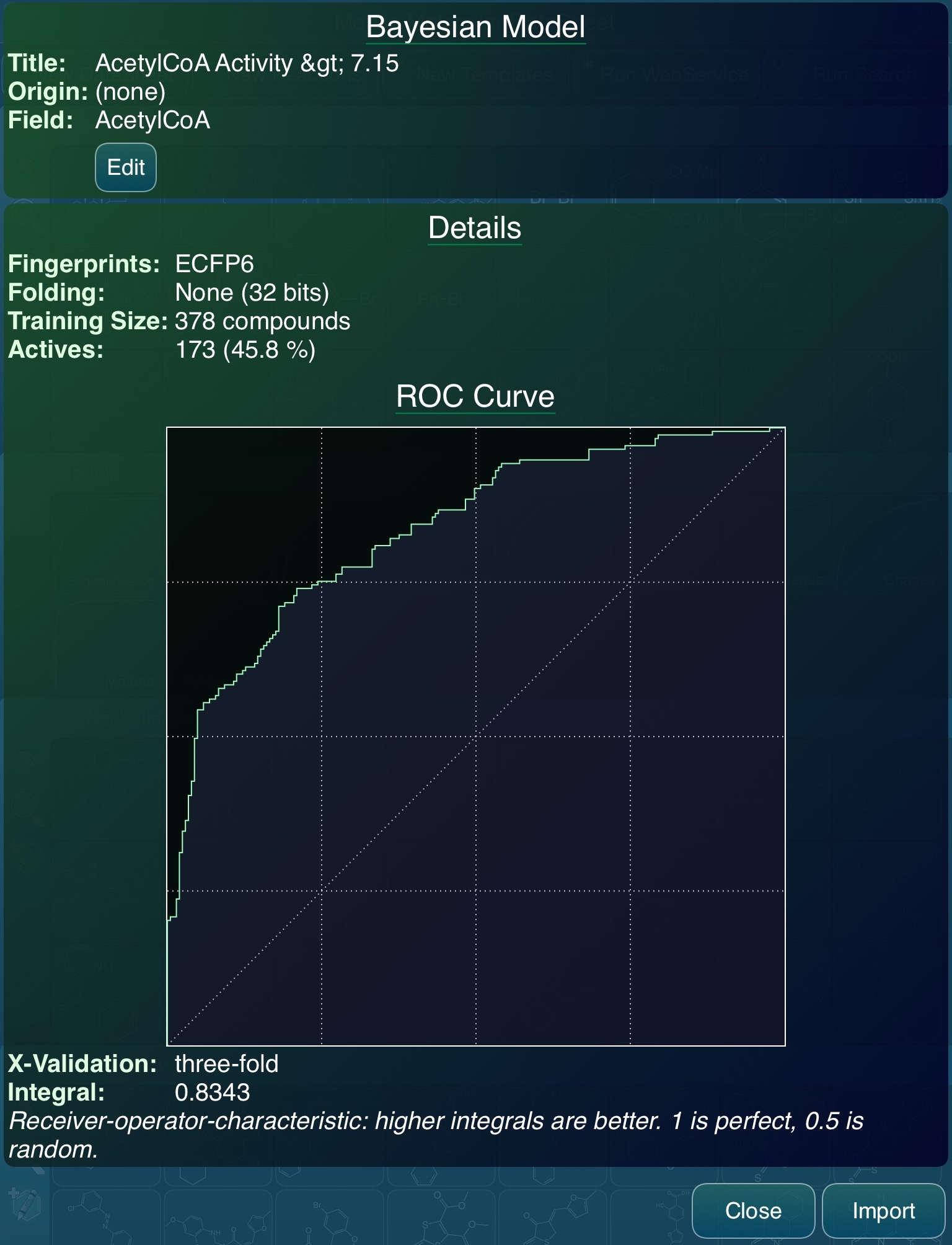
 The CDD Vault web product has recently delivered on one of its promises: making models truly sharable to the community, including both open source and participating commercial products. Bayesian models can now be exported in a well documented and openly consumable format, which removes a major bottleneck in the creation and use of models for structure-activity predictions. Continue reading
Uncategorized
Honeycomb clustering in Approved Drugs app: sneak preview
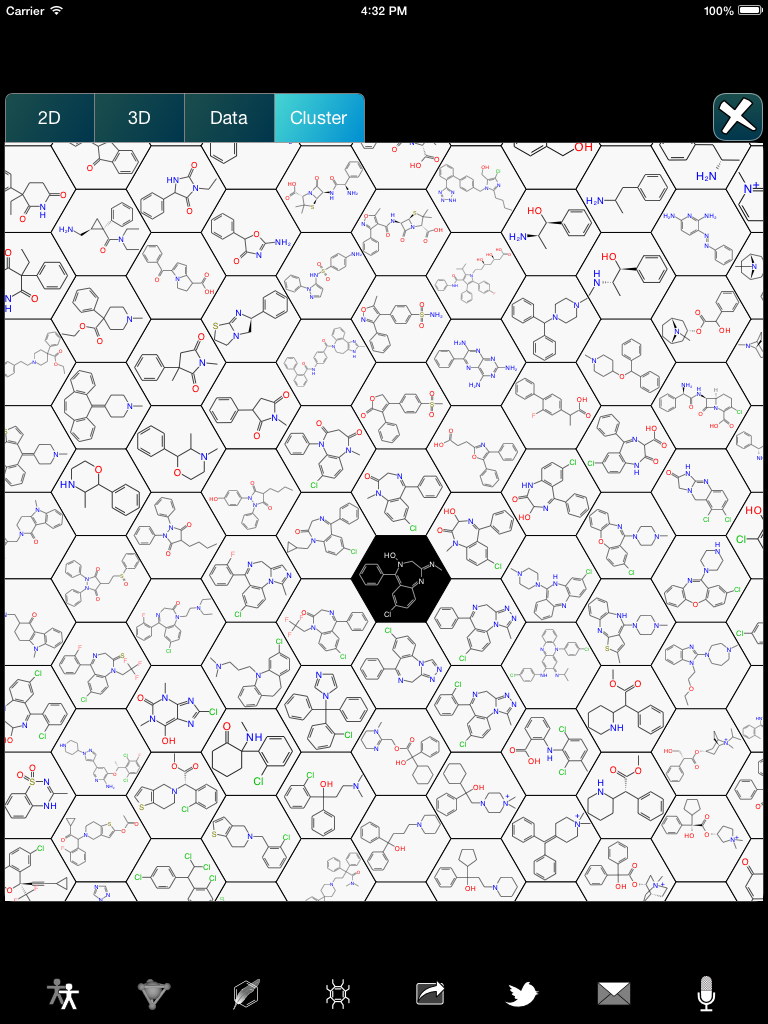 Work is currently underway on a novelty feature that will first be exposed within the Approved Drugs app: honeycomb clustering, which is a greedy visualisation technique that is remarkably effective for examining how a particular chemical structure relates to a collection of compounds. Continue reading
Summer conference schedule
I’ve been out of the spotlight for awhile as far as scientific conferences go, but this summer-of-2015 it’s all back in form, with three in a month long window:
- 12-14 July: Green Chemistry & Engineering (Washington D.C.) – “Green chemistry in chemical reactions: Informatics by design“
- 19-24 July: Gordon Research Conference/Computer Aided Drug Design (Vermont) – “CADD of the future: using tablets and phones for drug discovery, and learning from the parallel universe of consumer electronics” [poster]
- 16-20 August: American Chemical Society (Boston) – “Compact models for compact devices: Visualisation of SAR data using mobile apps” and “Anatomy of a chemical reaction: Dissection by machine learning algorithms”
If you’re going to be attending any of these, perhaps I will see you there. If not, the materials will be going up on slideshare shortly thereafter…
Medicinal Chemistry Toolkit app, now with structures and calculations
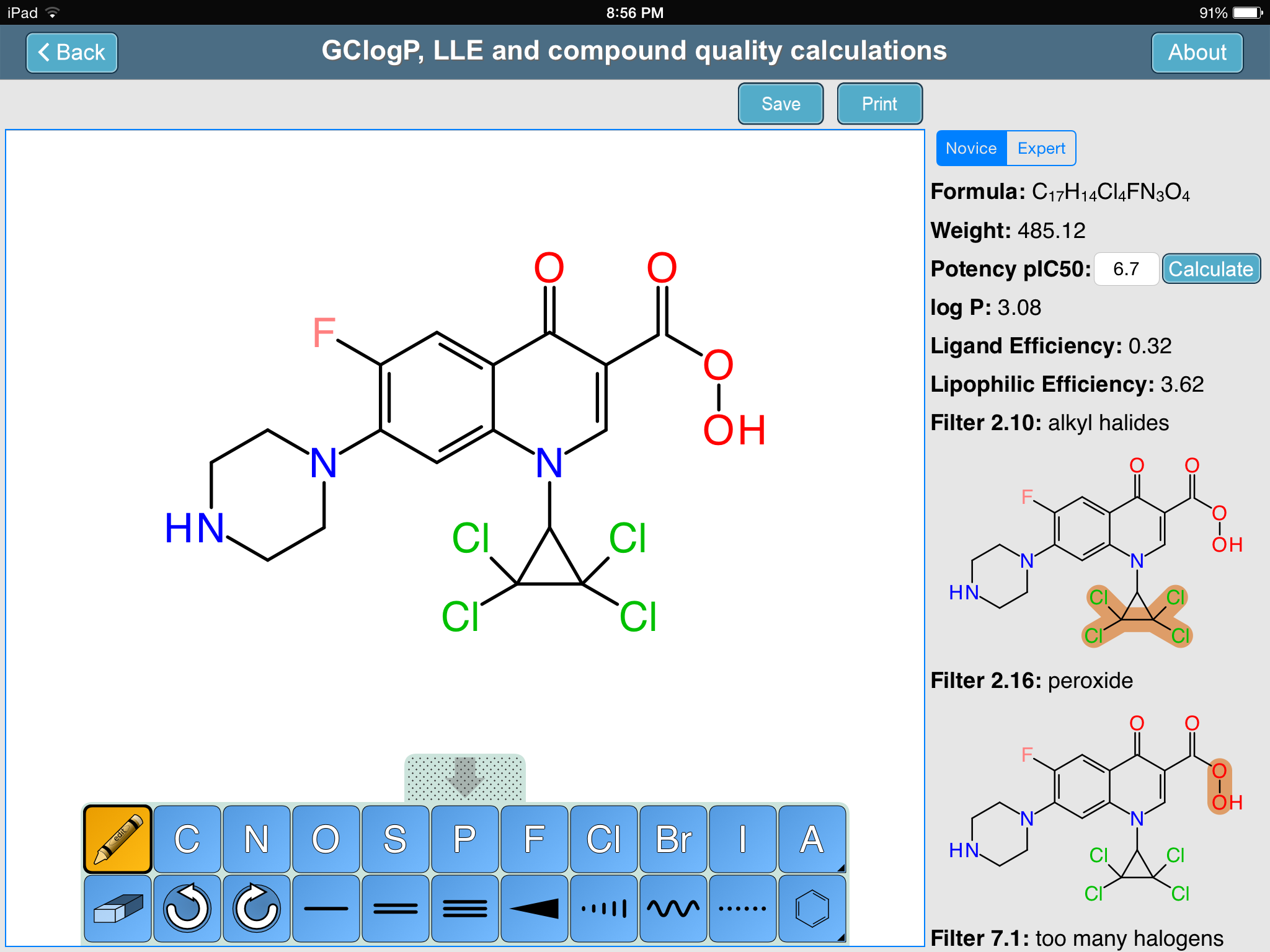
The Royal Society’s Medicinal Chemistry Toolkit app has been up on the AppStore since late last year, but a couple days ago it got updated with some major new functionality: an interactive tool that allows a structure to be drawn, and various properties to be calculated from it. If you can’t guess who supplied the sketcher and the structure-derived calculations, you’re probably not a regular on this blog. Continue reading
Swift gets a bit swifter: version 1.2 first impressions
Xcode 6.3 appeared in my update tray this morning, and since it contains Swift 1.2, I installed it right away. The first thing I noticed, after fixing about 200 compiler errors due to minor changes in language syntax, was that the work-in-progress XMDS app all of a sudden got really snappy. Rather than feeling like using a computer that’s 10 years obsolete, algorithms that were borderline rate limiting running in the main UI thread just happen like they ought to. As a reality check, I re-ran the horrendously underperforming algorithm that I complained about awhile back, and rather than taking 320 seconds to calculate 7 log P values, it now gets the job done in 30 seconds. That comparison is with standard compiler options. The alternate target with all the optimisation settings dialled up actually crashes the Swift compiler, so no metrics for that.
Nonetheless, 10x improvement in a scenario that’s relevant to cheminformatics, and a qualitative observation that this seems to be representative for GUI tasks, is a big deal. I’m sure there’s a lot more fat to trim over the coming years, since the Swift syntax is designed in a way that allows the compiler to do some pretty hardcore optimisation. Getting the practical implementation levelled up to “adequate” is a good start!
XMDS takes another step: copying molecule into CDD Vault
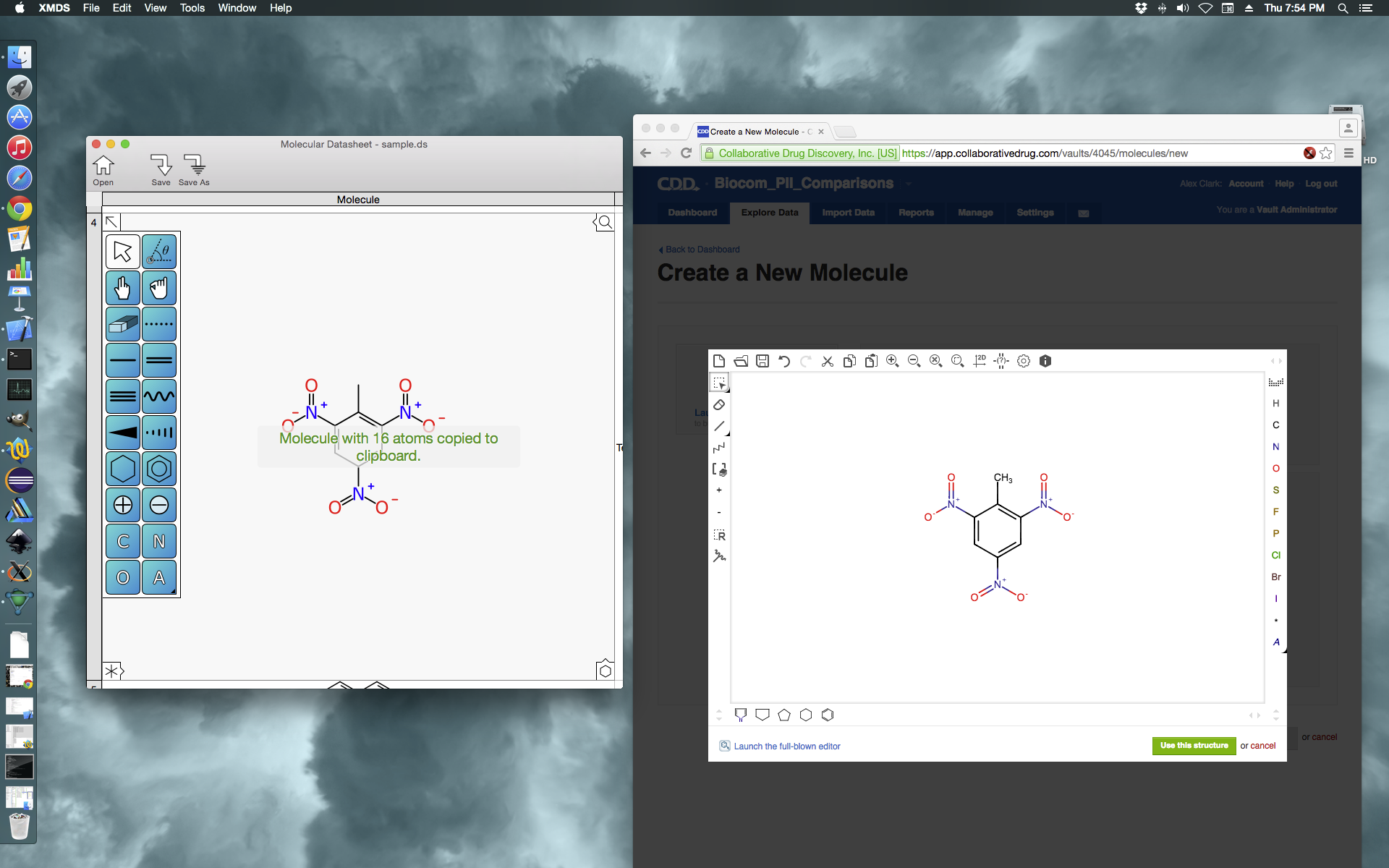 It may be a slightly arbitrary milestone, but the Mac app-in-progress XMDS has performed the first instance of a deed that might be argued as being useful. Most of the sketching functionality is now operational, which combines pretty much all of the drawing capabilities of the MMDS app and the SketchEl desktop structure drawing tool, as well as a few new ideas. The feature that was added today is clipboard interoperability, which means that structures can be used elsewhere. In this screenshot, the structure has been pasted into an instance of CDD Vault in the browser, in draw-new-molecule mode.
2014 redux
The year of 2014 is almost over, so it’s time to write the summary. The year started by taking a few unexpected turns that I could not have predicted, but things turned out well, and a lot got done. Continue reading
Second impressions of Swift: making Objective-C look good
I held off writing this post since Apple’s new Swift language was at version 1.0, and it was clearly rushed to market/probably should’ve stayed in beta for quite awhile longer, but now that 1.1 is out, I can say that things are not looking good from a performance point of view. The reason I was excited about the language from the moment I read the specification (other than wanting to see the end of Objective-C) is that the design takes into account the notion of having a clean high level syntax that provides enough information for the compiler to understand what is, and isn’t, trying to be accomplished in a given block of code, and optimise accordingly. A reading of the spec suggests that Swift is, among other things, a better Java: all the safety and convenience of bounds checking and automatic memory management, but with clever ways to reduce or eliminate the performance penalties that come with it. Continue reading
The Beer Lab Notebook
 Today another of my apps just got through onto the store: the Beer Lab Notebook, which can be found on the iTunes AppStore. The name of this app is inspired by the title of my last new app (the Green Lab Notebook): its subject material is more or less serious, depending on your priorities. The app is designed to help record the process of creating a fermented beverage, as practiced by millions of homebrewers, myself included. Continue reading
Publishing with PeerJ: first paper and first impressions
Spoiler: the experience of publishing a manuscript with PeerJ was very positive. My first paper published with them just arrived online: Fast and accurate semantic annotation of bioassays exploiting a hybrid of machine learning and user confirmation. This is a summary of the work that I was doing in San Francisco for the first half of summer 2014 (with Collaborative Drug Discovery), and it describes a hybrid machine learning/interactive method for marking up bioassay data, which is an optimised compromise between the two extremes of methods for taking plain text and turning it into semantically rich markup. Continue reading
 Cheminformatics 2.0