My latest contribution to GitHub is PDFBoxLite, which represents a few hours work. Basically, all of my software efforts that involve creating chemical graphics are leaning toward pushing PDF as the format of choice for creating inline figures. Everyone knows PDF as the Portable Document Format – things you look at before sending to the printer. But what you may not know is that PDF files with just a single page, of arbitrary size, are a very well supported as a way to get pictures into a larger document (Word, Pages, PowerPoint, Keynote, Excel, etc.). This is particularly true within the Apple ecosystem. Unlike SVG, correct rendering is essentially universal; and unlike WMF/EMF, it works on platforms other than Windows. And unlike PNG, it isn’t a trainwreck when you try to print/zoom/convert your document. Continue reading
Uncategorized
Composite Bayesian models: latest open source project
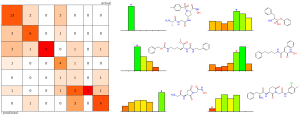 My latest publication has just come out as early access in Journal of Chemical Information & Modeling, entitled “Open Source Bayesian Models: 3. Composite Models for Prediction of Binned Responses“. This is an extension of previous work on the Bayesian/fingerprint theme, and in the interim while waiting for peer review, we have some additional developments to share. Continue reading
Breaking radio silence
This site hasn’t had a post for couple months, and there’s a reason for that: I’ve been out of town, doing some collaborative work on-site, but now things are getting back to normal. Continue reading
MMDS with a news cycle feed (and how to turn it off)
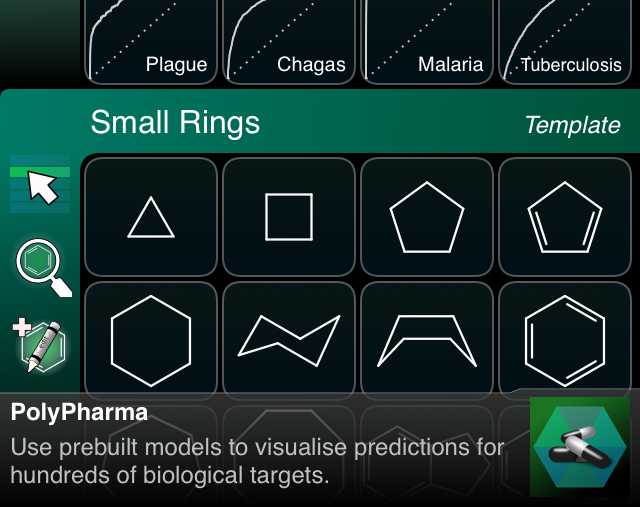 The latest version of the Mobile Molecular DataSheet (for iOS: see AppStore) has a news ticker feature, which shows a rotating series of facts and links that are displayed along the bottom of the screen. The items include mentions of other related apps, as well as news from Molecular Materials Informatics, and articles from this blog. The functionality is the same as what originally appeared in the free MolPrime app. Continue reading
Structure queries: a bit of attention to editing
 Using chemical substructures with query annotations is a cheminformatics trick that goes back a long way: by annotating the query structure with additional logical constraints, the utility of this functionality can be juiced up, by matching a variety of certain kinds of fragments, rather than literal pieces. The amount of work involved to implement such a system is quite evenly divided between providing the low-level algorithm for doing the matching, and providing a high-level editor for people to design the queries. One of the “TO-DO” features in the XMDS beta version has taken some steps toward fulfilling the latter. Continue reading
XMDS and Mac OS X integration: drag’n’drop and previews
 The OS X Molecular DataSheet (XMDS) app has been getting a bit more attention lately, after being interrupted by the summer conference season (slides, poster, slides & more slides) and the PolyPharma app (which is now submitted to the AppStore and waiting for approval). The next step that brings XMDS closer to being a finished product rather than a functional beta is deeper integration with OS X. Continue reading
Some app housecleaning & ACS aftermath
 Writing this post from Boston as the American Chemical Society meeting winds down – by Wednesday evening most of the action is over – it has been a good one. My first talk (see slideshare) went without a hitch, which was not a foregone conclusion, since the second half involved a live demo of the PolyPharma app, which didn’t exist 2 weeks ago, is half finished, and consists mostly of brand new original code.
Besides a new app on the way and a busy month of conference presentations, there are changes afoot in the app lineup which will start to be noticed on the Molecular Materials Informatics product page shortly. For chemistry app users, there’s good news and bad news. The bad news is that some apps have been retired, and some more are slated for the glue factory in the near future. The good news is that all the rest of the flagship apps are now free, as of several days ago, and the intention is to leave them that way indefinitely. Continue reading
The PolyPharma app: a mash-up of ideas and technology
 Things have been a bit quiet around here lately, but there is a good reason: at the Gordon conference on Computer Aided Drug Design a couple of weeks ago, a confluence of ideas came together. With the opportunity to observe a series of talks and posters about what practitioners in the industry are interested in right now, and the chance to discuss my recent projects and gauge the level of interest, it all happened to coincide with a number of partially complete product explorations that have been sitting on the workshop floor, waiting for the right time and place to assemble release to the outside world. Continue reading
What’s in a name: Molecular Materials
I am presently attending the Gordon Research Conference: Computer Aided Drug Design meeting, having a wonderful time, and at this moment taking an afternoon break to relax and catch up on some work. This is one of my favourite properties of the GRC meeting format, because it means that it’s not necessary to be pretty much out of the loop for the entire week.
So far I’ve met and reacquainted myself with more scientists of my own particular species than I can count, and a recurring theme of the introduction/renewal process is taking turns to explain what we’re both doing these days. One part of this which seems a little incongruous is that the name of the company that I created is called “Molecular Materials Informatics”. Since the occasion is a conference that is exclusively devoted to the pursuit of drug molecules and a few related parts of life sciences, this requires some explanation. Continue reading
Inline abbreviations with XMDS
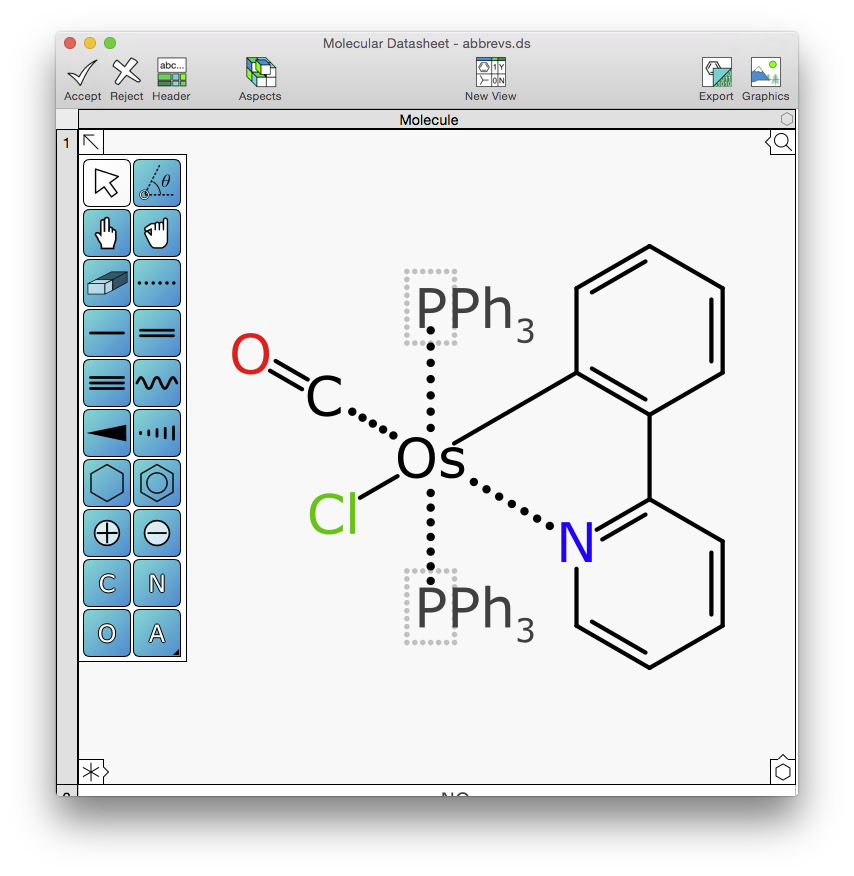 Abbreviations are a common shorthand used by chemists to alleviate the tedium of drawing out structures by hand, and in many areas – including much of organometallic and inorganic chemistry – use of abbreviations is more or less essential to achieve any kind of visual clarity. This presents a challenge for cheminformatics, though, because there is no universal dictionary for abbreviations: different research groups use different shorthand notations for their own nefarious purposes. Now the beta version of XMDS is catching up to MMDS by adding the ability to conveniently define inline abbreviations, which are readable to humans in diagram form, but also completely well defined behind the scenes for the benefit of machines. Continue reading
 Cheminformatics 2.0