 One of the opinions (arguably of the educated variety) that I’ve been pushing for awhile now is the idea that when a model building or visualisation technique requires a user parameter in order to get the correct result, that is essentially an admission of partial failure. If the method really was so great, then it would be able to figure it out, because a parameter is an extra degree of freedom that the method has punted on. Now of course this is not a rule by any stretch of the imagination, and there are numerous exceptions, or grey areas between what’s a parameter and what’s an integral component of the source data. But sometimes a parameter really is just something that a method ought to know, but gives up and passes the burden on to the user – and that’s not necessarily a bad thing, as long as we admit it. Continue reading
property calculation
Mobile Bayesian modelling: importing
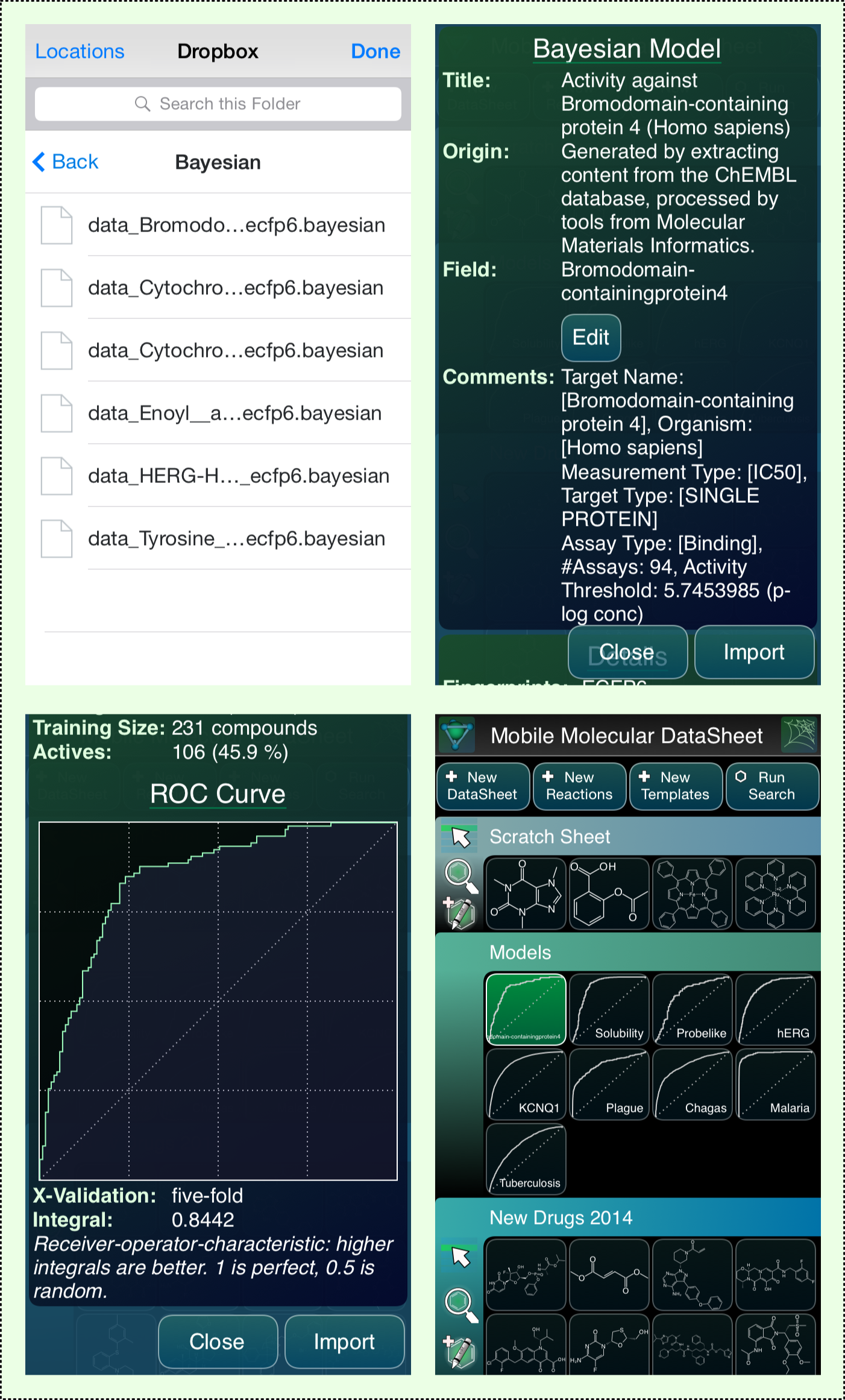 One more key piece is in place for Bayesian modelling with apps: MMDS 1.6.1 just got approved on the AppStore, and brings with it the ability to recognise files with the .bayesian extension (or MIME type chemical/x-bayesian), and import them into the collection of available models that can be used to calculate properties. At the present time the only official way to create such models is to use the bleeding edge build of the Chemical Development Kit and roll your own wrapper code, but we’re working on that!
Recent developments with Bayesian models and app data sharing
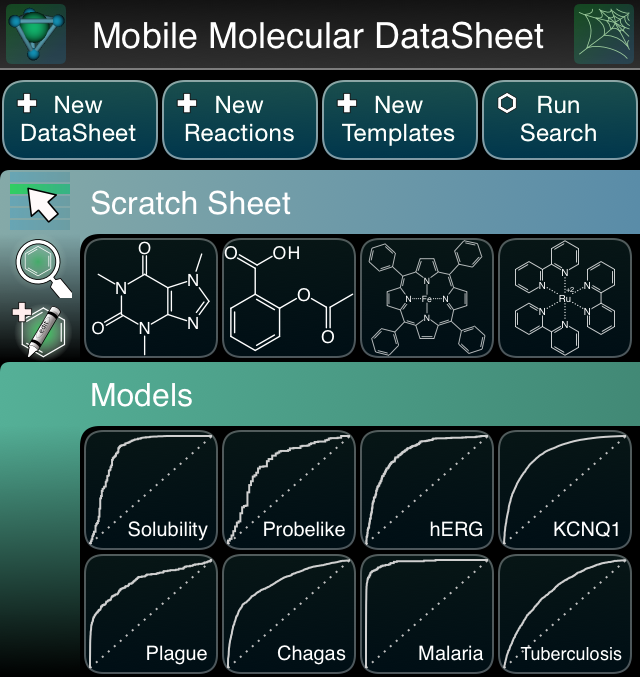 Several of the flagship apps from Molecular Materials Informatics have had major updates recently: the Mobile Molecular DataSheet, SAR Table, MolPrime+, Green Lab Notebook and Approved Drugs. Two separate groups of features have motivated these updates: (1) the inclusion of in-app calculation of nontrivial properties, lately supplemented by the inclusion of Bayesian models, and (2) leveraging the new iOS 8 API feature for importing & exporting data to any compatible service, which includes iCloud by default, but also Dropbox if it is installed. Continue reading
Structure property calculation in apps: MMDS
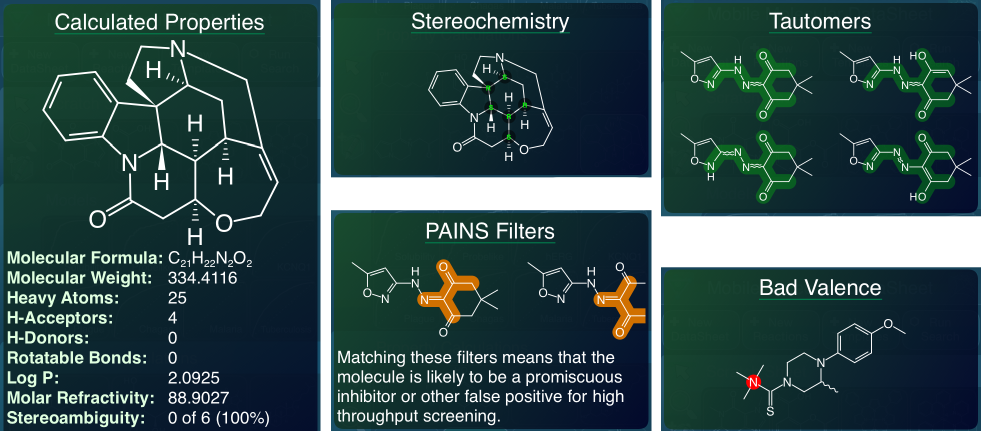 An important milestone in has been reached in the migration of complicated structure-based calculations to pure mobile. The latest version of MMDS (1.5.9) is now available on the AppStore, and allows visualisation of calculated properties for individual molecules, as well as calculating new columns for entire datasheets. Continue reading
PAINS filters now on mobile, with MolPrime+
 One of the trends that you should expect to see more of from apps produced by Molecular Materials Informatics is a shift toward performing more advanced calculations internally on the mobile device, rather than calling out to a cloud service. One of the recent demonstrations was shown with the Approved Drugs app, which can now call up Bayesian models for various predictions. The next version of MolPrime+ that is awaiting review on the AppStore incorporates internal calculation of log P, and also brings the ability to identify PAINS filters for molecular structures.
Cheminformatics, scaffolding & tuberculosis: a work in progress
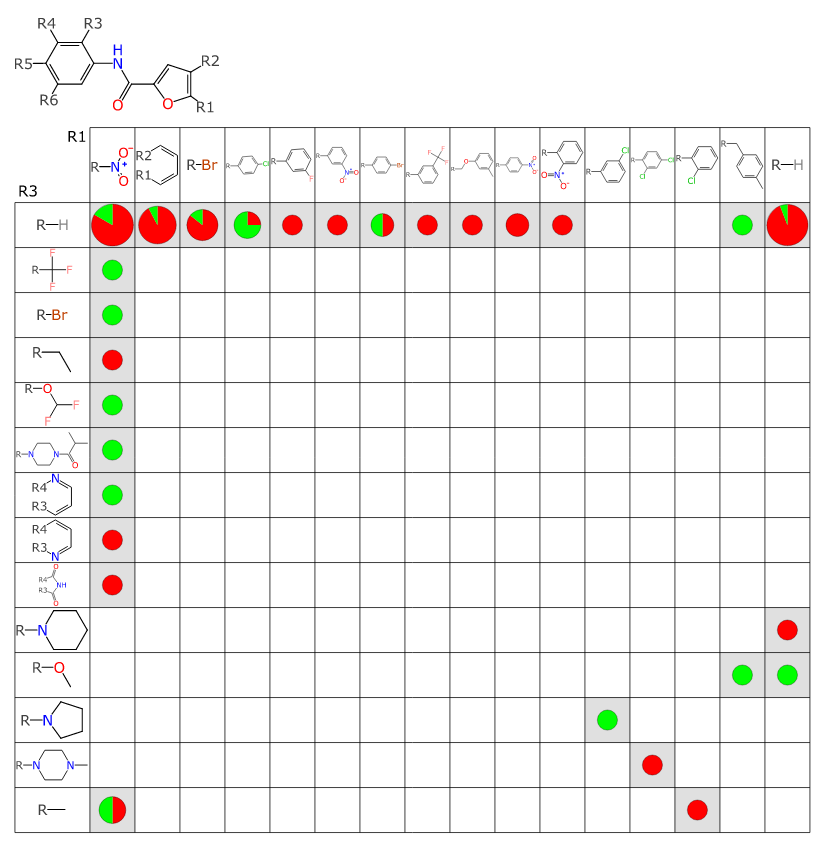 One of the projects that has been keeping me busy lately is a structure data-mining exercise intended to reveal some interesting scaffold hypotheses that can contribute to research into finding new cures for tuberculosis. The process is at an early stage, but if you’re interested in taking a look at some of the preliminary results, you can view them here. Continue reading
SAR Table prediction of empty matrix cells
 The next version of the SAR Table app is going to be accompanied by quite a few enhancements, one of them being the ability to use a previously built model to come up with predictions for empty cells in the matrix view. Continue reading
More model building: log P, melting point, and beyond
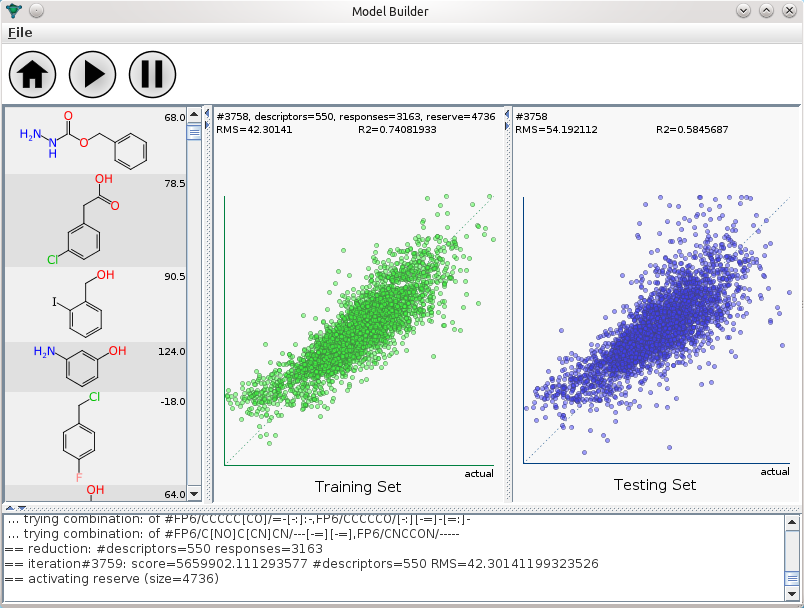 To enhance the capabilities of apps, one of the main side projects that I’ve been working on in between other major distractions is a framework for building and applying models that correlate chemical structure with physical properties or biological activities. The ability to apply a model, and even better to build one then make use of it, has been introduced to the SAR Table app. The underlying machinery for that particular feature is not very friendly toward larger datasets (where large means more than about a hundred compounds in this context), but there has been considerable progress in that regard, which happened to involve creating a more conventional desktop user interface, shown above. Continue reading
Structure-property calculation with MMDS
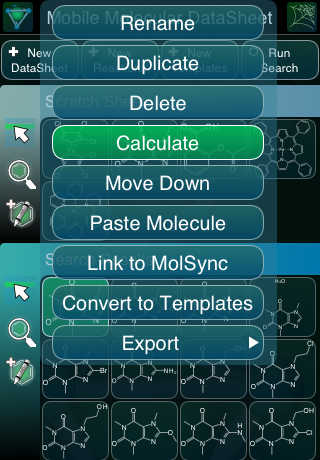 Version 1.4.1 of the Mobile Molecular DataSheet (MMDS) has just been submitted to the iTunes AppStore, and its notable new feature is the ability to select a datasheet and calculate structure-based properties. A new column is created for each selected property, and the calculation feature is applied to each row. The available properties currently include molecular weight/formula, log P, molar refractivity and topological polar surface area. The functionality is provided by the molsync.com webservice. Continue reading
CINF webinar ‘Practical cheminformatics workflows with mobile apps’ now available
Check out the webinar now on YouTube. The talk consists of me doing a brief introduction to mobile chemistry apps, then going through a fictional, yet realistic, workflow example that involves searching for new tuberculosis drug candidates. The workflow includes a tour through several of the apps that I’ve created, or had a hand in creating. But enough spoilers, watch the video whenever you’re ready.
 Cheminformatics 2.0