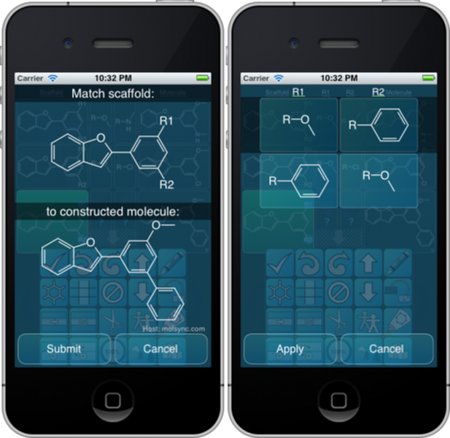
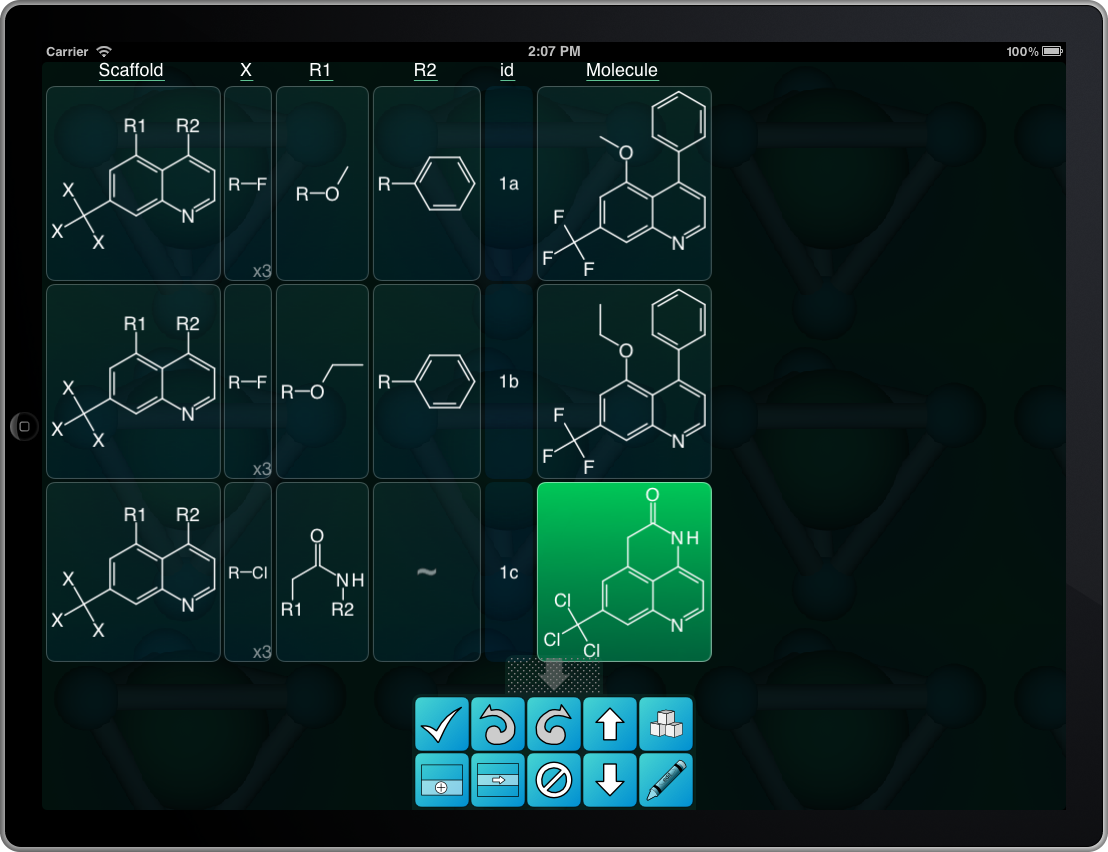
Version 1.1 of the SAR Table app just passed review and is available on the iTunes AppStore. This release is an important one, because it adds a major new feature: scaffold matching. For a row which has a whole molecule defined, and a scaffold core, the scaffold matching algorithm can be invoked to figure out the substituents:
2011 redux
2011 has been a busy year for Molecular Materials Informatics, with new products, new features and new developments coming on hard and fast. 2012 begins tomorrow, and promises to keep up the same breakneck pace. This post is an executive summary of some of the news that was released over the year. Leaving out of course some of the projects that have yet to be unveiled.
At the beginning of 2011, there were just two products, with the same name: the Mobile Molecular DataSheet, or MMDS for short. Due to the rapidly shifting fortunes of mobile device platform makers, the iOS version for iPhone, iPod and iPad took centre stage in 2011, leaving the BlackBerry version behind. The iOS version was mostly feature complete by the beginning of 2011, having already added webservices access and reaction editing. Throughout 2011 the product has steadily matured, with a regimen of software updates adding minor and not-so-minor features, enhancements, bug fixes and ergonomic improvements.
Recent MMDS improvements: drawing and rendering
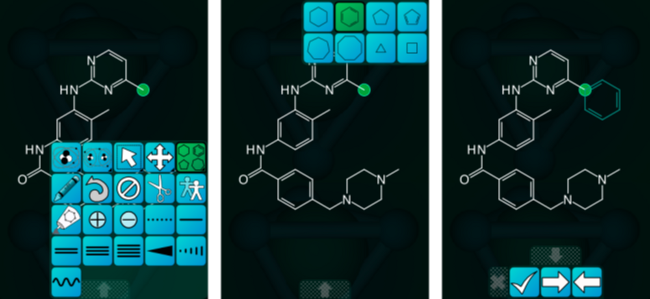
The Mobile Molecular DataSheet (MMDS) v1.3.7 has had a bit of attention to its sketching interface, and now makes available the most commonly used small ring templates from the context menu:
New paper: Accurate Specification of Molecular Structures: The Case for Zero-Order Bonds and Explicit Hydrogen Counting
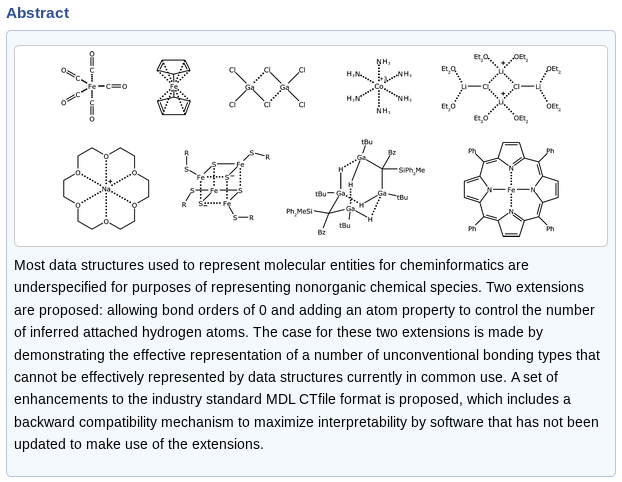
For anyone interested in representation of small molecules, I would emplore you take a look at my latest paper in the Journal of Chemical Information and Modeling:
This article addresses a long-standing shortcoming in the cheminformatics cottage industry: the inadequacy of common file formats to reliably represent structures of non-organic compounds.
SAR Table app: significant roster of new features
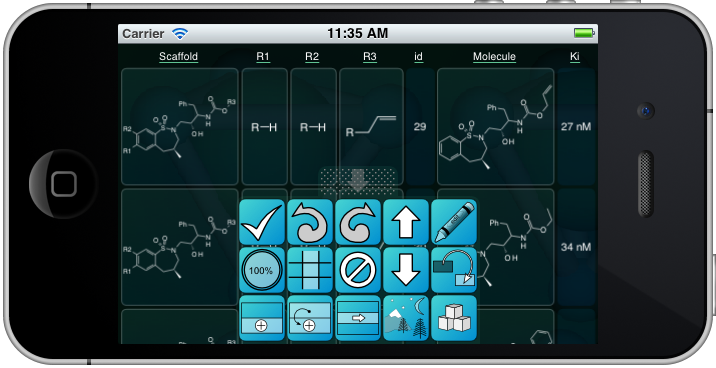
Version 1.0.2 of the SAR Table app has just come out on the iOS AppStore. This is a significant upgrade, since it introduces a number of features that have been planned all along, but were left out of the 1.0 release, in order to get a minimum viable product in place.
One of the most noticeable differences is an expanded command bank for editing SAR tables:
Most of the new features are described in the introductory tutorial, which has been updated for the new version. Continue reading
New sketching features for MMDS
The designed-for-mobile sketcher that was introduced with the Mobile Molecular DataSheet app in 2010 is based on a collection of primitives that was later published in the scientific literature. Over the last year or so the molecule drawing interface has received a lot of fine tuning, but not many major new features. The next version of MMDS (1.3.6), currently awaiting approval on the AppStore, has two important new primitives, which are seen in a redesigned bond sub-bank.
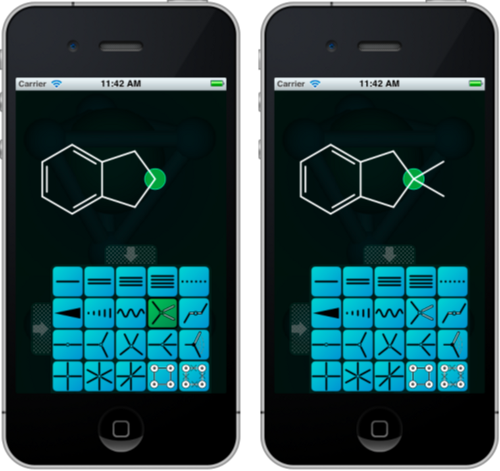
The first of these new primitives is used to add two new substituents to the subject atom:
Creating Microsoft Office documents from within apps
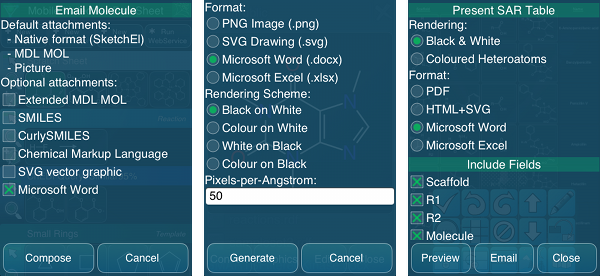
As mentioned in an earlier post, updates for apps from Molecular Materials Informatics with Microsoft Office export capabilities are starting to pass through the AppStore.

Creating Microsoft Excel spreadsheets with vector drawings of structures
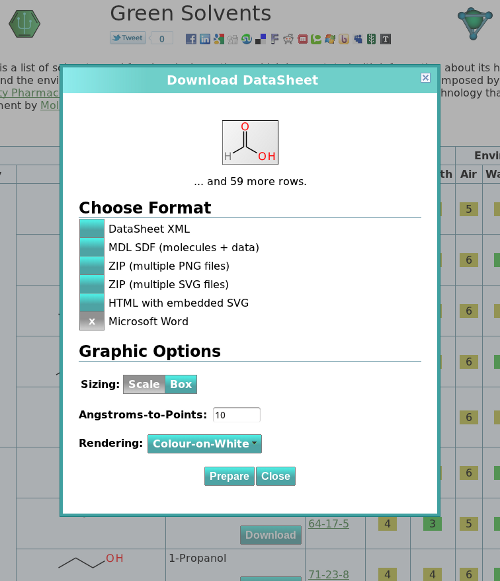
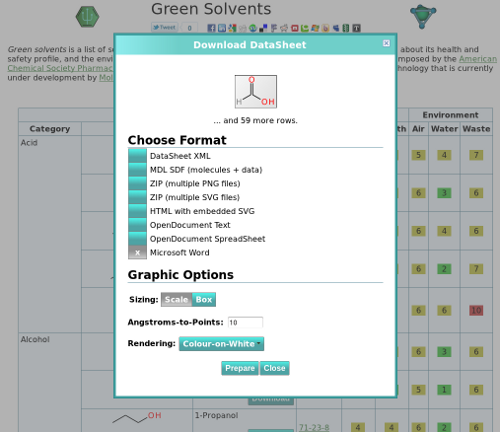
As a follow-on from the previous post, which described the creation of Microsoft Word documents from molecular datasheets, the next logical step has been completed: likewise, for Excel. The new functionality is currently available via the molsync.com web interface, e.g.:
Creating Microsoft Word documents with vector drawings of structures
The latest piece of technology from Molecular Materials Informatics provides the ability to convert a datasheet into a Microsoft Word document, in which all the structures and reactions are rendered as vector graphics. This capability will be made available to some of the mobile apps, such as MMDS, but there’s no need to wait for AppStore approval, because you can see it at work right now via the web demo software hosted on molsync.com: